Historical fiction podcast series

Had a fabulous time recording this series of interviews with authors of historical fiction, as part of the lead-up to our big historical novel conference in September.

Imagining the Past is presented by the Historical Novel Society of Australasia,  and produced by the good folk at Swinburne University (thanks team – they even composed the music!).

You can hear me chat to:

Here’s the conversation with the lovely Kate Forsyth:


The conference runs from 8-10 September,  at Swinburne’s Hawthorn campus, with these great writers and many, many others – you can see the full programme here.

For anyone interested in learning to use Scrivener, I’m running a workshop on the Sunday (10/9) to introduce people to this wonderful software for writers – and there are a whole lot of other workshops too, on topics from research to armour (how cool is that?).

There’s also an academic stream, including a panel on biofictions.

Hope to see you at the conference.

Coming up: Festivals and conferences

August is writers festival season here.

Oh, who am I kidding? Every month is writers festival time here.

But August is one of the busiest months, especially with the massive Melbourne Writers Festival taking over the heart of the city (and lots of other places as well).

So here’s when you can see me. (Of course, you can see a whole lot of other amazing people too, which is what I’ll be doing.)

Bendigo Writers Festival, 11-13 August

One of the great regional festivals, with a huge line-up. I’m looking forward to talking with Belinda Murrell about researching and writing historical fiction, as part of the schools day, Text Marks the Spot.

If you’re a writer, you might like to join me for a special workshop on research for writers (11 August),  where you’ll learn techniques and tips to help your research and writing process.

For fans of young adult fiction, there’s a #LoveOzYA super-session of three panels on 12 August, with me and the lovely Michael Pryor, followed by Amie Kaufman and Jay Kristoff talking all things Illuminae, and then author Will Kostakis and comics genius Bruce Mutard on heroes.

Melbourne Writers Festival, 25 August – 3 September

This year, I’m part of another simply brilliant Schools Program, in conversation with Mark Smith about one of my favourite topics: the hero’s journey (29 August).

I wish I was a school student, and able to go to MWF sessions – honestly, what a cast of thousands and so many great authors and illustrators. The main festival program is released in a few days, so I can spend next week figuring out how many of the visiting and local authors I can hear in one festival. Paradise.

Historical Novels conference

A few days after MWF finishes, we have the conference of the Historical Novel Society of Australasia.

Running from 8 to 10 September, it features dozens of talks, workshops and panels with writers of historical fictions of all kinds. You can hear the likes of Kate Forsyth, Kerry Greenwood, Deb Challinor, Sophie Masson, Lucy Treloar, Kate Mildenhall, Robert Gott, Sulari Gentill, and Robyn Cadwallader. This year’s conference focus is on identities, and the first keynote address will be from memoirists Lesley and Tammy Williams.

I’ll be there all weekend, chairing panels and running a couple of sessions, including an introduction to the writing software Scrivener.

With my colleague Catherine Padmore, I’m convening an academic panel on biofiction.

In the lead-up to the conference, I’ve had great fun interviewing a lot of the authors for a podcast series, Imagining the Past. You can listen here (there are more to come).

Hope to see you out there.

Coming up

March is a busy month.

But what fun.

I get to chat with my old mate Kate Mildenhall about writing 1917, and especially about the research and writing about war and politics for young readers. That’s a special event for teachers and librarians at Readings Books in Hawthorn on 7 March 2017. Details and bookings here.

But that’s not all.

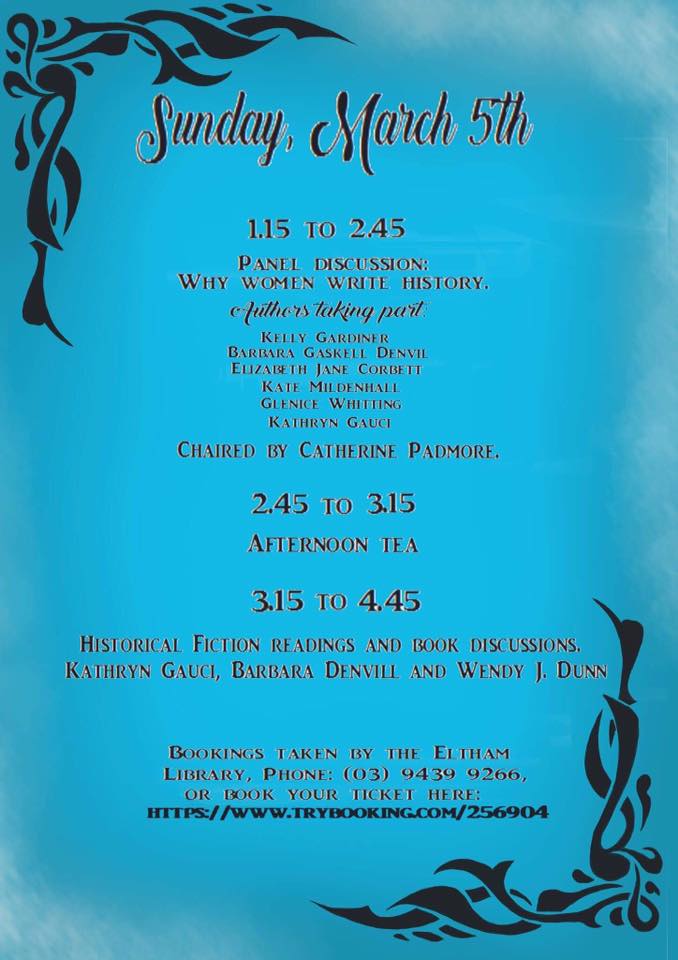
It’s Women’s History Month, and there’s stacks going on, including a whole program of events based around Eltham.  First up is a full day of discussion about writing history and historical fiction, starting with a panel (Oh look! Kate again)  on why women write history on 5 March.

780c9281-48a8-464a-859d-af1f2e0a7fb5-6469-000005f78a9b7621_tmp

There are events every weekend, and then I’m back again in Eltham for a debate on 25 March on the powerful and different ways that nonfiction and fiction tell the stories of the past, and why women are so good at telling these kinds of stories. The panel includes:

  • Professor Josie Arnold
  • Barbara Gaskell Denvil
  • Glenice Whitting
  • Me.

Details of all the events for Women’s History Month at the gorgeous Eltham Library are here.

But that’s not all.

I’m hosting a discussion on researching and writing biography on 21 March at State Library Victoria (I’m lucky enough to work there). I’ll be talking with Minna Muhlen-Schulte  and Sandra McComb about their work in history and biography, and particularly their new articles in the La Trobe Journal.

And then the very next day, Unladylike podcast records live for the first time, as part of the Castlemaine State Festival. Unladylike co-host Adele and I will be interviewing Lynne Kelly and Robyn Annear about writing nonfiction – how they manage to convey incredible detail and knowledge for their readers.  That’s on 22 March in beautiful Castlemaine.

Phew! Well, we wouldn’t want to sit still for too long, would we?

Coming up: workshops with Writers Victoria

Happy new year! How did that happen? It seems like only yesterday it was 1987.  Then there were a few years after that which are a bit of a blur. And now suddenly it’s 2016. ALLEGEDLY.

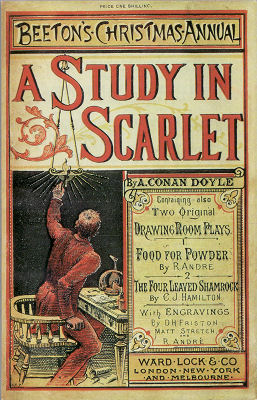
It’s definitely summer here in Melbourne, anyway, and I’m just back from a week or so at the beach, reading Sherlock Holmes stories and getting sunburned. It’s an annual tradition.

Sherlock Holmes story

So. Where were we? Ah yes.

I’m teaching a couple of new workshops for the good people at Writers Victoria this coming term.

First up, we’ll be unravelling the mysteries of Scrivener in an all-day class on 10 April. If you haven’t heard of it, Scrivener is software created especially for writers. I love it, and I’ll show you how to make the most of it too.

Then there’s a webinar on Online Marketing on 10 May at 6pm.  We’ll talk about how to engage with readers online and create a public persona that supports writing practice but doesn’t (we hope!) sound like hard-sell advertising.

If you’ve never been part of a webinar before, it’s like a live web-based video workshop in which everyone can participate.

You can find details of both workshops here.

Busy bee

It’s spring here in Melbourne. Sunday. I ought to be gardening or, given that I’m a Melburnian, out to brunch, but instead I’m crazy busy.

All good though.

Yesterday I went to a briefing about the Dinosaur Dreaming project at Melbourne Museum. I’ve volunteered to go on a dig along the “Dinosaur coast” in February. Next weekend, they teach us to break rocks. You have to take your own chisel and magnifying lens thingummy. I can’t tell you how thrilling that is.

Then I spent the afternoon on a panel at the Professional Historians Association’s social media masterclass, full of excited historians embracing Twitter and Facebook, Pinterest and Periscope.

The ebook I co-edited earlier this year has just come out: academic papers from the fourth global Gender and Love conference in Oxford. It’s called Past and Present: Perspectives on gender and love. 

Earlier in the week I gave a paper to colleagues in my department at La Trobe University – my initial thoughts on something which just keeps getting bigger and more complex, about the idea of the “strong female character” in young adult fiction, where it comes from and what impact it has.  See? There’s another book project right there. As if I haven’t got enough to do. But it’s so fascinating. Early days. I don’t even really know what questions I’m investigating yet.

And I’m loving the idea that Goddess is now out in the US and Julie is becoming famous all over again, in places she couldn’t even imagine.

She deserves it.

I’ve had a few questions from readers coming through, so I’ve just published some FAQs about the book and Julie. If you think of any more, drop me a comment below.

Festival season

Melbourne Writers’ Festival is here again, with hundreds of amazing panels, workshops, talks and fun events.

I’m appearing as part of the fabulous schools program, talking with Jane Caro about re-imagining and writing history. It’s for school groups, so teachers and librarians, get those buses booked!

It’s on Thursday 27 August. Details here.

But honestly, if you’re in Melbourne, get along to something in the festival. I am certainly booked in to see Sarah Waters speak on 30 August.

Logo for MWF

There’s so much to choose from. Might see you there.


Coming up

I’m teaching a workshop at Writers Victoria in October, as part of the Writers on Wednesdays series.

It’s a Writers Toolkit workshop, perfect for people who want to learn some tips and tools to help research and write your masterpiece (or anything at all).

It’s on 21 October at 6pm. All details are here.


Sensational

I’ve been on a belated summer holiday, and finally got stuck into some reading.

And the first few books on my reading (or re-reading) pile were some nineteenth century Sensation novels including The Moonstone and The Woman in White, by Wilkie Collins.

Sleepless nights ensued. I am so easily affected by page-turning, pot-boiling, gasp-a-chapter books like these (and that’s why I don’t watch too many thrillers on TV or I’d never sleep at all – I used to get insomnia just from watching The Bill). I’ve also read a whole stack of early detective stories (this is for an upcoming conference paper and article on female detectives in historical fiction), which were fascinating, but not quite so disturbing.

What’s a sensation novel?

So glad you asked.

Here’s a little snippet of the background section of the paper:

The sensation novels of the 1860s were not framed as historical fiction, but they were, like their Gothic predecessors, often set in an uncanny, out-of-time misty moment where the past – and the secrets of the past – influenced the present. The detective stories of the 1880s and 1890s were intentionally modern. Both genres combined elements of the Gothic novel with contemporary realism, presented new approaches to their female characters, and have been enormously influential in mystery, thriller and historical fiction ever since. […]

Early mysteries often unfold so slowly that the crime itself is not committed until well into the plot, and in some cases revenge rather than detection is the goal after discovery. ‘The mystery,’ Patrick Brantlinger suggests, ‘acts like a story which the narrator refuses or has forgotten how to tell’ (1982, p 18). The stories are often told through the eyes of someone other than the protagonist – Doctor Watson being the most famous. Sensation novels such as The Woman in White feature a constantly changing narrative voice, as legal advisors, butlers and housekeepers, apparently objective or clearly biased observers, even the sleuth herself, take on the role of unravelling or bearing witness to a complex web of clues and disasters.

There is a crime or scandal of some kind, and often several layers of secrets which threaten or act as motive – a stolen letter or jewel, a confusion of identities, someone incarcerated or kidnapped or thought missing but returned. The secret or scandal motif is particularly common in the sensation novel, a phenomenon that flourished briefly in the late nineteenth-century, and drove millions of readers crazy waiting for the next serialised episode or melodramatic chapter – for Australian readers, books like Bleak House were ‘despatched at intervals from England, arriving on faraway docks with the expectation that they would be seized by feverish readers, burning with curiosity about the fate of their favourite characters’ (Martin & Mirmohamadi 2011, p 37 ).


Still from TV series The Moonstone

Still from 1996 TV adaptation of ‘The Moonstone’


Why are they sensational?

If you’ve ever read one, you’d know – whether the 1860s originals or some of their descendants such as Sarah Waters’ Fingersmith? They can be, quite simply, excruciating – sometimes in the knowledge of a character’s depravity or deceit, while the heroine remains oblivious; sometimes because the suspense is so acute and masterful, engendering a miserable pleasure in the agony.

Sometimes it’s the full Gothic experience: entrapment, menace, isolation in a country house, dark secrets to be uncovered, the possibility of the supernatural or the uncanny (usually proven to be quite human and explicable), the irrational, the sublime, the subversive. There’s that sense that familiar boundaries – of humanity, of the law, of fiction, of the psyche – are being transgressed, that what is hidden and possibly unmentionable is about to be revealed. But not quite yet.

We fear for the innocence or the safety of the heroine – she will survive, we feel fairly sure, but at what cost? The mystery eludes us. The characters appal. In the later historical novels, particularly when the author is trying for a sense of heightened affect, you desperately want it to end so you feel the mystery has been solved, but also you don’t ever want it to be over, because once you know what happens in the end, something is lost.

The first time I read Fingersmith, for example, Waters lulled me into false sense of security – although aware it was a reimagining of The Woman in White, I had no idea such fiendish twists awaited me, and was happily revelling in its neo-Victorian ventriloquism. Until … gasp!
 

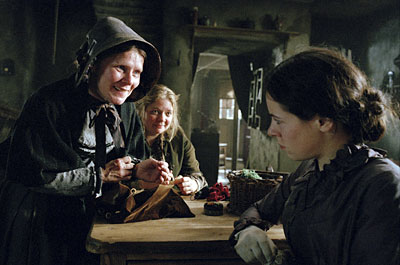
Still image from TV series of Fingersmith

Mrs Sucksby acting innocent in the 2005 TV adaptation of ‘Fingersmith’


I can’t say any more because spoilers. Also I have to get back to reading my book. It’s sensational!

 

Historical novel conference: coming soon to Australia

If you write or read historical fiction, here’s the conference for you.

The Historical Novel Society’s Australasian branch is holding the first ever historical novel conference in Sydney in March.

It’s a great program, with writers such as Posie Graeme-Evans, Toni Jordan, Kate Forsyth, Colin Falconer, Deborah Challinor,  and Jesse Blackadder debating and discussing, and also running masterclasses such as research tips with Gillian Polack.

YA and children’s historical novelists include Pam Rushby, Sophie Masson, Felicity Pulman and Goldie Alexander. And me.

I attended the Society’s conference in London last year and it was wonderful to be in a room filled with people who love and understand your genre. So do come along if you can.

It’s on 20 – 22 March 2015, with the opening night debate (which I’m chairing) at the State Library of NSW and the day programs at the Balmain Town Hall.


Image of State Library NSW


All the details and program are on the HNSA website.

If you can’t make it, the hashtag is #HNSA2015.


Coming up: La Trobe University

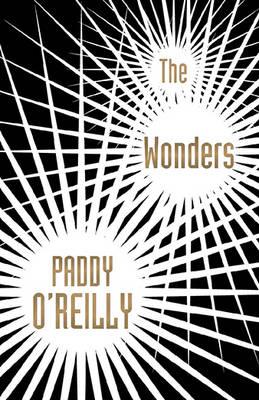
Paddy O’Reilly and I will be in conversation about our new books (in her case, The Wonders), writing, and reading this coming Thursday 23 October at 12.30pm at the Coop Bookshop at La Trobe University (from which we have both just graduated with our doctorates, and where we shared an office and many months of writing together).

It’s market day on campus, the bookshop is laying out a bit of wine and a few nibbles, and there’s a strong possibility that Paddy and I will have an attack of hysterical giggling which is always fun to watch. Apparently.

But we will also read a bit form our latest books and talk about the processes and thoughts that led us to The Wonders and Goddess.

Do get along if you’re in the area.

Book cover - The Wonders

Image of book cover - Goddess, a book about Julie d'Aubigny