A sense of place

Place in fiction is so much more than setting. Think of the mean city streets of detective noir, the high moors or lonely cabin, the claustrophobic sailing ship or space station, dusty country roads, wide wheatfields, dark London alleyways, vast oceans or skies, Highland villages and German forests.

Hovea montana, overlooking the Kiewa Valley
Kiewa Valley – bushranger research

Place is atmosphere, it’s mood, it’s possibility. It’s not a backdrop – it’s also society, community, class, trade, faith, ritual, food, textures, conflict. A place helps form the people in it. Characters in fiction are who they are, who they become, for better or worse, because of where they are, how they live, who they love or don’t, how they grew up, what they believe. As writers, we have to imagine and recreate the world for them.

Place is people, which means it’s also plot. The things that happen to people in a story are often influenced by the world the author has built for them. It might be social expectations of marriage (Pride and Prejudice, My Brilliant Career) or devastating circumstances (The Hunger Games), compelling characters in an everyday world (Heartstopper, The Murder of Roger Ackroyd) or extraordinary people and creatures in incredible worlds (Lord of the Rings, The Left Hand of Darkness).
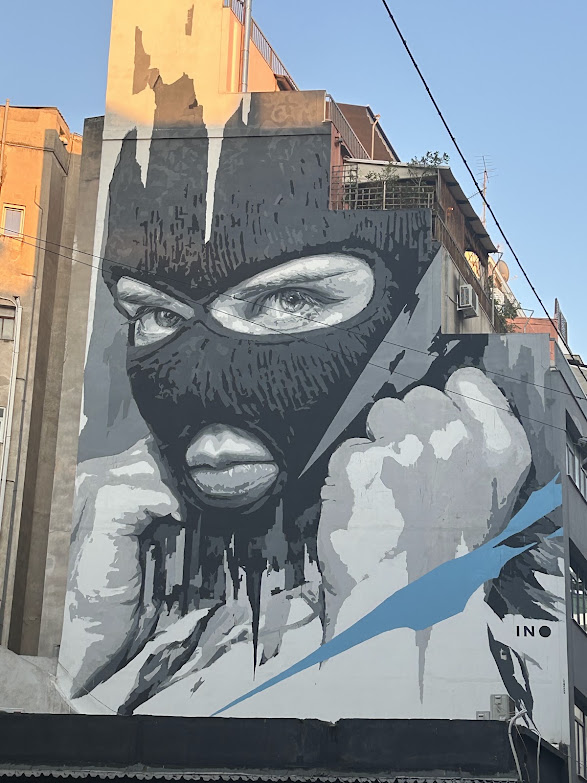
Athens street art

A masterclass in writing place, and one of my favourite books, is Leo Tolstoy’s War and Peace, with its virtuoso moving between worlds: from the joyful chaos of the young Rostovs to the Ibsen-like stifling routine of Princess Marya, trapped in a country house with her dictatorial father; from a riotous gentleman’s club in St Petersburg to a soldier’s campfire in the forest or a quiet conversation between two prisoners; the battlefield of Borodino, to a grand ballroom, to a convoy of refugees. People often don’t realise this is historical fiction: he’s writing about his grandparents’ era, not his own.

Tolstoy had his own class biases, of course, and his overwhelming admiration for the “Russian soul”, but his research and specificity are unsurpassed. Sure, we probably don’t all rejoice in the many pages of discussion around contemporary Freemason philosophy, but if a character is obsessed with it, as Pierre is, we need to know what’s going on in his head (anyway, I just flick over those pages now when I reread). His love for the soul of Russia doesn’t extend to the serfs on the Bolkonsky estate, but he too is a product of the world he creates so vividly. Napoleon watching the fires roaring through Moscow, General Kutuzov weeping over battle casualties, the little dog howling in the snow – every image is memorable.

We aren’t all Tolstoy, and we don’t need to be. But as writers, we do need to create a sense of place – wherever, whenever and wherever it might be, to enrich and perhaps even drive our stories. It matters more than we know. I spend a lot of time and thought on creating a sense of place, so my readers feel how it might be to walk through bombed-out London streets or the stables at Versailles, ride the Victorian High Country or enter a printer’s workshop in Venice.

Which is why I’m teaching a full-day workshop on writing place and building worlds soon – on 17 October, in Melbourne. You can find out more and book here.

Lately I’ve been…

Things are getting pretty exciting on the publishing front. We (my co-author Sharmini Kumar and I) submitted the final manuscript of Miss Caroline Bingley: Private Detective a couple of months ago and we expect copy edits back from HarperCollins any day now.

Even more thrillingly, we’ve seen cover designs for the US and Australia/NZ/UK editions and they are gorgeous. We could show you, but we’d have to shoot you, so you’ll have to stay tuned.

It’s not out until April but things are heating up behind the scenes.

While that’s happening, I’ve been working on a new historical crime novel, currently titled Afterwards, which is set at an archaeological dig on Hadrian’s Wall just after the Second World War. I’ve got a first draft and am revising that now.

Teaching time

Last year, I gave up teaching full-time, after around a decade at La Trobe University. I do miss it, especially my colleagues and students, but it was the right time. I want to focus more on writing and various other projects.

But somehow I couldn’t quite seem to stop. I love teaching writing, working with writers, talking and thinking about writing.

So I’ve figured out a way to have the best of both worlds: teaching what I want to teach, the way I want to teach it, a few times a year. A couple of months ago I set up New Pages Writing Retreats & Masterclasses, and I’m looking forward to teaching in different ways over the coming year. I’ve been reviewing my favourite writing books, exploring new methods of teaching and articulating thoughts about writing, and preparing in every way I can.

First up, there’s a one-day masterclass on How to Build a Heroine, for any fiction writers with a heroine in mind, but especially for genre and YA writers. That’s on 21 September, in person, in Melbourne.

In November, I’m focused on one of my favourite genres, with another one-day, face-to-face masterclass, Do Crime: Writing Unforgettable Crime Fiction. That’s on 16 November, also in Melbourne.

Then early next year, I’m hosting my first weekend writing retreat at the gorgeous Continental House in Hepburn Springs. It’ll be a fiction intensive, with masterclasses and writing exercises, and lots of lovely food. That’s in March 2025 and bookings came in almost as soon as I opened them!

Really looking forward to all of these, and more.

And because I’m me, I’ve also set up a private online writing community for people who come to the classes, where we can stay connected, share tips and opportunities, and I can offer a few extra goodies.

So all in all, even though I haven’t been teaching full-time, I’ve been pretty busy.

Image of Kelly with list of classes - same as text in blog post

Coming up: Women in history and Creating characters

Look, there was a moment there when we thought 2021 might start feeling a bit more normal.

But no.

We’ve been back in lockdown here the past few weeks, although things are easing now. And we’re watching with horror as the pandemic flares up in places all over the world, including some countries that have been able to keep it under control. But it simply will not behave. Pandemics are a bit like that.

So while it did seem as if writing workshops and author events here might start up again, it’s all still a little precarious. Writers festivals are exploring hybrid models of presenting events – some online, some in person, some a bit of both – but others have decided to postpone or cancel. It’s tough on everyone involved – and most are run or supported by volunteers. Thank you to all the organisations and bookshops and event organisers who have done so much to support writers and readers over this time.

But now for the good news. Here’s what I have coming up soon:

WordFest 2021: The Hidden History of Women

I’m hosting a keynote panel in Monash Library Service’s WordFest, featuring authors Michelle Scott-Tucker, Mirranda Burton and Dr Victoria Grieve-Williams. The panel will look at different perspectives on the history of Australia, from early colonisation through to the present day.

Online via Zoom Zoom information

Tuesday 29 June 2021 at 7pm – 8pm. Free. Bookings using TryBooking.

Writing workshop: Crafting Compelling & Complex Characters

I’m delighted to be back teaching face-to-face (we hope) at Writers Victoria this year. My next workshop will be on creating characters (in any genre). Here’s the blurb:

No matter what genre we write or read, our focus is on the people on the page, and what they do and feel. So how do we create characters who feel like people in our heads – and in the minds of our readers? In this workshop, we’ll aim to give you some essential techniques and the tools to create characters your readers will remember.

It’s on 8 August 2021 – 10AM to 4 PM – at Writers Victoria in Melbourne. Details and bookings here.

The Writer’s Toolkit

I’ve posted quite a lot about different tools that writers can use to make the most of the web and their own time.

And now there’s a course: The Writer’s Toolkit, at Writers Victoria from 5 June.

In it we’ll cover:

  • Productivity tools to help you manage time
  • Finding and managing information and resources
  • Note taking and research
  • Drafting and plotting tools
  • Networking and promotions online.

The course runs for four weeks, one night a week. More details and bookings here, but be quick! Booking deadline looms.