Unfamiliar familiar worlds

Don’t you love that feeling of reading a book set in a world that is eerily familiar – but not quite? A world, perhaps, that seems like ours but where everything is unexpected, different – foreign?

In expert hands, it can be one of reading’s great pleasures.

Here are two cases in point, in recent YA literature.

This is Shyness, Leanne Hall
Set in Melbourne (kind of), along Smith Street (maybe). Or not.

This is Shyness is the story of one night in a suburb, Shyness, where night is all there is. The sun doesn’t rise, wild kids roam and ravage, creepy men in black suits cruise the streets, and Wildgirl meets a dark, handsome howling boy just at a moment when they both need to escape.

It’s a spooky place that feels like a world we know, gone badly wrong. It’s not even dystopian fiction, really – just a beautifully imagined parallel universe of inner city bars, government flats, gangs and music and darkness.

Looking forward to the sequel, Queen of the Night, due early next year.

The Leviathan trilogy, Scott Westerfeld
Goliath (just out last month) is the satisfying final instalment of Westerfeld’s re-imagining of World War I into a steampunk world of Clankers versus Darwinians, of enormous – living – flying machines and sea creatures pitted against mechanical clanking monsters spitting bullets, of a girl dressed as a boy and a prince dressed as a commoner, of a world caught up in war and espionage and intrigue.

For younger readers, it’s a non-stop action adventure of the very best kind: intelligent and fascinating.

Voices

I’ve been hearing a lot of voices lately, but that was the plan. Part of my PhD project is about the quest (or lack thereof) for authenticity in voices in historical fiction, and now I can’t read anything without seeing through that lens. It’s a bit like when you’re going to get a new car or a new dog, and suddenly the world is filled with that model or that breed. Except this will last for years. And is, thankfully, rather more interesting than ten year-old station wagons.

So here are some initial thoughts on a few voices I’ve heard recently.

Bethia Mayfield is the narrator of Geraldine Brooks’ Caleb’s Crossing. Brooks can enable her readers to hear a voice from the past with sublime felicity: her March is a tricky and unsympathetic narrator whose weakness and selfishness are difficult to bear but a joy to read. Bethia, on the other hand, is the opposite. the character is engaging, but her voice – I am very sorry to say – is uneven. I heard Brooks speak about the book recently, and she mentioned that she makes great use of the Oxford Historical Thesaurus. It shows*. The reader is happily meandering around the island with Bethia when we all trip over a word, and then another, which seem to be perfectly accurate in a historical sense but somehow out of time – out of tune – with all of Bethia’s/Brooks’ other words.

It’s a very very tricky business, maintaining a voice that is palatable to the modern ear but somehow historically accurate – what Sarah Waters describes as “right enough – for us”. Brooks almost always gets it right. Just not this time. Not quite.

In Room, Emma Donoghue’s narrator is five year-old Jack, who lives in a small room with his Ma and that’s the only world he knows. Hard to imagine a more difficult task for a writer – a credible five year-old voice, but also one whose world is so confined he simply doesn’t realise, at the start of the book, that the things he sees on the television are real – and yet convey the entire action of a book, including some genuinely thrilling action – in that voice and world view.

But Donoghue manages it, beautifully. There may be the odd word that seems out of place, one or two concepts that Jack couldn’t possibly know but it doesn’t matter; it doesn’t throw you out of the story. Anyway, as Jack says, “I know all the words”.

Finally, a TV series: Downton Abbey.

I love it. I do. But please: there is no way on earth that upstairs and downstairs ever collided and colluded so often and so intimately. After the Great War – perhaps. As people’s lives were shattered by grief and missing, and as the men and women at the many Fronts discovered they could be friends or enemies across class and that death really didn’t distinguish; then the social – if not economic – barriers in British society began to crumble. Or in a crisis, such as a corpse in your bedroom, yes, one might feel a trusted maid is the only place to turn.

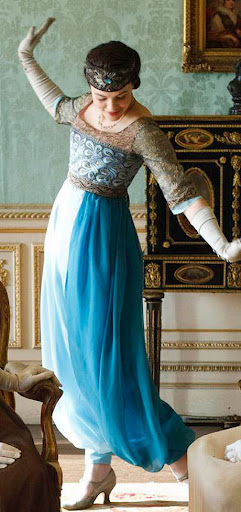
Sybil: can’t touch this

But it really does reek of narrative reshaping history for upstairs characters to confide in the servants, for maids to offer unsolicited personal advice, for there to be such informality and idle chatter in the house of an earl. An earl! Not a minor baronetcy, but one of the great titles in the kingdom. Perhaps I wouldn’t mind the inaccuracy it it managed to be consistent, but it isn’t. Some of the voices and relationships are consistent and some aren’t. I don’t mind the lovely daredevil Sybil being too egalitarian, but other characters on both sides waver in and out.

Yes, I am one of those people who shouts at the television or scoffs in the cinema at blatant rewriting of history. Don’t get me started on Shekhar Kapur’s versions of Elizabeth I, for example.

As if!

And if I huff “As if!” several times in one viewing, we are in trouble.

I’m afraid there have been many “As ifs” during the otherwise winning Downton Abbey, though it won’t stop me watching it.

* [Later: that sounds more brutal than I meant it to. It’s a terrific story.]

And then you get wrinkles in time

“The concentration of a small child at play is analogous to the concentration of the artist of any discipline. In real play, which is real concentration, the child is not only outside time, he is outside himself. He has thrown himself completely into whatever it is that he is doing. A child playing a game, building a sand castle, painting a picture, is completely in what he is doing. His self-consciousness is gone; his consciousness is wholly focused outside himself.

“When we are self-conscious, we cannot be wholly aware; we must throw ourselves out first. This throwing ourselves away is the act of creativity. So, when we wholly concentrate, like a child in play, or an artist at work, then we share in the act of creating. We not only escape time, we also escape our self-conscious selves.
“A writer may be self-conscious about his work before and after but not during the writing. If I am self-conscious during the actual writing of a scene, then it ends up in the round file.”
~ Madeline L’Engle

Mixing metaphors

Reading some nice posts over on the AFTRS blog about genre films and television: 

Karen Pearlman argues that “Genre is Necessarily Metaphoric“, including a claim that:

The purpose of Australian feature film production, I propose, is not to tell our own stories.  The purpose of our feature film industry is to make our myths.

and follows it up with Genre is not a Dirty Word“, which surveys classic genre films and argues:

…when we say Genre is not a dirty word we are not saying “sell out”, we are saying pay attention to audience expectations, create them and fulfill them.  We are saying pay attention to the history and techniques of cinema.  We are saying make stories that are bigger than yourself.  And finally, we are saying: consider the role of myth in storytelling and what stories are for.  

It doesn’t seem to be an argument against realism as such, but rather a vindication of the use of myth and metaphor in film, and especially of genre film – and television. We hear the same discussions about genre writing in print. Attack, dismissal and defence.

I wonder whether genre writing has a much healthier future on TV than in film in spite of all the death knells. It certainly seems rosy at present. Period drama, space, procedurals, westerns, even musicals are thriving.
Never mind all the vampires.

Go girl

Love this rant from Rachel over at Forever Young Adult:

Important Literary Journals and Established Intellectual News Sources say I should be ashamed of my reading habits. I’m the reason the publishing world is in such a state, me and my crummy stupid YA books, and it has nothing to do with shitty, self-important authors who are working out their issues in their “plots” rather than with a therapist, because the book isn’t actually a book – it’s the author dealing with the fact that he (and Important Adult Literary authors are almost always men) didn’t win the box car derby when he was nine, and that pain has haunted him for his entire life!

What she said.

And also:
Why the pages and pages of review inches and breathless feature articles for books only ever read to the end by twelve geeks, and virtually none allocated to books read endlessly and adored by thousands of young people?

Anything that smacks of self-importance never even gets opened in this house. So authors, choose your covers and promo blurbs very carefully. Because sometimes we do judge a book by its cover.

Martin Amis has a lot to answer for.

Superheroes

I’ve been watching Buffy, The Vampire Slayer. Pretty much non-stop. For weeks.

Missed it completely when it was actually on TV. Couldn’t have cared less. Didn’t watch Xena. I grew up with The Bionic Woman, Princess Leia, and the original Charlie’s Angels; and nobody, I figured, could measure up to Lynda Carter in her red undies in the superhero stakes. So the 90s superhero phase completely passed me by. Never even saw The Matrix on the big screen (something I deeply regret).

Also, while I quite like action thrillers, I’m not very good at watching scary things, so I’ve never seen Alien.

But since then, you see, there are children – then teenagers – who really want to watch Spiderman or X-Men over and over and you get sucked in and the next thing you know, you’re begging your niece for Buffy DVDs. All seven series.

Now I remember what’s so super about superheroes.

My pirate books were, in fact, anti-superhero. I’d read so many frustrating kids’ books where the protagonist – especially if she was a girl – only escaped the usual near-death experiences due to her amazing and often unsuspected superpowers.

Superpowers suck, I decided. My books will NEVER feature superpowers. In fact, I think I constructed some sort of thesis along the lines of superpowers undermining feminism because … well, I don’t remember the rest and that’s probably just as well ’cause it’s bollocks.

I am, however, still quite happy to argue that many authors let themselves and their characters or plots off the hook with the use of superpowers or paranormal activity. It can be lazy, distracting, pointless. It can be just plain stupid. Read I, Coriander? I rest my case. I’ve mellowed, and am again quite happy to be completely immersed in a well-constructed world of superheroes, so long as that world has its own creative and mythological logic – and not just powers splashed about like fairy dust.

At any rate, Lily Swann, in the Swashbuckler trilogy, quite specifically has only one power that her fellow pirates consider to be extraordinary. She can read. Oh, and she can fence. Both quite remarkable for an ordinary girl in 1798.

She follows the Joseph Campbell-style Quest, as do all heroes, and as many Jungian archetypes a person can muster – they come out of the mythical woodwork while you’re not watching, I swear.

Of course, she is incredibly brave. That goes without saying.
She’s consciously a hero without superpowers, as is Isabella in Act of Faith (out next year) – unless you count education as a superpower which, until recently in the western world, it was. They save themselves and others, including men; they overthrow great powers almost single-handedly; and they – I hope – get all the good lines.

But then, so does Buffy.
Brilliant lines in some pearl-like scripts – scripts so good that I have twice stood and applauded, literally, at the end of episodes – although one of those episodes had no dialogue at all.
For example:

Xander: I’ve been through more battles with Buffy than you all can ever imagine. She stopped everything that’s ever come up against her. She’s laid down her life – literally – to protect the people around her. This girl has died *two* times, and she’s still standing. You’re scared, that’s smart. You got questions, you should. But you doubt her motives, you think Buffy’s all about the kill, then you take the little bus to battle. I’ve seen her heart – and this time not literally – and I’m telling you right now she cares more about your lives than you will ever know. You gotta trust her. She’s earned it.
Faith: Damn, B. I never knew you were *that* cool.
Buffy: Well, you always were a little slow.

It’s hilarious and moving and strong and beautifully written (especially the later series) and scares the shit out of me on a regular basis.

Drusilla: [as The First] Do you know why you’re alive?
Spike: Never figured you for existential thought, luv. I mean, you hated Paris.

Jennifer K Stiller argues in Ink-stained Amazons and Cinematic Warriors that the quests of female superheroes are different to those of their male counterparts. Their attributes – and challenges – include compassion, leadership, friendship, family, love, community, and the potential loneliness of those who wield great power. Above all, their stories are about redemption. They usually operate in ways that are not found amongst the Justice League of America or even the X-Men.

The rules about vampire slayers, says Buffy as yet another apocalypse draws near, were made up by a bunch of men, thousands of years ago. Her friend Willow (who happens to be one of the best-loved queer characters on TV – ever) is more powerful than all those men combined. Together they create an army which conquers not only the great evil, but also Buffy’s loneliness, Willow’s insecurity, Faith’s alienation, and the gang’s paralysing fear.

Harry Potter can’t survive without Hermione Granger. Superman’s greatest hero is Lois Lane. It’s Sarah Connor (and her astonishing arms) who terminates the Terminator. Drew Barrymore’s version of Charlie’s Angels kicks ass only when the team is in synch.

There are exceptions – lame chicks who still have to get saved by someone else (I’m looking at you, Gwyneth Paltrow), or whose main aim in life is to look hot in latex in movies aimed at a male audience, rather than inspiring young women (and men) to think differently about female protagonists. In recent years, many of the female superheroes in comics seem to have had breast implants and a ticket to Sleaze Ball 1998. And don’t start me on Twilight.

Perhaps it’s a pendulum that swings back and forth, much like attitudes to feminism. Boringly.

So who knows? Maybe I might have to create someone with superpowers. Some day.

In the meantime, I can’t wait to see what Joss Whedon does with Scarlett Johansson in The Avengers.

And most importantly – what will she wear?