My final appearance for the year is, fittingly, on Miss Austen’s birthday: 16 December, and it’s back in beautiful Warrandyte, where I lived for years (wish I still did, except in bushfire season).
Come wish Miss Austen a happy birthday with me, at Warrandyte Library, 11am, 16 December. It’s free, but you do need to book.
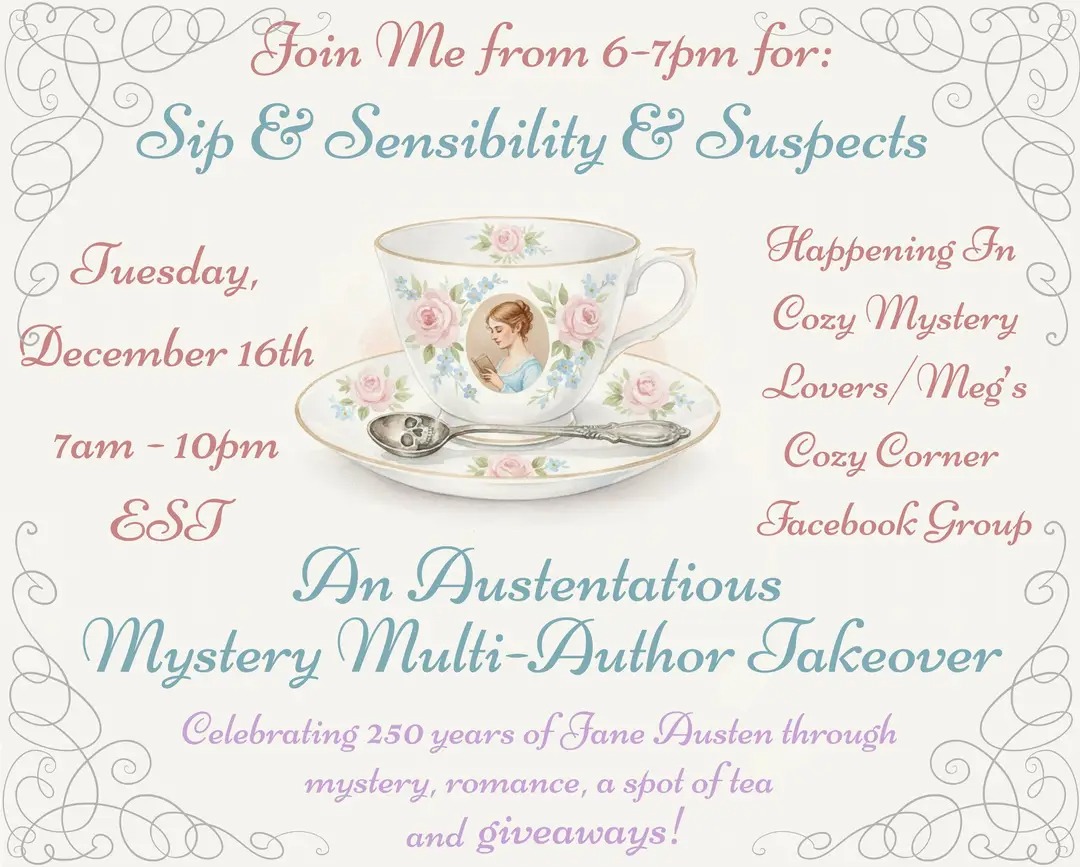
The next day, though still 16 December in some parts of the world, Sharmini and I will be taking part in a day-long tribute to the birthday girl in the Cozy Mystery Lovers Facebook group. You’re very welcome to join us and a whole line-up of other authors and Jane Austen enthusiasts there. We’re on at 6-7pm US Eastern time, 10am in Aus (AEDT), or 12noon NZDT.
Here’s where we are (in various combinations) next:
Launches at the Library In a way, it all started at a Jane Austen seminar in the Library at La Trobe University, hosted by my dear colleague Kylie Mirmohamadi many years ago. Now Kylie’s gorgeous novel, Diving, Falling, is out and so is ours, so we’re celebrating both books, with Sharmini, Kylie and me in conversation with another dear colleague, Carrie Tiffany. 12.30, 29 April, Seminar room 1.34, Bundoora campus Library, La Trobe.
Books in Bars Join Sharmini and me for a great night of cosy crime and murder (well, talking about murder), with the good folks of Dymocks Geelong. 6:30pm, 30 April, Waurn Ponds Hotel.
Utter Ruin! I’m interrogating – I mean, interviewing – Alison about her new book, The Ladies Road Guide to Utter Ruin, hosted by the lovely people at Ulysses Books, on 8 May. 7:00 pm – 8:30 pm, in the bookshop itself, in Hampton.
A Very Austen AfternoonThe fabulous Wendys at Bookish in Bendigo have invited Alison and me to celebrate Miss Austen’s 250th birthday with a high tea and a conversation with the delightful author Katrina Nannestad, to discuss all things Austenesque – mystery, manners and the role of women in the Regency period. 2:30pm, 10 May, Mackenzie Quarter, Bendigo.
The same day, Sharmini is taking part in another very special Austen celebration: Jane Austen’s Music, Pemberley Revisited. In this performance, Austen’s razor-sharp wit and keen observations on love and society come vividly to life through carefully chosen readings and period-perfect musical selections, performed by Rachael Beesley, Aura Go, and Lizzy Bennet’s Band. Afterwards, Sharmini will be in conversation with Melbourne book editor, event moderator and bookseller, Jaclyn Crupi about Jane Austen, her literature and her legacy. 4pm, 10 May, at the Melbourne Recital Centre.
Anna Chancellor as Miss Bingley in the 1995 TV adaptation of Pride & Prejudice
Here’s what’s coming up for the first little while as we take to the high road. Three authors, two books, wonderful booksellers, and plenty of laughs.
Sydney launch, Miss Caroline Bingley, Private Detective, Monday 7 April, 6pm for drinks and nibbles, followed by a conversation with author Pamela Hart – at Better Read than Dead in Newtown
Writers to Watch is an online event for librarians in North America hosted by Library Love Fest but anyone is welcome, featuring new or forthcoming books including Miss B. It’s broadcast live at 7pm ET (8 April in the US) or 9am Melbourne/Sydney time (9 April) and you can RSVP here for Facebook or here for Crowdcast.
Ballarat celebration: Sharmini and I, in conversation, on Thursday 10 April, 6pm, at the Old Colonists’ Club in Lydiard Street, with Collins Booksellers (free, but please book)
Austen Con: April 12, Abbotsford Convent – Alison Goodman and I are on a panel in the morning, and there’s a dramatised reading of a scene from the book, as well as all sorts of Austen-world delights. Sharmini is hosting as always.
Moonee Ponds, in conversation: on April 16, Sharmini and I will be in-store at Collins Booksellers in Puckle Street, having a chat and answering questions from 6pm (free, but do book)
Then we’re all having a little break over Easter to breathe and eat chocolate.
The novel, co-written with Sharmini Kumar, is published by HarperCollins and out now in Australia and New Zealand. It will be in shops in the UK next week (April 6).
We hope you like it.
We’ve got lots of events lined up, and some of them are with our friend and Regency co-conspirator Alison Goodman, whose fabulous new novel, The Ladies Road Guide to Utter Ruin, is also out about now.
It’s summertime here, so we’re buckling down not only for festive celebrations of various sorts but also for bushfires and heatwaves and all the true delights of summer (sandy togs, ice cream dripping down your fist, long light evenings, cicada song, cricket on a distant radio – although that’s a sound that’s dying out). I have sunburned feet already after a day messing about in boats.
I love teaching, and especially love teaching writers. My first full-day masterclass, on How to build a heroine, happened last month and it seemed to go pretty well. I have a few more in the pipeline, and big plans for next year.
Next year I’ll also run masterclasses on historical fiction, Scrivener, writing YA, and a new weekend writing retreat on creative practice and creativity (and relaxation!).
People – especially emerging writers – often ask me what happens when you publish a book? How long does it take? Can you say you don’t want to change anything? Do you get any input on how it looks? Don’t you resent being edited? (Short answer: no, I love it.)
First, you write your book. I know that sounds silly, but plenty of aspiring writers worry way too much about getting published before they’ve actually finished the thing. I get that. It’s scary and also exhilarating to think you might one day publish a book, but you won’t publish anything at all if you don’t write it first, and make it as good as it can be.
Second, you pitch your book. That’s a whole topic of its own so I won’t bang on about it, and anyway I leave that to the experts nowadays – my fabulous agents at Jacinta Di Mase. They know what they’re doing, and they do all the hard work.
Then, once you have secured a publishing contract, your publisher’s processes kick in.
Editing rounds
So, you get early feedback on the manuscript from the publisher. These might be queries about plot points that miss the mark somehow, or about character development or voice: the big questions that an expert eye picks up, from someone who really cares about the book. Your publisher also knows what else they’ve got coming out (maybe similar titles, or in the same genre), in general what other houses have out, what the market’s doing, and what readers expect.
You have a think about any issues they’ve raised, respond accordingly with any amendments, and submit your final manuscript. Your book is given a slot in the publishing timeline which gives everyone enough time to work on it, but also aligns it with overall strategy (eg, not clashing with another similar title, lining it up for Mother’s Day or Christmas sales, hitting shops at the right time for its anticipated readers). At this point, your agent or publisher will start pitching it elsewhere – for translation rights, or adaptation.
Then there’s a structural edit. This may be done by an in-house editor or outsourced – either way, it will be done by someone who knows their stuff. They focus on big structural issues like character and plot, and their fresh eyes can pick up continuity errors or variations in voice, for example. They might recommend structure or plot changes, or point out the need for more clarity. Often they ask questions rather than edit – they leave the resolution up to the author. I’ve never had a serious argument about anything significant with an editor or publisher, and find that questions are usually insightful and all about making the book better.
Ideally this feedback also includes any outstanding issues from the publisher. In the case of Miss Bingley, our publisher, HarperCollins, brought together any feedback from all three publishers who are releasing the book (Australia/NZ, UK and US), plus the editor’s notes. And as the book is co-written with Sharmini Kumar, the two of us had to go away and figure out what we thought about anything significant, and we both went over the manuscript again to make any changes.
By this time, generally, you’re pretty sick of reading your novel, but again, you read through it all, correct any errors and give thanks they were discovered early on (!), and again amend the manuscript to make sure it works for you and the publisher.
But there’s no rest for the wicked, since after that comes the copy edit. Again, this is done by a professional editor, in-house or outsourced, who goes over the manuscript word by word, line by line, noting any errors (simple things like missing words or typos) and making suggestions about anything they find – might be word choice, sentence structure, the rhythm of a scene, overall pacing, dialogue, plot – anything. And when it’s historical fiction, they also ask questions like, “are you sure that type of hat was worn that year?”, to send you scurrying for your research notes (they are usually right to ask). And again you go through it, word by word, line by line, accepting their suggested changes, coming up with your own solutions, or flagging things for further discussion.
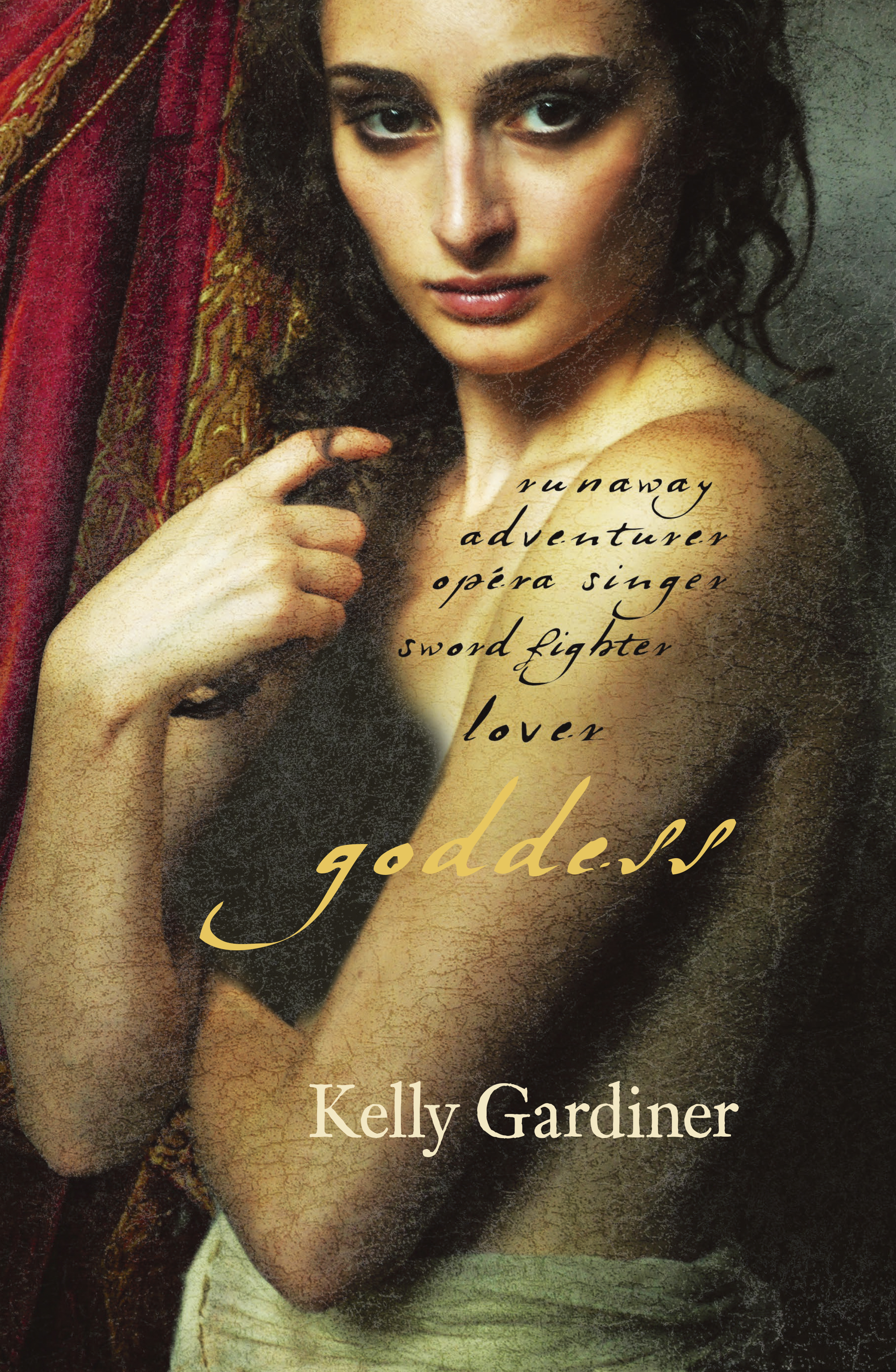
By now you probably have some cover concepts presented to you. It happens sometimes that authors hate their book covers, but I think it’s pretty rare, since publishers want you to love it. After all, you have to sell it too. Sometimes you get a few options to choose from, and sometimes they design different covers for different publishing territories. Whatever happens, I always go into the process knowing (from years working with designers in print media) that it’s someone else’s creative process, and I respect that. By the time it gets to you, a lot of people have worked on it, and they know what they’re doing, but you usually get a chance to make suggestions as well. (A confession: I asked for more arm muscles on the Julie figure on Goddess! Got knocked back on that. But that was such a gobsmackingly gorgeous image, and cover, I was very happy. And anyway, it wasn’t her sword arm.)
After the copy edit, your changes are incorporated, there may be a bit of back and forth about little things, and then the book is typeset. Yes, we still call it that. Every book has an internal design, even if you don’t really notice it, with creative decisions on typeface, chapter headings, drop caps, etc. This is the critical stage, because after this, it’s hard to change anything major.
Once it’s typeset, everyone proofreads it, over and over, even though by now you never want to see the bloody thing again. For some books, there’ll be a slightly different edition for different territories – the main issue is US spelling for that edition.
For each of these stages, you’re on a deadline and so are all the people behind the scenes at the publishing house. So be kind to anybody who says they’re proofreading or working through copy edits. They may have letters dancing before their weary eyes.
While this is happening, advance reading copies (called ARCs – without your final corrections) go out to booksellers, reviewers and journalists. So this is the first time your book is out in the world, even though it’s semi-secret and may contain errors. These early copies are for people who need to know in advance what the story is, who it’s for, and what they can do with it – order a million copies, set up interviews, book you for festivals, or get ready to review when it hits the shops.
And from then on, it’s in the hands of the publisher’s sales, marketing and publicity teams for pre-order, then promotions and sales to booksellers. And eventually in the loving hands of your readers.
All of that, in the case of Miss Caroline Bingley, Private Detective, will have taken about a year and a half, from contract to publication in April 2025.
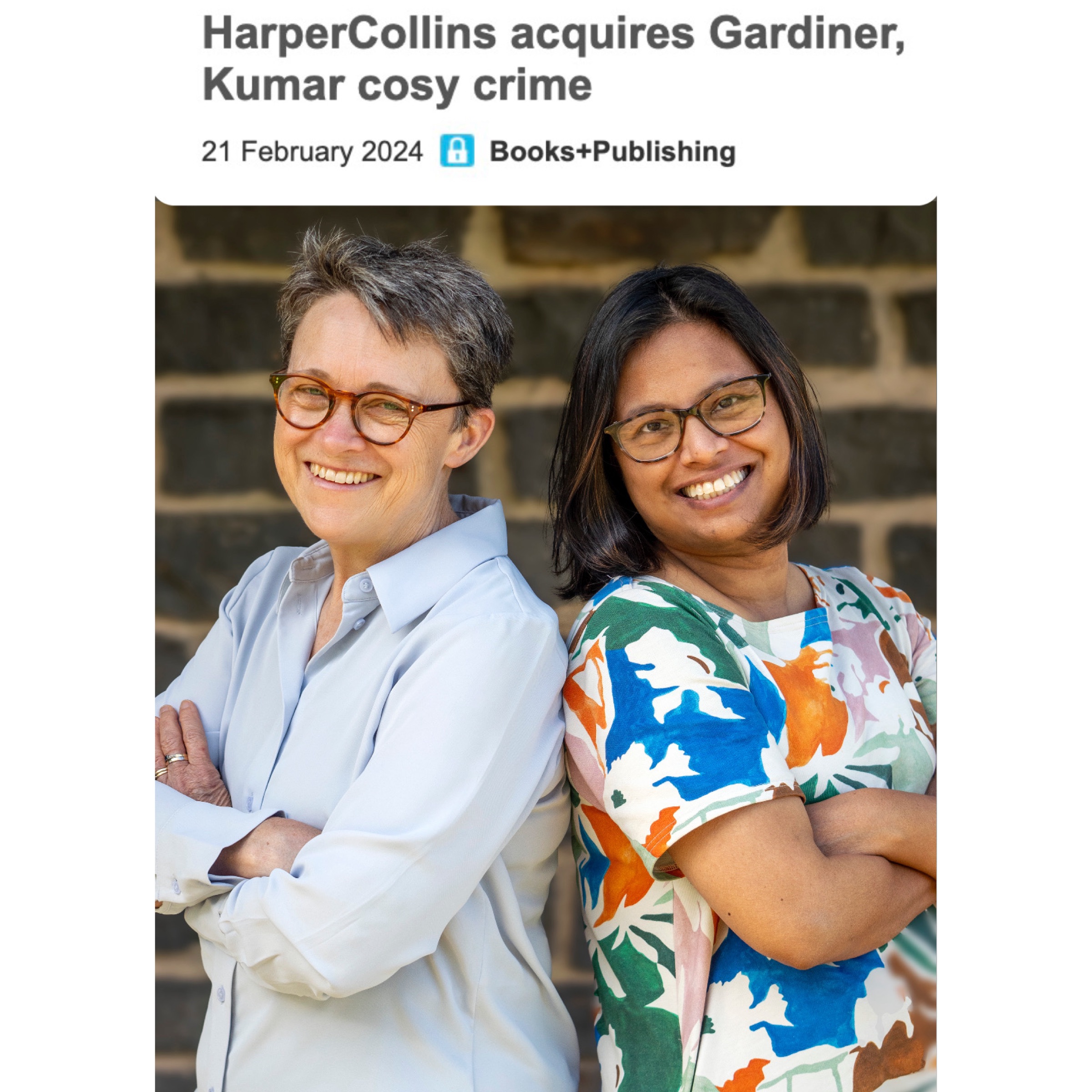
I’m absolutely delighted to announce that HarperCollins Publishers Australia has acquired World rights to publish Miss Caroline Bingley, Private Detective, the crime novel I co-wrote with Austen expert and all-round good egg, Sharmini Kumar, founder of AustenCon.
That means the novel will be published simultaneously in Australia, New Zealand, the UK and North America in April next year.
From the HarperCollins press release:
Roberta Ivers, Publisher at HarperCollins Australia, said: ‘I’m so excited to be publishing this brilliant, affectionate tribute to outspoken, independent women of the Regency era alongside my colleagues in the US and the UK, Rakesh Satyal and Cat Camacho. Not only is this story a delicious romp about women who won’t take no for an answer, it treads a skilful line between humour and pathos, with serious themes around colonial privilege that give us the other side of Austen’s story. I know everyone will fall in love with Caroline Bingley’s superior talents, as we all have around the world.’
Rakesh Satyal, Executive Editor, HarperVia said: ‘This ingenious homage to Austen is both respectful to the source material and daring in its scope, revealing to us new layers of this oft-visited and beloved world. I’m thrilled that this book will be available to readers around the globe. It’s fresh, wise, and endlessly diverting.’
Cat Camacho, Commissioning Editor, HQ, said: ‘I devoured Miss Caroline Bingley, Private Detective in one sitting. At the first page the authors pick you up from wherever you are and transport you utterly into the Regency world. It’s a brand-new, completely fresh take on the classic we all love, giving fan favourite characters their own stories and voices for the first time. I can’t wait to see it unleashed on the world.’
Literary agent Jacinta di Mase said; ‘From the moment I first pitched the concept to Roberta Ivers during an informal catch-up between sessions at Sydney Writers Festival in 2022, I knew she was the right publisher for the inimitable Caroline Bingley.’ While fellow agent Danielle Binks adds; ‘The reaction from the entire Harper family has been wonderful! It felt like we jumped from admiration to love, from love to acquisition in a moment, and we’re delighted at this home for Caroline, Kelly, and Sharmini.’
We’re pretty delighted too! Huge thanks to our agents, Danielle Binks and Jacinta Di Mase, and to everyone at HarperCollins.
Photo by Liliana Braumberger in this screenshot of the news in the trade magazine, Books & Publishing.
Haven’t posted for ages, sorry. I think the pandemic ate my brain.
Don’t know about you, but all through our many lockdowns I found it hard to read, hard to write, and hard to focus. My teaching work has been demanding, with the sudden shift to online and everything else going on (remind me not to volunteer to write any more academic articles this year!).
But I have been chipping away at a few writing projects and right now I’m on my Creative Fellowship at Varuna, the national writer’s house, so I’m ploughing through stuff.
Gorgeous, wintry Varuna
Here’s what I’ve been working on lately:
Fine Eyes: Miss Caroline Bingley, Private Investigator
I’ve told you this before, but I’ve been collaborating (for the first time) on an Austen-inspired crime novel, with playwright and Austen expert Sharmini Kumar. We’ve had great fun testing out our Regency research and plotting mysteries, and we’re nearly done. I know a few people who write collaboratively, and it’s been such an interesting way to work – especially during lockdown.
Wildfall
Wildfall is a YA historical fantasy novel – I mean, it’s fantasy, set in an imagined world, but influenced by the history of eighteenth century Europe. Sort of. Except with giant eagles. I’m in the late stages of drafting.
Roar
What I’m working on here at Varuna is Roar, a YA novel set in the 1980s in London and then in Africa, and especially Apartheid-era South Africa. I wrote a solid draft a while ago, on a May Gibbs Trust Fellowship in Canberra, and then undertook another round of research in South Africa, but then had to put it aside when the pandemic struck – like just about everything else. But I’m enjoying revisiting it now, and hope to have a final draft by the end of my time here.
Lion – Pilanesberg National Park, 2019
They’ll be a while yet, but I can’t wait to share these novels with you.
Not much walking going on today, to be honest, and not much writing, because as everyone in Victoria knows, last night’s thunderstorm developed into something rather fierce over night and this morning, and it’s still pretty miserable, with lashing rain. There’s a great deal of damage all over the state – roofs off, power out, NBN down, at least one sighting of a trampoline flying through the air, and everything smashed.
Especially trees.
I went back to the Moaning Tree Forest today, after the worst of the storm had passed. Two big eucalypts were uprooted and crashed right near where I sat in my car to write yesterday, and I could see trunks snapped and tree limbs torn off all along the area and in the Sanctuary – I didn’t go in, because it was still pretty wild and teetering branches are not my favourite thing. To be honest, for the final day of lockdown, a minor apocalypse seemed appropriate, after all we’ve been through, and also a little bit freaky. The roads and lawns were covered in debris – leaves, branches, and blossom – to the great delight of a huge gang of galahs who were feeding on the gum nuts and seeds scattered everywhere. I feel very sorry for all the fledglings who were trying to stay in their nests in that wind. I’m sure there must’ve been quite a few casualties.
So let’s think of something happier. I stopped at one of my favourite pieces among the many in the huge outdoor sculpture garden that is the Bundoora campus: Karen Ward’s Hermitage (2001). Before the pandemic, when I was teaching Writing Creative Nonfiction, I’d bring my students here, or to the Sanctuary, for a walk and a few writing exercises. We’d look at things – bark, mushrooms popping up in the lawn, Hermitage, the old hospital buildings, the waterhole with frogs – and everyone would wander off to write some short pieces about place, then stand together and read them out loud. It was always my favourite class. I hope we get to do it again.
And that made me remember that I haven’t yet written about the sculpture that can be found along the waterways in Nangak Tamboree. So here are a few I have admired on previous days’ walks over the past few weeks.
I find my students often don’t realise that they’re studying in a sculpture park. But then, I didn’t realise we had all these different waterways and open spaces. I guess you take it for granted, once you’ve seen a life-sized bronze rhinoceros or an upside-down Governor La Trobe. And some of the pieces along the waterways probably don’t get noticed so often. Which is a pity, because some of them are splendid.
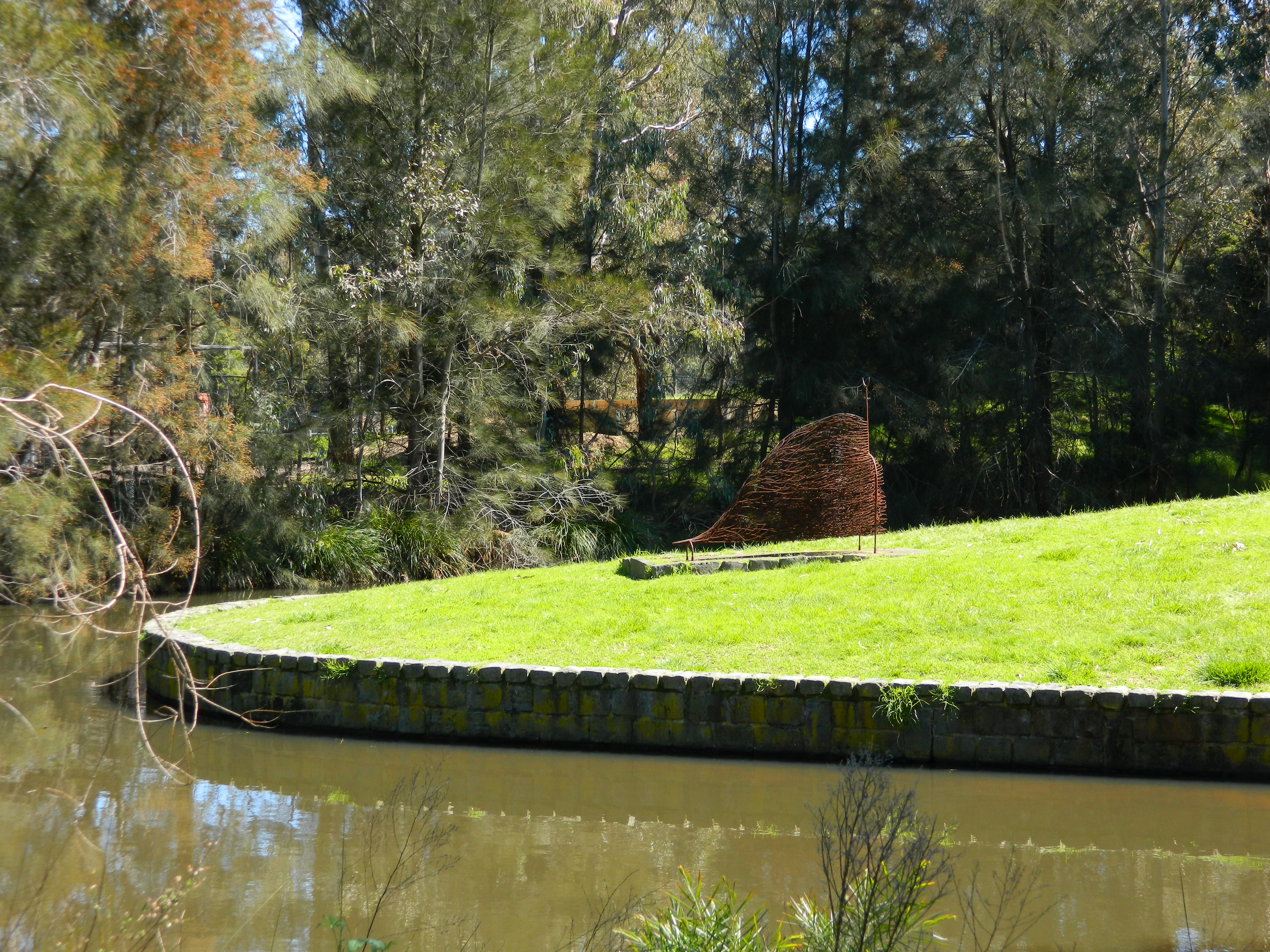
This is another favourite, partly because of its positioning. You can’t get to it easily – instead you glimpse it through a break in the shrubs along the banks of the moat. It’s Heather B. Swann’s Horned Night Walker (2003).
Further along the Moat are two pieces by one of Melbourne’s best loved sculptors, Inge King. (Probably her most recognisable work is the series of massive black-painted waves, Forward Surge, on the lawn between the NGV and Hamer Hall.) There are several of her pieces along here, but the most dramatic (and she was very good at drama) sits almost in the moat, at the foot of the amphitheatre, so that it forms a backdrop to performance and everyone in the audience can see it. It’s called Dialogue of Circles and was commissioned in 1976.
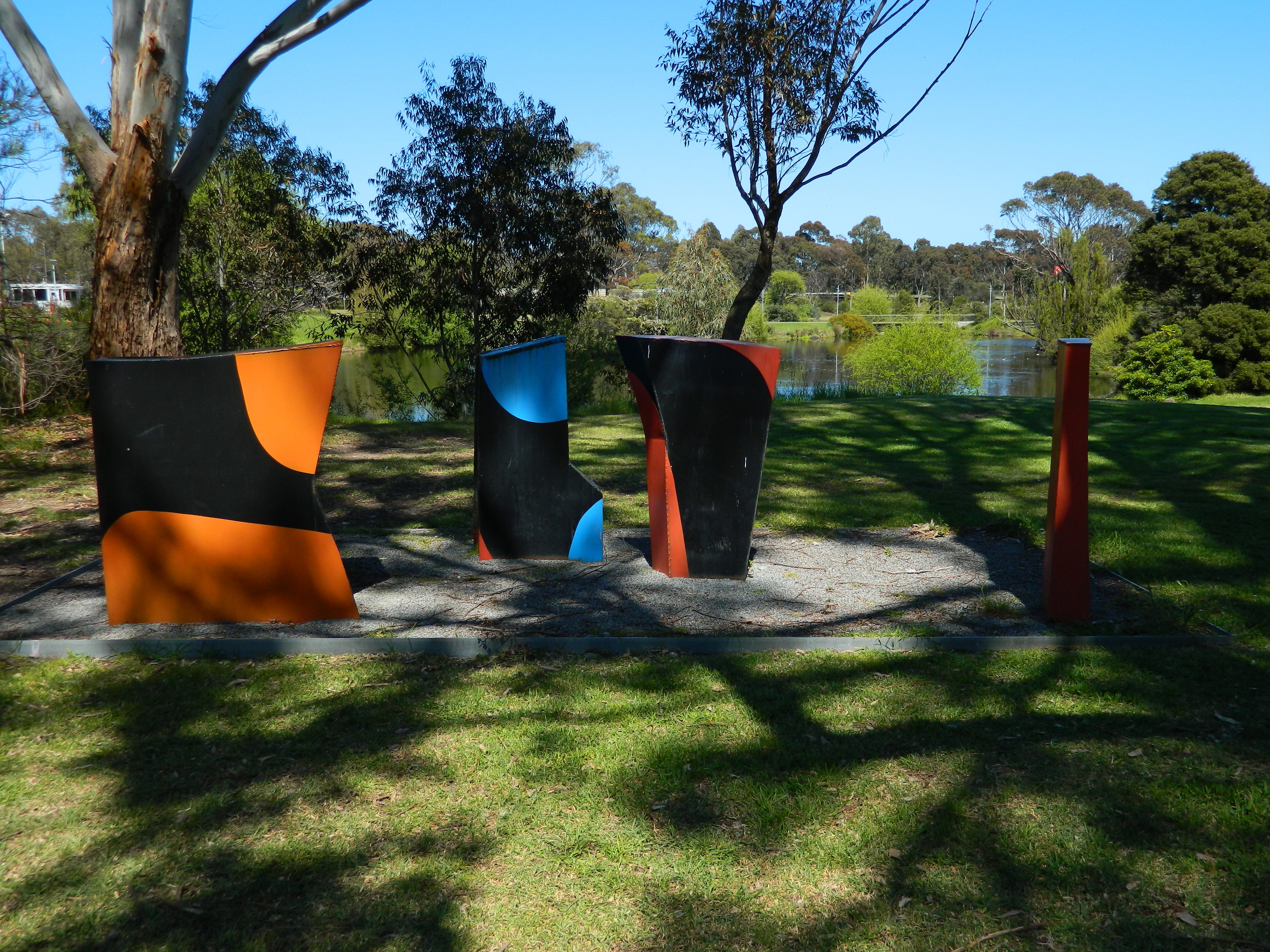
A hundred metres or so further on is a small group work, also by Inge King, called Group of Boulders. It’s right next to the Main Lake, on the grassy slope that I have learned is called Academic Lawn. I imagine that means that it’s a lawn where, on a warmer day than this one, academics are meant to lounge about like extras in Brideshead Revisited, and possibly roll right down and end up in the lake.
If you want to wander around the sculpture park for yourself and have a look, here’s a map. If you need a reason to go for a walk, it’s a damn good one.







 Kelly Gardiner