I recently read a review of the new film which described Atonement as based on “Ian McEwan’s romantic epic”.
I can’t think of anything less like a romantic epic.
Well, actually I can (Chesil Beach, for one), but that’s beside the point.
That’s not even a PR person resorting to that cliché: it was a film critic. Shoddy.
Makes me wonder about interesting ways to apply some of those other standard film/book cover blurbs…
Charlotte’s Web: E.B. White’s story of forbidden love
Possum Magic, a sweeping family saga
Silence of the Lambs is a sensitive and insightful portrait
War and Peace, a fearless expose of one man’s driving ambition
Then of course there’s that hard-hitting documentary, laugh out loud, unputdownable, wickedly funny, classic, five-tissue, pageturner – Hansard.
writing life
Changes
We have a new government. I use the term “new” advisedly. I hope it will be filled with zeal and ready to kick the place back into shape.
I should be relieved but I am strangely furious.
John Howard was shown the door by the electorate in no uncertain fashion, and I spent some hours on election night hanging out waiting to see him concede defeat on the TV.
But I’m not entirely sure that he did.
He agreed that the election had been won by the Opposition, but he didn’t concede anything much.
And I woke up the next morning in a fury, because one of his major claims in the concession speech was that his legacy was an Australia that is “prouder”.
I have rarely been ashamed of my country until the last few years, and I know many others who feel the same. I’ve been living overseas and been called to account many times for “my” country’s attitude to refugees, its own indigenous peoples, Kyoto, and the war in Iraq. (And the rugby scores, but that’s another matter.)
I know exactly what Howard means because his version of national pride is completely transparent and God knows we’ve been beaten around the collective head with it often enough. Howard’s pride has to do with installing flagpoles in every school and keeping out anyone different and narrowing the study of history so that it only tells the “good bits”.
But pride is not about flagpoles or packaging history.
Nor is history about pride – it’s much more interesting than that, and much more important. History has light and shade, shame, regret, humour, anger and innovation.
Only a simplistic nationalist pride is less complicated than history – and that, as we know, can have disastrous consequences.
Howard makes much of Anzac Day and the Gallipoli spirit – that’s a central motif in his version of pride.
Well, I’ve stood on the beach at Gallipoli, and pride had nothing to do with it. What I felt was horror, humility, sorrow, awe and anger. I felt loss. I felt the savage edge of hypocrisy and stupidity, and I felt that nationalism had an awful lot to answer for.
Australia after eleven years of Howard’s “history” is not prouder: it’s going to take an awful lot to overcome the shame, and the scorn of much of the rest of the world, and to return to the country a decent ethical framework, a deep sense of justice and, above all, vision.
I hope the new government is up to it.
Good luck.
Tom Kitten

We have a new member of the household.
He’s not very big.
Touche
I fenced when I was young. A great deal. Every day at school, and training in the evenings and competitions on weekends.
I ended up with an enduring obsession with swords, a few medals, and quadriceps the size of Uluru. I even have a sword tattoo.
So it’s not surprising that my first books were about pirates, and I’m working on another now about a duelist – a real-life female D’Artagnan. I sit on the train, researching for the new novel, re-reading some of my histories of sword-life, and imagining the moves and plays in each duel as I read.
The other day I noticed my sword hand subtly moving into quarte – a parry – and get ready to riposte, as I read.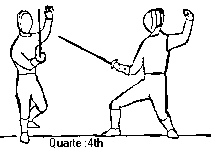
So that’s it.
I have to start fencing again.
My quadriceps are aching just at the thought of it.
Scribbles
I don’t get to sit at this desk much lately.
In fact, since I moved into this house – the dream house – and started working full-time again, I haven’t sat still anywhere at all, except for an awful lot of collapsing exhausted in an armchair in the evenings, something that has resulted in strange new behaviours such as a fixation with So You Think You Can Dance and anything else that might flutter past my eyes.
There’s just so much to do. And no clear headspace.
This morning I woke up at five, lay still and good and quiet for an hour, crept out for a cup of tea at six and by seven, when I was impatient to start planting and banging around, it started pouring rain.
So here I am. At the desk.
From here I can see frothy white sea of ti-tree flowers, and misty rain across the river, and the stick that was a rose bush last week until it became collateral damage in the ongoing rabbit insurgency.
I don’t think I’ve actually sat here to write anything creative at all. Ever.
I have, however, started madly scribbling on the train in the mornings, the long-awaited (by me, anyway) novel about La Maupin: an 18th century swordswoman, opera singer and outrageous flirt. A story so ridiculous that it couldn’t possibly be true – and yet it is. I started researching her about four years ago, but didn’t have her voice in my head to start writing until a couple of weeks ago. Now I can’t stop; or, at least, when I allow the time, I can’t stop. I sit on the train every morning, with Pergolesi’s Stabat Mater in my MP3 (for some reason, if I listen to anything else I stop writing) and scribble.
It’s something. It’s fun. It might even be readable. One day.
Lately I’ve been…
Reading
A.C. Grayling’s philosophical miscellanies
Australian Gardens by Diana Snape
Victoria Glendinning’s life of Leonard Woolf
The Monthly
I am, at last, onto Suite Francaise.
Listening to
Missy Higgins’ new album
Podcasts of The Book Show
Thinking about
Gardening, mostly, and the huge number of things on my To Do list.
Western philosophy. No, really. But that’s another story.
Writing
Not much and not very well. Have to sort that out. Maybe I can put it on the To Do list. Or write a gardening book instead. That might be easier.
Though I have done a final sweep of my never-ending World War One novel and sent it to my agent (again).

Forbidden nonsense
You may recall I love a good scandalous literary hoax, and there are none better than that of Norma Khouri, the Jordanian exile who wrote such a devastating story of her best friend’s death at the hands of her family, in Forbidden Love – and exposed the truth about honour killings to millions of readers around the world.
Or not, as the case may be.
Khouri may well be one of the more spectacular literary con artists of all time: not merely confused, or making a literary point, or psychopathic, or in a bit deep. This is someone who seems to have perpetrated yet another in a series of deceptions – the unkind, such as the FBI and the Chicago police force, may call it fraud – and writing a book about something that never happened is perhaps less of a crime than ripping off old women with dementia who now have no life savings or anywhere to live.
Last week, I saw Anna Broinowski’s documentary, Forbidden Lie$. It is, like its subject, aggravating, flowery, declamatory and many-layered; and that’s not a criticism of the film-maker. Khouri is eel-like in both her slipperiness and opaque expression, though pathetically transparent in certain moments. Lies upon lies upon lies.
Like Helen Demidenko/Darville (who at least never claimed to be writing “faction” in The Hand that Signed the Paper), she not only deceives readers, publishers, media (and in Demidenko’s case, award judges) but also betrays and undermines the efforts of people coming to terms with extremely difficult issues in their own lives and in their communities; be it Holocaust survivors, or women struggling to find identities in the modern Arab world, or those affected by so-called honour killings in any society.
I can’t believe Broinowski refrained from slapping Khouri hard during one of their ridiculous traipses around Amman. The woman sitting behind me in the cinema was so engrossed she heckled, and I can’t say I blame her.
Although the film does go on a bit long, that’s understandable, because it takes the film-maker, and the authorities, and the con artist’s victims, and consequently the audience a while to really get our heads around the depths of deception and layers of lies.
Exhausting, exasperating, and necessary.
You can watch a trailer here.

In the bag
Got my new book in the mail, quite unexpectedly. Didn’t think it’d be back from the printer for weeks.
It’s gorgeous, even if I do say so myself. Though I can say so, because the gorgeousness is nothing to do with me, and all to do with illustration, printing, and Random House’s willingness to invest in a splash of gold tinsel across the front cover.

Don’t call us
These are the sorts of stories floated to make fools of book publishers, but in fact secretly delight every hack (of which I am one) who has ever had a rejection slip:
In the summer of 1950, Alfred A. Knopf Inc. turned down the English-language rights to a Dutch manuscript after receiving a particularly harsh reader’s report. The work was “very dull,” the reader insisted, “a dreary record of typical family bickering, petty annoyances and adolescent emotions.” Sales would be small because the main characters were neither familiar to Americans nor especially appealing. “Even if the work had come to light five years ago, when the subject was timely,” the reader wrote, “I don’t see that there would have been a chance for it.”
Knopf wasn’t alone. “The Diary of a Young Girl,” by Anne Frank, would be rejected by 15 others before Doubleday published it in 1952. More than 30 million copies are currently in print, making it one of the best-selling books in history.
The New York Times reports that researchers with access to the archives of the venerable house of Knopf have discovered a delightful history of tragic reader reports and no doubt deeply regretted decisions:
The rejection files, which run from the 1940s through the 1970s, include dismissive verdicts on the likes of Jorge Luis Borges (“utterly untranslatable”), Isaac Bashevis Singer (“It’s Poland and the rich Jews again”), Anaïs Nin (“There is no commercial advantage in acquiring her, and, in my opinion, no artistic”), Sylvia Plath (“There certainly isn’t enough genuine talent for us to take notice”) and Jack Kerouac (“His frenetic and scrambling prose perfectly express the feverish travels of the Beat Generation. But is that enough? I don’t think so”). In a two-year stretch beginning in 1955, Knopf turned down manuscripts by Jean-Paul Sartre, Mordecai Richler, and the historians A. J. P. Taylor and Barbara Tuchman, not to mention Vladimir Nabokov’s “Lolita” (too racy) and James Baldwin’s “Giovanni’s Room” (“hopelessly bad”).

At my feet
There’s a dog at my feet.
Not my dog. I’m babysitting a Spoodle.
It’s a long time since I had a dog adhered to me like a shadow. When poor old Lil died it took me months to remember that I didn’t have to hold the door open after me – I’d been waiting for her to follow me everywhere every day for 16 years.
Now Shiloh and I are blogging. She’s a very big help. This morning she helped me get dressed, and as you can probably imagine was an enormous help to my girlfriend while she was working out this afternoon.
She has even brought us a small indefinable fluffy thing that may be part of another living creature. It’s too disgusting to tell. Can’t be a rabbit. I watched her this morning and she pays no attention to rabbits at all.
Perhaps it’s a bit of whatever beast pulled out all my irises and freesias and threw them around the garden for fun.
It’s a jungle out there.
 Kelly Gardiner