Thar she blows!


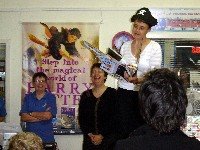
My book hit the decks last night, blessed by kind words from Lorain Day (Commissioning Editor, HarperCollins, and person of impeccable taste in manuscripts) and Julie from Jabberwocky Children’s Bookshop, which hosted the launch.
For those who weren’t there, here’s – roughly – what I said, besides thanking everyone:

It’s an honour to be a part of such a rich tradition of children’s literature, and to be welcomed into a community of writers, illustrators, teachers, librarians, and devotees completely focused on books and the children that read them.
My family isn’t here this evening – they’re all in Australia – but if they were, they’d all say, without exception: it’s about bloody time. They’ve been waiting a while for this.
I meant to start writing my first book about twenty years ago but somehow it slipped my mind.
I finally got around to it just before I moved to Auckland. My girlfriend reckons I wandered into the study and by the time I came out for dinner I’d written a book.
She might be exaggerating slightly. The truth is that when I’m writing I usually forget to eat dinner altogether.
But it does seem that suddenly (well, three years later) there are three books, and more on the way, and more ideas for new books and stories than anybody could ever write.
So here’s the first one, and I’m very happy you’re all here this evening to help me launch her upon the stormy waters.

Yes, that is a pirate hat on my head. I snatched it from the head of a passing Jabberwockian, who had dressed for the occasion.
And don’t I look tall? That’s what being published does for you.

History repeats on me

More on the idea that the children’s fantasy writing can offer freedom to discuss contemporary issues.
I don’t deny it. It’s just that this is nothing particularly new, even for JK Rowling, and nor is it a freedom confined to fantasy books. I don’t read much realist fiction because I figure the world’s dreary enough as it is. Although I do read a lot of non-fiction and reportage – so clearly I’m conflicted and contradictory. And I read a lot of history and nowadays a great deal of (preferably good) historical fiction for kids.
Over the past month or so, I’ve read a few of Catherine Jinks’ Pagan books, all about a young Jerusalem street kid who gets caught up in the Crusades and their aftermath. Her latest is Pagan’s Daughter, who is stuck in the middle of the European Crusades against French heretics – not all Crusades, of course, being based in the Holy Land.
There are myriad concepts in these books, almost an antidote to all the great children’s Crusade adventures of the past, where the Infidels (always partly clad and swarthily untrustworthy) were little more than slavering hordes, and Richard the Lion Heart rode up on his charger at the critical moment (I always loved that bit).
Those moral conceits were more anachronistic, in a sense, than Jinks’ street slang. On the other hand, the recent movie Kingdom of Heaven failed to achieve credibility, with a protagonist who was 1990s wishy-washy liberal and a plot that bore no relation to the real historical characters on which it was based, nor their actions and documented beliefs.
I recently re-read Ronald Welch’s Knight Crusader, which I remembered clearly from my childhood, and which is perhaps a midway point between that tradition of great heroic Crusader novels and our contemporary story-telling.
But moral-heavy Victorian interpretations still weigh on our image of the Crusades, and create a potency around them almost unmatched by other historical events.
It’s the tradition that led to George Bush seeing modern parallels, although he’s stopped using the word “crusade” about his own efforts. Perhaps Condoleeza Rice managed to get through the idea that he had the wrong end of the stick: that the Christians failed, and took hundreds of years to realise it (not a good precedent, after all); and that Holy War, martyrdom, and excessive slaughter have often been associated with Christian wars.
But Jinks is not using history (nor is Rowling, for that matter, using fantasy) to whack readers over the head with a current message about violence, or religious intolerance, or war. Those ideas are timeless and will often be part of good writing about the Crusades; or historical fiction set in any war; or indeed fantasy. Someone clever, like Jinks or Rowling, or Jackie French in Hitler’s Daughter, can present more facets of these ideas, and pose questions without sermonising.
Pure evil and pure good exist – or do they? Where do temptation, and fury, and fear, and weakness fit?
Into the fictional human stories that are woven from history – the conflicts and messages aren’t trumpeted, and the stories are above all compelling adventures. That’s what matters, what engages, what creates drama.
In his action-packed A Very Short Introduction to the Crusades, Christopher Tyerman (Oxford, 2004) mounts a sensible and determined argument that bears repeating:

There can be no summoning of the past to take sides in the present. Plundering history to deliver modern indictments serves no rational or benign purpose. To observe the past through the lens of the present invites delusion; so too does ignoring the existence of that lens. However, the burden of understanding lies on us to appreciate the world of the past, not on the past to provide ours with facile precedents or good stories, although of the latter the Crusades supply plenty.
Tony Blair: Muggle man

Prominent children’s authors are incorporating issues of terrorism and government propaganda in their books, a Monash University study has found.

Dr Rebecca-Anne Do Rozario examined children’s books and movies including J.K. Rowling’s Harry Potter series, Jonathan Stroud’s Bartimaeus Trilogy, Eoin Colfer’s Artemis Fowl series and Disney movie Lilo and Stitch.
She also analysed the way these authors questioned ideological and political motivations.
“Rowling’s Harry Potter and the Half-blood Prince and Stroud’s Ptolemy’s Gate were released in 2005, just after the terrorist attacks on London in July. Both books question government propaganda,” Dr Do Rozario said.
“In Harry Potter and the Half-blood Prince, the magical world’s response to terror is increasingly reminiscent of contemporary Western governments. For instance, a purple pamphlet, ‘Protecting your home and family against dark forces’, resembles Australia’s ‘Be Alert Not Alarmed’ campaign advice regarding suspicious behaviour. There is the sense of bureaucratic compulsion to guard against fellow citizens.
“Harry and his mentor, Dumbledore, though, dismiss bureaucratic measures as ineffective in ensuring security against villains such as Voldemort and the Death Eaters.”
Dr Do Rozario said children’s books, particularly those from the United Kingdom and Ireland, were well ahead of most adult books in writing on 9/11 themes and aspects of terrorism.
“These authors present an acute understanding of the ambiguities of war and terrorism,” she said.
“They are not writing on what is literally happening, but through their storytelling they reflect that not everything is black or white, or as simple as ‘good versus evil’. Readers are shown the importance of questioning what is going on – of looking at all sides of the issue.”

She later told Radio National’s Kate Evans this was “a good thing – it’s encouraging children to question.”
Ms Evans wondered if these authors are particularly prescient, but points out that “political and contemporary themes in children’s literature are nothing new: in the Cold War a lot [of books] had alien invasions and threats of nuclear weaponry, Bedknobs and Broomsticks was set in WW2, Lord of the Rings can be seen as that whole anti-modernist statement.” She asked whether if was more possible to deal with such themes in fantasy writing.
“More literal realistic literature can’t quite deal with those big difficult questions because it’s bound by what’s happening in the real world” Dr Do Rozario replied. “You can’t portray George Bush in a certain way, but you can portray a Muggle Prime Minister who is invented, and question that way.”
Now, that’s a bit of a stretch. I’m fascinated by the fact that my niece and all her friends are reading the best-selling Parvana books and other really quite harrowing stories about life in our war-torn world – quite the opposite to Dr Do Rozario’s theory about realism.
Ms Evans quite rightly went on to remind listeners about the animals in Animal Farm. There’s nothing astounding about children’s authors dealing well with contemporary issues, or indeed with young readers wishing to engage with them.
Fiction helps explain the world, and writers can use it to explain or expound to their heart’s content. Sometimes it works, because the engagement is genuine – see, for example, the arguments about “mudbloods” in Harry Potter – sometimes it sounds hollow (Tamora Pierce’s Protector of the Small bangs on about girl power so much even this die-hard feminist wanted to slap her). Hopefully we’re well beyond the era when good versus evil is a simple equation.
Young readers know perfectly well when they are being spun a line, or a moral, and when the author is trying to understand and analyse with the reader the mysteries of real and imagined worlds.
At least, I hope they do.

Reviews

My book is officially launched this Thursday, but there have been a couple of reviews so far – one in the NZ Herald with a whopping great mug shot which nearly gave me a heart attack when I opened the paper on the ferry. Forgive me if I brag – I promise to post critical ones here, too:

Ocean Without End is a rollicking, action packed yarn sure to captivate young readers.
– Dorothy Vinicombe, NZ Herald.

Kelly Gardiner writes fast-moving, lively prose and Lily’s indomitable spirit makes her an engaging pirate.
– Trevor Agnew, Magpies Journal (Source/online).

A great read! 10/10.
– Erik Steller (aged 10), Chatterbooks Kids’ Bookclub newsletter.

Easter appetites

Bit cold over Easter. Such a pity. Had to stay inside and read. And eat (why do they call them scorched almonds? Anyone know?).
But there was a no-writing rule in place over Easter. After weeks of work, and writing, and study and everything else, I thought my writing arm was going to drop off last week. Luckily it’s recovered, because it’s back in action this morning.
Finished Kipling’s Kim, which rekindled the desire to write about the Great Game; the first volume of Diana Cooper’s autobiography, which I thought might help with my task for the next month, the re-writing of my adult WWI novel, but the Lady Diana’s adventures are really too other-worldly to be any use at all for my middle-class protagonists; two very good YA historical adventures by Sherryl Jordan (The Hunting of the Last Dragon and The Juniper Game); and an awful lot of picture books while looking for a suitable present for a one-year-old (The Very Hungry Caterpillar and our old favourite Harry The Dirty Dog won out). And Eloise, of course. I also read Rumpus at the Vet to the one-year-old, who has got very good at turning pages since we last met. And squealing. That’s her real specialty.
Now I’m back in The Crusades.
The problem is, the more you read, the more, usually completely tangential, ideas you get and there simply aren’t enough hours in the day.

Cross, hot buns

Today I went into a bookshop to see if my book was there. It was. Sitting on the shelf between Maurice Gee and Sally Gardner. Right there. Did I mention it was on the shelf? In a bookshop. A proper bookshop.
Just like a really truly book.

(Then I had to buy a copy of Kay Thompson’s Eloise. I always wanted a copy of Eloise. It makes me laugh out loud.)

Anyway, from the sublime to the rollicking, my book’s being launched next Thursday, 20 April, at Jabberwocky children’s bookstore in Mt Eden, Auckland.

In the meantime, I’m away in Taranaki for a few days over the Easter break, eating chocolate and buns and probably sneaking into bookshops. Just to look. Maybe I’ll do a little subtle reshelving while I’m there.

New best poems

I’ll shut up about poems soon, but just noticed that the new crop of Best New Zealand Poems (whatever that’s supposed to mean) has recently gone live.
They are, of course, a mixed bunch, but it’s a splendid idea publishing the anthology online.
I particularly like Fiona Farrell’s Eel. Here’s a taste:

…but now I am old
and the sea knocks
at my head and there’s
a taste to the water
that was not there before

I cannot eat cannot settle
guts shrunk to dry rattle
I turn head on to the current
and swim against the stream
drawn by the sound in my head

Read the whole journey here.

More on remembering poems

Some poor soul innocently asked their students in my Children’s Lit diploma to “recall personal experiences of responding to and creating poetry” in school. Next week they’ll be churning through reams of paper wishing they’d never asked. Anyway, here’s part of my answer:

Then along came a dishevelled, chain-smoking teacher with a wild look in his eye (denim shirts, for God’s sake) and an incisiveness that left me marvelling. I marvel still. At Marvell.
Let us roll all our strength and all
Our sweetness up into one ball,
And tear our pleasures with rough strife
Thorough the iron gates of life:
Thus, though we cannot make our sun
Stand still, yet we will make him run.

Dickinson. Keats. Eliot. Plath. Frost. Donne.
Thou sunne art halfe as happy as wee,
In that the world’s contracted thus;
Thine age askes ease, and since thy duties bee
To warme the world, that’s done in warming us.
Shine here to us, and thou art everywhere;
This bed thy centre is, these walls, thy sphere.

Smith (1967) criticises the teaching of poetry “as a sort of mystery, and to the student it remains a mystery, a mystery that belongs to shy men and elderly ladies” . My experience was the cliché: a class of girls with a gay teacher – albeit far from shy. But I quite liked it being a mystery, because it was a mysterious world within reach; with willing guides and no sense of reproach if you followed the wrong path.
Of course there were exams, the trials of forced memorisation, dull moments wrestling with Blake, who I only pretended to understand. We read aloud, discussed context, questioned interpretations, stared blankly when Mr Lewis asked us what “Mending Wall” might mean – none of us had ever seen frozen ground, never mind the sub-text.
Other teachers used poetry too, especially for social studies or political purposes, for it was the time of the Vietnam War (Owen, Sassoon) and a growing modern nationalism in Australia (Slessor, Wright, Walker) and a movement I now know to be Aboriginalism.
I always loved the way poems can slam home a message (political or not) and deliver that unexpected “Ah!” moment with a deft twist or a sudden thud.
Kathy Perfect (1999) sums it up:
“And when you like a poem, you care about understanding it. But it must be an understanding you can personally embrace. One’s own understanding is a vital element in forging personal connections to poetry and making the reading of poetry an activity one seeks instead of dreads.”