“Books are the basis of our cultural heritage. Some may influence our world view or even shape our lives. Many of our childhood memories have to do with the books that we read or that were read to us. We identify those who are like us, and understand their inner world, by the books they read. We approach a book as we approach a work of art or a meeting with a new acquaintance, bringing with us our knowledge and experience, and during the encounter – in the course of reading – an intimate relationship is formed between ourselves and the book. The words stimulate our senses and engage our emotions. We see in our mind’s eye the characters and places described. We hear their sounds and smell their scents – but we smell the paper, too, and stroke the pages and the covers, and some readers even ‘taste’ the book by moistening their finger to turn the pages.”
From ‘Beauty and the Book’, an exhibition at the Israel Museum last year.
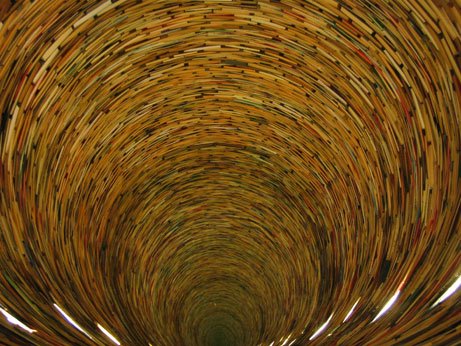
This piece, by Matej Kren, is called Idiom. The tower is constructed from thousands of books, collected from libraries and publishers. This and more extraordinary photos of the book tunnel are at BookLust.
writing life
Lies, damn lies, and fiction
“I became a novelist because I am interested in exploring the truth. If I wanted to lie to readers, I’d write a memoir.”
– Tim Hall, Blogcritics.
“Fiction is a piece of truth that turns lies to meaning.”
– Dorothy Allison, Skin.
“I am an author of fiction, I lie for a living, I am paid to perpetuate a habit I picked up in childhood; the one which leads me to tell stories which are not true.”
– A L Kennedy, Edinburgh Book Festival, 2001.
“Truth is stranger than fiction, but it is because Fiction is obliged to stick to possibilities; Truth isn’t.”
– Mark Twain, Pudd’nhead Wilson
“A writer is congenitally unable to tell the truth and that is why we call what he writes fiction.”
– William Faulkner
“I’m telling you stories. Trust me.”
– Jeannette Winterson, any time, anywhere.
Storyteller on a tightrope
As the stage production of the still-astounding Nights at the Circus opens in London, Paul Barker recalls in The Independent the late, lamented, hilarous, and really rather terrifying Angela Carter: “She wrote with wild grace, like a dandy.”
Toast and jam
At last year’s Edinburgh International Book Festival, the ABC’s Ramona Koval spoke about writing with someone who should know:
Margaret Atwood: My daughter isn’t here … she somewhat resents this story, but maybe she’s got through her period of resentment because she’s now 29. But when she was five, she and her friend Heather put on a play, and they sold the tickets to this play which were five cents. We bought the tickets and we were, in fact, the only audience members. The play opened, and the play was two characters having breakfast, and they had some orange juice and they had some cereal and they had milk on the cereal and they had some toast and they had butter on the toast and they had jam on the toast…
Ramona Koval: You did have hopes for this play early on though. You thought that you could see in its structure perhaps something Pinteresque or …
Margaret Atwood: That was after we’d had more toast, more orange juice and more tea and more jam, and then more orange juice, and finally at about the third go around we said, ‘Is anything else going to happen in this play?’ And they said, ‘No.’ We said, ‘In that case, we’re going away, and when you think of something else that’s going to happen, we’ll come back,’ because otherwise it gets to be like an Andy Warhol movie about somebody sleeping. It makes an artistic point but you don’t want to actually sit through it for 12 hours. So that’s the difference. In literature, unless something happens fairly early on in the book, people are probably not going to turn the page.
Ramona Koval: It seems like a simple message but so many people don’t get that.
Margaret Atwood: Well, maybe they have more faith in the reader than they ought to have. Maybe they think they can have the thing happening on page 15. They really need to have it happening on about page three … something, anything.
The moral of the story
A couple of years ago, the Chicago International Children’s Film Festival surveyed its young audience members to ask: “What new and interesting things did you learn from seeing these films?” Here are some of their responses:
Don’t be afraid to help sharks. —A.F., ten
That people in other worlds have more problems then we do. —L.H., ten
I learned that you should never take a former evil king on a long desert hike. —A.S., eleven
Never play that game. —K.S., ten
How to fight about toilets. —L.M., ten
Life. —R.H., eight
I learned that it was sad and that you had to go to someplace and get stuff. —J.T., ten
Do not marry someone that you don’t know. —K.B., nine
We found out what our dog does when we’re away. —M.B., five
And my personal favourites:
If you lose your baby you will get mad. —F.G., ten
Penguins have troubles too. —S.H., ten
These are really very sensible responses (beside the shark thing), although most ten year-olds I know would probably be a bit more articulate, so we’ll give them the benefit of the doubt and assume that:
A. They thought it was a dumb question, or
B. The comments are ripped out of context.
But it really begs the question: why do we feel the need to have a Moral in a children’s story?
Is it still the influence of the Victorian authors, of the so-called Golden Age of children’s literature, offering the guiding light of faith and goodness through the darkness of the world?
Do we think children need an author to take a moral position, more than adult readers do?
Or do we assume that part of the role of children’s literature is the moulding of young ethics – the writer as Jesuit?
I had hoped that the debate over the Chronicles of Narnia would have sparked a bit more questioning on this, but it seems to have been largely an argument over which set of morals is the correct one. The heavyweight Lewis versus Pullman is fun (although it would be more wittily argued if Lewis was here to defend himself against the Pullman right hook), but in their writing they both bang on about right and wrong without questioning whether they have the authority or obligation to do so.
I’m as guilty of it as anyone. There are ethical questions raised in my books about slavery, empire, gender, nationalism and violence, and I’m still thinking about how to deal with the question of Moral in the future.
But it wasn’t until writing the third book that I realised I didn’t have to provide answers as well as questions.
Who says there’s no such thing as a new idea?
Is the term “literary fiction” redundant?
“Popular does not necessarily mean poorly imagined,” writes Malcolm Knox in a thoughtful piece in the Sydney Morning Herald. “It’s the innovative language and ideas that define truly great writing.”
What is literary fiction anyway? Usually it is posed as an opposite for “commercial”, and so commercial fiction is what sells in large numbers, and literary fiction is what doesn’t sell. But this ignores the fact that most fiction that is written to a formula, for a mass audience, does not sell any more than non-formula fiction. Your average Australian thriller or chick-lit novel sells no more than a work of literary fiction. And sometimes, as in the case of Tim Winton, non-generic fiction sells in large quantities…
Original writing speaks from the real world, from the concrete. The hostility to cultural elites is based on a supposition that they are detached from real life, that their art is only answering other art. Another supposition is that cultural elites have no standards, that everything is relative.
I reject both suppositions. The best original writing… is grounded entirely in life. … Formulaic writing, on the other hand, is entirely grounded in other writing. This is what cliche is – writing that mimics other writing
… Original writing is always going to threaten such inversions. Formulaic writing on the other hand is going to entrench them, and entertain us while entrenching, by repetition and cliche, what we think we already know. Original writing strives to assign words their true value, not just today’s market price.
So why bother? Because art – invention, original thinking – is the answer. Why write? Because the alternative – silence – is unbearable.
You can read his entire argument here.
In whose opinion?
Opinionated writing is always the most difficult … simply because it involves retaining in the cold morning-after crystal of the printed word the burning flow of molten feeling.
– Gavin Lyall
Red letter day
Yesterday I saw the first sketch of the cover of my first book. I could tell you what it’s like, but then I’d have to shoot you.
But it’s spot on. Better than I had hoped. I’m chuffed.
And another thing
So I watched The Terminal, for some reason. But let’s not go there.
The thing is, Catherine Zeta-Jones’s air steward character is, inexplicably, fascinated by Napoleon.
She says: “After he lost the Battle of Waterloo, he isolated himself on the island of St Helena.”
Why would she say that? Like he had a choice?
I don’t particularly care that it’s wrong (well, I do, but that’s another matter). I just can’t get my head around the idea that a multi-million dollar film, with a team of script writers, and someone somewhere who has decided there has to be a constant stream of Napoleon references, includes a detail that is wrong. Somebody in that movie team has researched the topic enough to know all sorts of stupid stuff about Napoleon. But they don’t know that he was exiled? It’s like not knowing he was Emperor. So why did they put it in there?
It’s very odd.
This is where I get to tell you [oh what a dashing segue] all about my great-great-great-great-many-greats uncle, Lieutenant Andrew Mott, who commanded the barge which took Napoleon aboard the glorious Bellepheron where he surrendered his sword to Captain Maitland. Napoleon presented Lieutenant Mott with a set of pistols. And if they ever come up for auction, I’m mortgaging the house.
From Maitland’s log:
“At break of day, on the 15th of July 1815, L’Epervier French brig of war was discovered under sail, standing out towards the ship, with a flag of truce up; and at the same time the Superb, bearing Sir Henry Hotham’s flag, was seen in the offing.
By half-past five the ebb-tide failed, the wind was blowing right in, and the brig, which was within a mile of us, made no further progress; while the Superb was advancing with the wind and tide in her favour. Thus situated, and being most anxious to terminate the affair I had brought so near a conclusion, previous to the Admiral’s arrival, I sent off Mr. Mott, the first Lieutenant, in the barge, who returned soon after six o’clock, bringing Napoleon with him. “
See? The poor man had abdicated, surrendered, and given away his pistols to one of my mob. No wonder he decided to isolate himself on a rock in the middle of the ocean.
Lost history
I’m having a bachelor weekend, as my girlfriend’s away, which means I watch war movies and shout at the History Channel and eat strange things and sing along with Robbie Williams really loudly and write until late at night. (Not all at once.)
But my shouting at the History Channel this afternoon has been on the topic of Lost History. A BBC (of all people!) documentary called White Slaves, Pirate Gold focused on the discovery of a 17th century ship hoard off the Devon coast, including gold Moroccan coins, Delftware plates, and cannon.
“Renegade pirate attack,” I shout, as if I’m a contestant on Mastermind. Specialist topic: pirates.
But oh no. This is Lost History, I’m told. This is clearly an astonishing revelation that only the perceptive people in the documentary research team will ever be able to unravel, and not until the end of the program.
Never mind that every maritime historian interviewed no doubt knows every date of every known corsair attack on the British coast and the name of every commanding captain. This is Lost History. Its unveiling is to take place before our eyes, like those Lost Mummies in Lost Pyramids or the Lost Mammoth and the Lost Ice Age Man. I don’t mean to diminish the importance of the find. It’s the story-telling that annoys me.
Because apparently none of us has ever heard of the white slave trade. Nobody has ever heard the term “renegade”. Nobody knew, Until This Amazing Discovery, that Barbary corsairs had attacked Europe. This is Untold History.
I know that I’m not your normal viewer. I’ve just written three books about pirates including a renegade. But really. Any history of piracy will tell you all about it -even the kids’ books, like DK’s Pirate. Good old Rafael Sabatini’s original swashbuckler, The Sea Hawk, is one of the most famous pirate novels ever written – all about a renegade, taken in a raid on the Cornish coast.
This isn’t Untold History. It’s been Told over and bloody over. You just weren’t listening, mate.
“Just look up Murad Reis in your stupid encyclopedia,” I yell at the screen.
It happens all the time. I’m not sure which is more frustrating: the idea that unless History is Lost History, it’s not interesting, which to me only indicates an inadequacy in the script; or the implication that viewers are stupid. Even the experts, whose interviews are edited so that it seems they are only just reaching their conclusions at the same time as the viewer, are made to look as if they are working in the darkness of Lost History.
But fear not. All mysteries can be solved by a documentary team. It’s patronising, it negates all other research on the topic, and it doesn’t necessarily make for a good documentary – or book.
There are lots of Lost History books about at present. One of the most offensive, and in the same vein, is White Gold, by Giles Milton of Nathaniel’s Nutmeg: Or, The True and Incredible Adventures of the Spice Trader Who Changed The Course Of History fame. That was another fearless expose of Lost History – hey, guess what? The spice trade made people rich! Who’d have thunk it?
Milton also wrote Big Chief Elizabeth: How England’s Adventurers Gambled and Won the New World, about Raleigh’s failed New World ventures, since of course none of us had ever heard of Elizabeth or Raleigh either, and somehow managed to make two of the most fascinating people in history boring as batshit.
But I digress. White Gold is offensive, in a throw-the-book-across-the-room kind of way, rather than just a shouting way, because its fearless expose of Lost History is also about the white slave trade in Morocco and he indicates absolutely no interest whatsoever in the fate of all the millions of slaves of other races and cultures who were also kidnapped, beaten, starved, and basically destroyed by the trade at that time. It’s as if nobody else exists. He bangs on and on about people being white, especially British, as if enslaving them is somehow more horrifying than if people are African, or perhaps even Maltese or Greek.
I could have sworn I was reading some Victorian melodrama.
Of course, it isn’t just called White Gold. Oh no. This is Lost History. So it’s called White Gold: The Extraordinary Story of Thomas Pellow and North Africa’s One Million European Slaves.
When these books started appearing, my brother and I used to laugh at our own brilliant ideas for the most ridiculous topics. Brooms: The Invention That Swept The World. Knife: The Cutting Edge of History. But anything we dreamed up has long been surpassed by Dust: A History Of The Small & The Invisible, Flea, Salt, and, for all I know, Sewage: The Pipeline of Humanity (actually, Dust was one of our ideas – I should sue).
I quite liked Cod: A Biography of the Fish That Changed the World. And anything that gets people reading history is a wonderful thing. But they can be just as easily put off history if they think it’s only worthwhile if it’s Lost. Surely, if Mark Kurlansky and Simon Winchester can take the reader on an entertaining and informative historical journey, then it ought to be possible for other writers to focus on the history, and tell a good story, instead of just going for the easy, flabby Lost History angle.
And don’t even start me on The Da Vinci Code.
Aren’t you glad you aren’t sitting on the couch with me? I’m about to watch Crusaders: The Crescent and the Cross. Be afraid. Be very afraid.