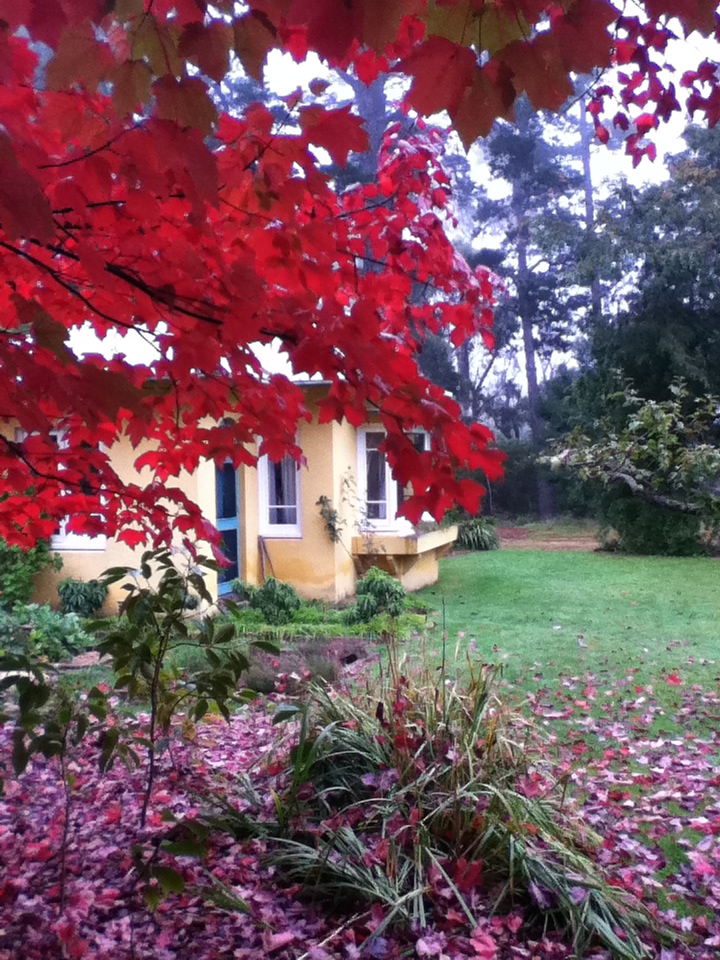
Am loving reading Ovid’s Metamorphoses, here at Varuna.
I have been meaning to read it for ages because I never have, and it’s the text on which the French Baroque composers based many of the operas in which La Maupin performed. Also because, hidden in among the exploits of Jason and Perseus is the story of Iphis, who was raised as a boy: a story La Maupin would have known well.
I don’t get much reading time, but it’s glorious, and one of those splendid, robust 20th-century translations (Rolfe Humphries, Indiana University Press, 1955). I imagine Eleanor Dark reading this, while the wind rages around the house, as Juno (or whoever is in charge of the weather in Katoomba) decides to flood the earth:
… he turned loose
The South-wind, and the South-wind came out streaming
With dripping wings, and pitch-black darkness veiling
I’m not much of an extrovert. Far from it. I’d happily stay home and never go anywhere, but that’s not how the world works. You adapt. Leave the house. Talk to other people. Real people.
So it fascinates me how networked and interactive the writing community is, online and in real life, considering how many writers are introverts. There are those huge web communities where people pitch ideas, get draft feedback, agonise over rejections, beg agents for advice, just like the Writers’ Centres and events we have in so many places now. There are courses and workshops and a whole lot of people (the extroverts, probably) creating careers out of connecting writers with one another and – of course – with publishers and agents. They scare me a little, but never mind.
The amazing thing to me is how communities develop organically, or when given a gentle boost. The Young Adult authors on Twitter, for example, many of whom have also met in real life at conferences or events, have proved with campaigns such as #YAsaves to be a force for goodness and niceness, able to be mobilised in minutes.
So this week and next I am in writing paradise: Varuna Writers’ House in Katoomba, in the gorgeous Blue Mountains in New South Wales. *
Dry stone wall under the liquidamber - Varuna
It’s autumn here, and some days it rains softly. There are five writers in the house, all working on different kinds of projects and at different stages of our careers. We each have a bedroom and a writing room, in a house filled with books and light. We wake up early most mornings. We may or may not see one another during the day. We slouch about, sit at our desks, proofread in the sunshine, go for walks, refuse to go for walks (in my case), browse the bookshelves, and write.
Mostly write. When we assembled on the first evening we all agreed there was some kind of magic going on. I’d written 5000 words that day – twice the usual rate. We start early (though it’s entirely up to the individual) and most of us are at our desks for 11 or 12 hours. But it’s not just that – somehow the mind becomes more focused, more productive. If there’s a writing zone, we are deep inside it. It’s quiet, respectful, peaceful, dedicated, and we are all conscious of the extraordinary privilege of being here – of being supported, as writers.
We help ourselves to the plentiful food supplies – in some cases every two hours – and then around 6pm we slowly assemble in front of the fire in the dining room, talk about our days, our work, the world and wait for the legendary Sheila to arrive and prepare a fabulous meal. It’s a little writing community, of sorts: a temporary one, although I know plenty of people who’ve made lasting friendships here.
It’s quite different from my select and extremely rowdy writing circle back home. There are three of us. Most weeks we meet for lunch, for coffee and then go write. Together. We sit about with our laptops somewhere soundproof (for the safety of those around us) and we write in 25 minute sprints, and then for ten minutes we gossip, drink cups of tea, and laugh until we weep. Then another writing sprint. I haven’t been part of that kind of writing community for years, and it’s lovely. (Thank you, Paddy O’Reilly and Fran Cusworth.) It developed naturally, in a way, but we are also all PhD students in a faculty of supportive people.
Online, I’m part of a community of writers and readers, many of whom I’ve never met. We share resources, articles, reading suggestions, outrage, shameless plugs, despair, jokes, favourite videos, support and encouragement. It’s called Twitter and it’s as much a part of my own professional development as – in fact more than, because it’s daily – my membership of any professional organisations.
So you see – even an introvert gets out sometimes.
Eleanor Dark's studio, Varuna
*Varuna was the home of author Eleanor Dark (The Timeless Land) and Dr Eric Dark, who served with the Medical Corps on the Somme and was awarded a Military Cross following Passchendaele. The MC citation, dated 15th August 1917, reads:
“For conspicuous gallantry and devotion to duty in leading his bearers. He displayed great gallantry and disregard of danger in moving about in the open under the heaviest shell fire, collecting and evacuating the wounded. He worked continuously for thirty-six hours, by his energy and determination contributing largely to the rapid clearing of the battlefield.”
Their house must have been an oasis in their busy lives: both were at the forefront of contemporary politics; Eleanor was a feminist and social justice advocate, Eric a socialist and committed member of the Labour Left during those turbulent decades around the Second World War. Varuna was donated “to literature” by their son Mick and is now a year-round haven for writers of all persuasions. It has a range of fellowships and programs: I was lucky enough to be awarded a Retreat Fellowship.
This week and next I’m at a writers’ retreat: the glorious Varuna Writers’ House in the Blue Mountains, outside Sydney. It’s the home of the legendary Australian novelist, Eleanor Dark (The Timeless Land and The Storm of Time, which I haven’t read for years, but must revisit).
All very 1930s and quiet and misty and autumnal and we are utterly pampered. Feeling very lucky. While I’m here, I’ll be finishing the first draft of Tragédie, and might even get on to some redrafting.
Delightful news today that Act of Faith has been listed as one of the Notable Books for Older Readers for 2012 by the Children’s Book Council of Australia. There are some fine books on the list, including Penni Russon’s superb Only Ever Always and Vicki Wakefield’s All I Ever Wanted, so I’m extremely honoured.You can read the whole list and the shortlist for Book of the Year here.
What’s the collective noun for the Tudors? A chalice of Tudors? A gauntlet?
A plague?
There are, at last count, 27,491* historical novels based in the courts of the Tudor kings and queens. It’s not hard to see why. They were a fascinating lot. Sex maniac Henry. His six wives and their sisters. His children: irrational and frigid or possibly sex maniac Elizabeth, psychopathic Mary, frail little Edward and his cousin the bewildered Lady Jane Grey. There are captains with sparkling eyes like Burt Lancaster in The Crimson Pirate. Priests in hair shirts. Head chopping. Rabid Scots. An Armada. There is even Geoffrey Rush. That’s what they were like, right? Ask anybody.
It’s time to enforce a moratorium.
From now on, nobody is allowed to publish any new books on the Tudors without proving to a committee (composed entirely of me) that they:
Undertake not to completely distort the historical record and their readers’ sense of history without reasonable cause
Have something new to say on the topic.
We get the some thing over and over. That’s right. Elizabeth never married. I don’t understand how that comes as a surprise to anybody. Mary, Queen of Scots was executed. So was Anne Boleyn. Henry had six wives. Amazing. Who knew?
But what you would never learn from many of the recent fictional portrayals is that these were among the best educated, most intelligent, influential people in Europe. That some of the most significant political and religious initiatives of all time took place under their reigns (alongside some disasters). That the Tudor queens dramatically altered the understanding of monarchy and leadership. That some of the alliances the Tudors forged and enemies they created resonate to this day.
Instead you can read about an Elizabeth who clings to her lover Dudley’s manly chest while he makes the decisions, like Fabio on a Mills & Boon cover – or was that Essex – or perhaps Walter Raleigh?; about a fey Jane Grey or poor wee sickly Edward; about Mary who lived only to burn people and stalk the hallways like Mrs Rochester; and about a Henry who jumps from bed to bed without ever pausing to ponder economics or military matters or foreign affairs.
Now don’t get me wrong. I’m very happy to see new interpretations that cast light on some of these people and those around them. I even think Jonathan Rhys Meyers never ageing as Henry is hilarious – although I can’t quite bring myself to keep watching The Tudors. I don’t mind the odd mash up (such as – a slightly different example – Sofia Coppola’s stylish take on Marie Antoinette, another historical object of mass obsession).
What I hate is the same drivel over and over, poorly written books that only sell because they are about the Tudors, or work that utterly distorts readers’ historical understanding for no good reason. So much of it is little more than fan fiction and bad fan fiction at that. They make me shout and scoff and snort, and that’s not what you want from a reading experience. I refuse to read another one unless a jury of my peers assures me it’s readable.
And as a result, we now have an entire generation of readers who think that one of the great dynasties of British history is just that: Dynasty without Joan Collins (and even she once played Bess Throckmorton).
Those readers now have a historical framework which includes the belief that Elizabeth had Mary of Guise either poisoned or killed by Walsingham’s own hand (she died of dropsy), or that she had Bishop Gardiner murdered for opposing her (he died of natural causes well before she took the throne). Minor examples, but symbolic distortions. And why?
Sometimes historical fiction needs to bend the laws of time or truth and the responsible novelist will make sure readers understand this in an appropriate note at the end. Film-makers do the same. Elizabeth and Mary, Queen of Scots never met, but who could forget Vanessa Redgrave as Mary, Queen of Scots sparring with Glenda Jackson’s Elizabeth? Katherine Hepburn as Mary also met Florence Eldridge as Elizabeth in 1936. Barbara Flynn as Mary and Helen Mirren’s inevitable Elizabeth locked horns just a few years ago.
It’s a gorgeous idea, if only for the casting – but always promoted as such. It’s a ‘what if?’ fiction. That’s different to swapping historical figures in and out of time or place or even marriages apparently at random.
But I fail to understand why, in your bog standard Tudor narrative, with real historical figures so wondrous, so entertaining, operating in a complex and sophisticated world, almost everybody feels they have to make anything up or add extra intrigue.
We also now have an entire Tudors industry, devoted to churning out trade paperbacks with sumptuous covers of women or girls in gowns but with no heads – which is, in a way, appropriate. (Hmm. Now I think about it, maybe all those headless historical fiction covers are subliminal nods to Anne Boleyn?)
Like Marie Antoinette and Napoleon, the Tudors are fascinating. They have what is known in LA as timeless appeal. You don’t have to do much with them, because the historical figures do a lot of the heavy narrative lifting themselves. And there are so many popular history books written about them, too, you don’t even have to do any really hard research. Easy.
That’s how so many of these books feel.
It’s not enough.
I’m doing my PhD at present, and to be awarded a PhD you have to make “a unique contribution to human knowledge and understanding”. That seems to me to be a very good guide for any book. Each novel, each short story, should be a unique contribution to human knowledge and understanding. It may not be major, earth-shattering, but it should at least be unique.
There have been revelations of new historical material and new perspectives on the Tudor years in the recent past. Most of this has appeared in the work of historians, archaeologists or other writers of non-fiction, but some has and will come from fiction; from novelists shining a torch into the dusty corners of the past. Mantel’s Wolf Hall is a brilliant example.
Find a legitimate way in. Focus on a character previously neglected. Shed light on a particular moment. Make a unique contribution. I know someone who is writing a novel about Dudley’s wife, Amy Robsart, and I feel sure it will offer unique insights, a different perspective and is impeccably researched. It will pass the committee appraisal with flying colours and satisfy both criteria.
To such authors I say, go forth and bring us as many fabulous new Tudor tales as you can imagine. More power to your arm.
Everyone else, step away from the keyboard.
*That’s a historical distortion – in other words, I made it up.
The day started with a workout, then after a much-needed and extremely strong recovery coffee I turned on my laptop to find messages of congratulations on email and Twitter, because the Barbara Jefferis Award shortlist was announced today and Act of Faith was highly commended.
It’s such an honour and surprise because, apart from anything else, this is an Australian Society of Authors award for ‘the best novel written by an Australian author that depicts women and girls in a positive way or otherwise empowers the status of women and girls in society’. That means a great deal to me. It is named in honour of the late Barbara Jefferis: novelist, founding member of the Australian Society of Authors and its first woman President.
And there are so many significant and terrific books this year that are eligible, I’m really quite delighted.
I mean, really – look at this shortlist:
Georgia Blain: Too Close to Home (Vintage)
Claire Corbett: When We Have Wings (Allen & Unwin)
Anna Funder: All That I Am (Penguin)
Gail Jones: Five Bells (Vintage)
Gillian Mears: Foal’s Bread (Allen & Unwin)
Frank Moorhouse: Cold Light (Vintage).
Also highly commended were:
SJ Finn: This Too Shall Pass (Sleepers)
Meg Mundell: Black Glass (Scribe).
Chuffed. Me. Hell, yeah. And I don’t care who knows it.
Hearty congratulations to all those commended and shortlisted. And happy IWD 2012.
First, let’s celebrate all the astonishing change that has happened in the last few decades with a little Aretha.
I remember when that song came out. If you ever doubt that art can change the world, remember that song.
I remember the International Year of Women in 1975. I was in high school (yes, I’m rather old) and it had a huge effect on me, and on the world. I remember televised debates featuring Eve Mahlab. I remember the badges and t-shirts and rallies, and also the backlash. I remember reading The Female Eunuch – God knows what I made of some of it, since I was 15 or so. I remember reading the poems of Oodgeroo Noonuccal and Judith Wright and Audre Lorde. I remember feeling like my life – the whole world – was shifting, and it was. I remember my great aunt Madge, a veteran of the women’s peace movements in World War One, telling me: You’re just like we were.
I remember so many IWD rallies of the 80s, remember speaking at one (it must have been 1983) in the pouring rain, and I remember our current Prime Minister in attendance. I remember being abused by bystanders as we walked down Swanston Street with our banners. I remember fighting with countless numbers of men in suits in boardrooms about childcare, about discrimination, about at least keeping their stupid bosom jokes to themselves.
And now look. So much has changed. Yet so much hasn’t. So far.
I feel like every day we need to focus on what more needs to be done, and that’s just as it should be. But maybe we should keep this one day for celebrating and reflecting.
So today I’m remembering Madge and her sisters and my great-grandmother and her friend Vida Goldstein and that whole stroppy generation. I’m remembering the generations of strong women in my own family who didn’t want to make a fuss about it, but did change the world anyway – just by example. I’m remembering the women who marched beside me, then and always. I’m remembering the poets and the visionaries.