That’s all.
That’s all.
I’ve wasted years of my life.
Happily I’m in good company.
A US writer – let’s call her M* – whose book for younger readers is just out, has advised a group of young aspiring writers not to bother with such feeble-minded tasks as research when writing historical fiction:
M said she didn’t know enough and had to write about what she didn’t know. ”To write a book about the past [as she has done], there is a saying that you read only two books and then close your eyes,” she said. That was all the research required.
I’ve been hearing a lot of voices lately, but that was the plan. Part of my PhD project is about the quest (or lack thereof) for authenticity in voices in historical fiction, and now I can’t read anything without seeing through that lens. It’s a bit like when you’re going to get a new car or a new dog, and suddenly the world is filled with that model or that breed. Except this will last for years. And is, thankfully, rather more interesting than ten year-old station wagons.
So here are some initial thoughts on a few voices I’ve heard recently.
Bethia Mayfield is the narrator of Geraldine Brooks’ Caleb’s Crossing. Brooks can enable her readers to hear a voice from the past with sublime felicity: her March is a tricky and unsympathetic narrator whose weakness and selfishness are difficult to bear but a joy to read. Bethia, on the other hand, is the opposite. the character is engaging, but her voice – I am very sorry to say – is uneven. I heard Brooks speak about the book recently, and she mentioned that she makes great use of the Oxford Historical Thesaurus. It shows*. The reader is happily meandering around the island with Bethia when we all trip over a word, and then another, which seem to be perfectly accurate in a historical sense but somehow out of time – out of tune – with all of Bethia’s/Brooks’ other words.
It’s a very very tricky business, maintaining a voice that is palatable to the modern ear but somehow historically accurate – what Sarah Waters describes as “right enough – for us”. Brooks almost always gets it right. Just not this time. Not quite.

In Room, Emma Donoghue’s narrator is five year-old Jack, who lives in a small room with his Ma and that’s the only world he knows. Hard to imagine a more difficult task for a writer – a credible five year-old voice, but also one whose world is so confined he simply doesn’t realise, at the start of the book, that the things he sees on the television are real – and yet convey the entire action of a book, including some genuinely thrilling action – in that voice and world view.
But Donoghue manages it, beautifully. There may be the odd word that seems out of place, one or two concepts that Jack couldn’t possibly know but it doesn’t matter; it doesn’t throw you out of the story. Anyway, as Jack says, “I know all the words”.
Finally, a TV series: Downton Abbey.
I love it. I do. But please: there is no way on earth that upstairs and downstairs ever collided and colluded so often and so intimately. After the Great War – perhaps. As people’s lives were shattered by grief and missing, and as the men and women at the many Fronts discovered they could be friends or enemies across class and that death really didn’t distinguish; then the social – if not economic – barriers in British society began to crumble. Or in a crisis, such as a corpse in your bedroom, yes, one might feel a trusted maid is the only place to turn.
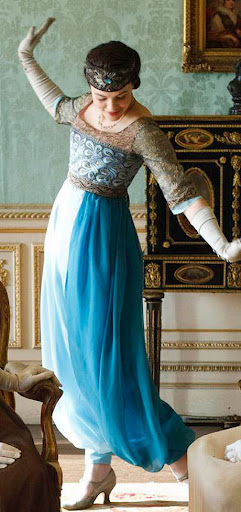 |
| Sybil: can’t touch this |
But it really does reek of narrative reshaping history for upstairs characters to confide in the servants, for maids to offer unsolicited personal advice, for there to be such informality and idle chatter in the house of an earl. An earl! Not a minor baronetcy, but one of the great titles in the kingdom. Perhaps I wouldn’t mind the inaccuracy it it managed to be consistent, but it isn’t. Some of the voices and relationships are consistent and some aren’t. I don’t mind the lovely daredevil Sybil being too egalitarian, but other characters on both sides waver in and out.
Yes, I am one of those people who shouts at the television or scoffs in the cinema at blatant rewriting of history. Don’t get me started on Shekhar Kapur’s versions of Elizabeth I, for example.
| As if! |
And if I huff “As if!” several times in one viewing, we are in trouble.
I’m afraid there have been many “As ifs” during the otherwise winning Downton Abbey, though it won’t stop me watching it.
* [Later: that sounds more brutal than I meant it to. It’s a terrific story.]
Sometimes things happen in the real world that are so weird, you really wouldn’t write about it. Because who would believe you?
It’s been a bit like that lately. Here are just a few wild media events:
All quite bizarre at times and terribly, terribly modern.
Or not. These are extensions of activities that have been central to the life of a great deal of the world for centuries – millennia.
Granted, there weren’t too many bloggers in Damascus in the seventeenth century, but there have always been rabble-rousers, trouble-makers, idealists and writers whose words have spread far and wide, whose ideas and discussions have ignited unrest or provocative debates or even revolutions.
Socrates. Luther. Spinoza. Galileo. Jefferson. Those kinds of ratbags.
You know where I’m going with this. People have always dreamed and written and published their thoughts and beliefs and aspirations, whether on clay tablets or parchment or – in recent centuries – in mass media such as the pamphlets that swirled around London in the 1640s or Paris before the Terror.
For everyone one of those ratbags, there’s someone trying to shut them up – or down: authorities burning books or burning authors, excommunicating or exiling people, throwing authors and teachers into prison or camps or dungeons, banning books and media outlets.
In many of the countries in the world today, the situation is not so extreme. But let me just unpack that: I was going to write “most countries” but then realised, I don’t even know if that’s true, numerically. There are writers, journalists, artists, bloggers, whistle-blowers and teachers in prison or exiled or in danger in dozens of countries around the world right now.
Even in the liberal democracies, the immediate political response to a Wikileaks or a controversial artist is banning. Often it’s just a play to the tabloids which, as we know, are peerless upholders of intellectual integrity. Even in the liberal democracy in which I live, Australia, there’s no constitutional right to free speech.
In the media, slippery slopes head off in all directions. Anyone, like me, who has spent any time in commercial media – print or online – can tell you that every day, every week, is a battle between editorial and sales/marketing teams about what messages are acceptable, from the annoying pop-up ad campaigns on your website to the pressure not to report on certain issues, or not to publish letters critical of advertisers.
In too many countries, that pressure is about not being critical of authorities or political movements or organised crime or businesses or religious leaders – and in far too many places, you ignore that pressure at your peril. Yet people still do. And many still die.
Yes, this is what my novel Act of Faith is all about. It’s set in the 1640s, when the Parliament in England and the Catholic Church in Rome were as keen on burning or jailing dissidents as each other. When I wrote it, I knew there were parallels happening around the world – what’s fascinating is how many of the debates are now at the forefront of public discourse. Or they should be.
And why, oh why, do we seem to be moving backwards? In 1948, in the aftermath of the Second World War and the frenzy that destroyed so many great thinkers, writers, artists, activists and musicians along with millions of other souls, the United Nations declared:
Everyone has the right to freedom of opinion and expression; this right includes freedom to hold opinions without interference and to seek, receive, and impart information and ideas through any media and regardless of frontiers.
– Universal Declaration on Human Rights.
It really is that simple.

Yes, must get on to that.
The sequel to Act of Faith is The Sultan’s Eyes, to be published in 2013.
There’s a little info here.
So Isabella and I are off to Istanbul in the 17th century. The Sultanate of Women. The Gilded Cage. Seraglio Point. The Golden Horn.
Poetry in a city. This book is going to write itself – if only it would.

A few people have asked me about the real world events that underpin the fictional world of Isabella and her friends in Act of Faith.
Here’s a timeline of some of the historical events in those years.
http://www.timetoast.com/flash/TimelineViewer.swf?passedTimelines=163419

Someone asked me, the other day, to recommend some good historical fiction for young readers.
Of course, there are many recent books that are sensational (by Jackie French, for example, or Catherine Jinks or Linda Newbery – or many others).
But my mind goes back to the books I adored when I was nine or ten, many of which hold up rather well even all these MANY decades later – and in which the historical research and detail are impeccable:

(Yes, I may have mentioned these before, but that’s because they’re good.)
And as for the paranormal/time travel/weird stuff, it seems to me that it’s still pretty hard to go past Penelope Lively, Ruth Park, L.M. Boston or Diana Wynne Jones. Or, for that matter, Beowulf.
I’m not suggesting the books of yesteryear will never be bettered, but if you write for younger readers, these are essential reading.
If you read books, or buy books for kids to read, don’t forget the gems lurking in the backlists.
Even if they are ancient history. And only 150 pages long.
This is the Preface from Act of Faith:
Dear Reader,This book you hold is a treasure, of sorts, as is every book I have ever known.I have made it for you – especially you – for reasons you will understand as my words unfurl before your eyes.Turn these pages tenderly.You hold my life in your hands.
Isabella HawkinsVenice1647
They are my words, of course, and as I send the book out into the world I feel much the same as – years ago – I imagined Isabella might when I wrote those lines in her voice.
These weeks around a book release are anxious ones – this time more so, for some reason.
But I’ve realised over the last couple of days that worrying, although inevitable, is useless.
I have made as good a book as I can.
That’s all I can do.

And here’s one good reason why:
You write your fiction based on facts. You create monster spreadsheets, track everything, check source after source.
Then you colour in the blank spaces, add a little depth or perspective here and there. You are scrupulous about keeping track of known facts and fictional embellishments.
And then you find another – impeccable – source which contradicts any number of previous “facts”, which means either you have to:
1. Change everything
2. Act like you meant that sub-plot to be fictional all along
or most likely
3. Shout a bit. Or a lot.
And when I say “you” I mean “me”.
Gah!

 Kelly Gardiner