So today my copies of Act of Faith arrived in a box. They are beautiful.

It’s in the shops in a couple of weeks.
All I can do now is bite my nails and wait.
So today my copies of Act of Faith arrived in a box. They are beautiful.
It’s in the shops in a couple of weeks.
All I can do now is bite my nails and wait.
This weekend I’m participating in Melbourne’s wonderful Emerging Writers’ Festival, an annual event for writers, by writers. It’s a terrific program, and the section in which I’m involved is called Living Library. It’s like speed mentoring: you book a 15 minute session with one or more of a range of experienced writers and publishers and ask them any questions you like on specific themes. Great idea.
I’m one of the Books you can borrow from the Library and am answering questions on creating characters.
I figured I may as well post some general thoughts, although for those people who came along and asked questions, I did rummage around in my head and rustle up more specific discussions connected to their own work.
So, some brief and random ideas and advice:
Bad guys
No matter how evil your baddie, you – at least, if not the reader – need to know why he or she is that way. Very few people in history are evil simply because they are evil – unless you’re actually writing about a psychopath (in which case, research the state very well). You don’t have to invent gratuitous redeeming features, but at least allow a little chink in the armour or a little glimmer of insight.
How much? That depends in part on the age group for which you’re writing. Younger readers like well-rounded characters as much as anyone, and they do need to understand motivation. Adult and young adult readers expect to be able to understand why each character behaves the way they do – without being banged over the head with it.
Baddies don’t need to have hearts of gold or tragic childhood circumstances. It may be that they do evil things simply because they are greedy. Or jealous. Or furious at the world. Or lack empathy.
Good guys
Flipside: your protagonists need to have chinks in their armour too. Nobody wants to read about a brilliant student/writer/mathematician/train driver/surfer who is perfect in every way.
What’s the catch? The fatal flaw? It doesn’t have to be something that renders them unsympathetic. It might be fear. Anger. Not listening. Being random. A bit ditzy. Not returning phone calls. Immobility in the face of danger. Uncertainty. Preoccupation. Lack of understanding about certain plot elements.
What mistake do they make that changes the course of their lives, or the plot? What don’t they notice? Do they let someone down? What is the conflict or pressure they have to live with or resolve? What drives them, gets them out of bed each day? Why on earth would anybody want to read a whole book about them?
So long as they don’t let the reader down. Some people may want to read about a protagonist who verges on insufferable – think of Lolita or, less extreme, Madame Bovary – but you have to be a genius to get away with it. For the rest of us, flaws and insecurities will be enough.
Voices
Everyone figures out their characters differently – there are no rules. I heard Geraldine Brooks speak this week, and she does months or years of historical research before writing, then waits to hear a first person voice in her head – and she really does hear it – and the voice tells her the character and the character (and, in her case, historical fact) leads her through the plot.
Some authors write out extensive back stories for each character before they even start drafting. It’s kind of Method. You learn/imagine everything you can about these people before you can understand them enough to portray them.
I’m somewhere in the middle. I tend to hear a voice and see a character in a situation, in an instant, then flesh out the main characters and some of the minor ones in some detail, as well as figuring out narrative. Some of this I do before I draft too much; some of it as I work; and I get as surprised as anyone else by where those voices go sometimes.
How to write specific voices is another topic altogether, but if there are any rules about voice and dialogue, they are:
If you’re not a writer that hears voices, at least make some notes about how the voice should sound. Just list words that embody the voice. Then make a list for another character, and you will see at a glance how different they need to sound.
Flesh
Because I work mostly in historical fiction, I also have to understand a great deal of context before I can imagine how the characters might look and dress and behave. What kind of houses do they live in? How do they sound? How often do they wash their hair? What books will you find on their bookshelves? Even if you are writing contemporary fiction, this is still valuable.
I keep a source book – it might just be a folder in your computer – with clippings, images, quotes, contemporary diary extracts and letters. My folder for the protagonist Isabella in Act of Faith, for example, includes a great many paintings by the Dutch artists of the 17th century, including this:

It’s a detail from Girl Interrupted at Her Music, by Vermeer, it’s Isabella’s face as far as I’m concerned, albeit a bit young, and I kept it in my mind and on my desk throughout the initial drafting process. Vulnerability, intellect and wisdom.
I’m happier once I have a face to think about. It can be imagined or it can be someone that looks just a bit like your character – so borrow a face, any face. Nobody else ever need know. Look at a photo stock site such as stock xchng, flick through art books, browse Flickr, until you find someone who has the right feel to them.
But everyone’s different. Last week at the Reading Matters conference, Ursula Dubosarsky said she never sees the faces of her characters – they are like shadows to her. But she was inspired, when writing The Golden Day, by Blackman’s paintings of schoolgirls and the Alice series. It’s easy to see how the very facelessness is intrinsic to the grace of her work.
Drawings, doodles, lists, pictures, postcards, recipes, dry cleaning receipts, anything can help you flesh out your characters. I remember hearing Victoria Glendinning recount how she spent months working her way through Leonard Woolf’s papers and he kept every receipt, so that became one way for us to know him through her biography: he was the kind of man who carefully filed his receipts for lawn mower maintenance.
Using it
On a practical level, I have used index cards to keep track of the back stories and now I use Evernote, but if you use Scrivener for your drafting, it has the character profile modules built in. It doesn’t matter how you organise it – use notebooks, mind maps, index cards, spreadsheets, corkboards, sheets of cardboard with everything stuck on to them – whatever works for you.
Your next decision, then, is how much back story to include. The general answer is: not much.
My back story for Master de Aquila in Act of Faith includes his childhood in Cordoba as a converso; his father’s arrest by the Inquisition; his own escape to Amsterdam; his happy marriage to a Dutch Protestant which lasted for many years until she died of cancer at sixty; his grief; his disconnection from any formal religion; his hair, clothes, shoes, reading habits and preferred meals. All that was imagined, but some was derived from historical fact. His life story was based in part on a generation of Jewish printers who fled to Amsterdam from Spain, and so I researched the books they printed, their family histories, their business arrangements. Only hints of this ended up in the text. I hope.
The readers need to learn about the characters slowly, just as we learn about people in real life. You will never (please) use all the back story, but those elements that are used are best revealed slowly – a hint here and there, maybe an outburst under pressure.
Surprise us, and let your characters surprise even themselves.
Then we’ll all be happy.
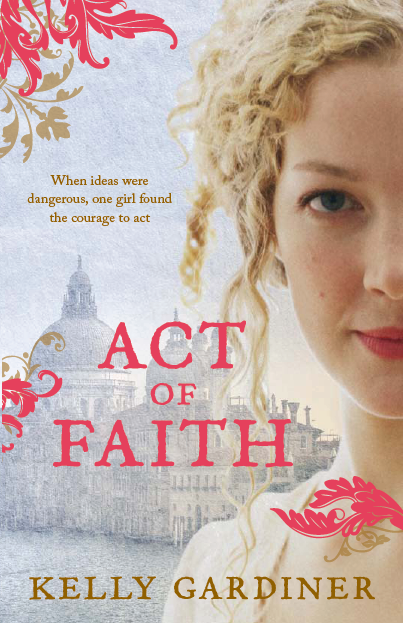
Here ’tis.
Gorgeous design by Jane Waterhouse.
Inching closer to release in July.
HarperCollins is finalising the internal design of Act of Faith and come July, even if I do say so myself, it’s going to look gorgeous.
It has to, really, because it’s a book about books; about printing and publishing and defending beautiful crafted books. Mind you, plenty of publishers wouldn’t put the effort into it for a paperback.
But the designer, Jane Waterhouse, publisher, Lisa Berryman, and I spent hours last Friday choosing 16th century Venetian and Dutch printers’ devices such as colophons and frontispieces from the wondrous Sticht collection of the State Library of Victoria (which is also where I work a few days a week).
These will adorn the front matter and chapter openers. I just can’t tell you how appropriate it is, on so many levels, because you haven’t read the book yet.
But you will. Won’t you?

The Blazing World.
Great title, for a start. Sounds like some new literary fiction, doesn’t it?
But in fact it’s by Margaret Cavendish, Duchess of Newcastle (born 1623, died 1673): infamous Restoration poet, philosopher, playwright, orator and all-round hellhound.

Bless her little cotton toga.
Happy to see Swashbuckler books on the lists for the Premier’s Reading Challenges in NSW and South Australia this year, and never fail to be amazed at what a wonderful idea the PRC is.
In news of other challenges, summer is the time for people to make resolutions and sign up for everything from gyms to book clubs, and book bloggers are no exception.
One of my favourites, to which I challenge you all, is the Australian YA fiction challenge, kicked off by Irresistible reads and Inkcrush. The idea is that you simply read 12 local YA books this calendar year, and post reviews: you sign up so everyone else can read your reviews (and vice versa) even if they’re on Good Reads or the like, rather than a blog.
And you get to wear the badge of pride:

I haven’t decided on my books yet, but titles by both Simmone Howell and Margot Lanagan are in the pile already. And I need a copy of Stephen Herrick’s latest.
I doubt very much that any vampire/angel/unicorn books will be on my list. Mind you, I’m not averse to a decent fantasy novel, especially if there’s lots of sword-fighting (unless it involves several chapters of crossing plains and mountains on horseback and eating herb-laden stew – which, by the way, fantasy writers, is a stupid thing to cook on the road unless you have a pressure cooker – or Esky).
In fact, I’m not normally averse to a decent vampire/demon novel either but I am so sick of standing in the YA section of a bookshop staring at nothing but black and red covers, and now just want it to be over.
Dragons? Any time.
Your good old-fashioned vampire-killer? Sure.
Smart, strong, sexy vampires? Depends.
Magic? You bet.
Evil trickster demons (so long as they aren’t too scary)? All good.
Total vampire epidemic? Done. Next?
Proofreading’s all done on Act of Faith.
Those sharp eyes at HarperCollins spotted a few howlers, thank God. That’s what happens when you chop and change, which you inevitably do. You lose track of whether you are just before dawn or just after dawn and make your characters do a bit of time travel – not a good thing when it’s not science fiction or fantasy. Or you move a sentence and then find it swinging in the breeze, alone and without meaning. Anyway, I hope we caught them all.
That’s what editing’s for.
I love being edited. As someone who is also in the business of publishing other people’s content (albeit online), and often trains people to write for the web, I’m always astonished when people say “Don’t change a word”. Meaning, “I don’t want my pearl-like prose to be touched by some talentless hack”. Don’t you mess with my text. You’ll ruin it.
Madness.
This book has been well edited and I’m very pleased with both the process and the result. Other people see things you simply cannot see – you stop seeing – especially words or phrases you use too often. Other people ask sensible questions like “Did you mean for that to happen?”. It all goes to make the reading experience as smooth as possible. Don’t you hate it when you’re caught up in an adventure or an argument and your mind trips over a typo or a logical gap?
Of course, we all make mistakes and sometimes editors do too. Have you ever seen those websites where people dissect in minute detail any bloopers in the Harry Potter books? Well, life’s too short to spend time documenting them, but they are all good fun – just the other day I was reading Deathly Hallows and was stopped yet again by the fact that Dean has no father on one page and parents a few chapters later. It’s easy enough to do, especially with that many characters and details.No doubt there will be something, even with all this wonderful editing, in Act of Faith. I will find it the day after it comes back from the printers.
But never you mind. Which is one of those phrases I used far too often in it.
Sneak preview of the new book: opening paras. All typeset and loverly. Though you can’t tell that from here – sorry. But anyway…
I wondered briefly if I should take Byron to read in Byron Bay. Settled instead on Christos.
Now wondering whether one should take one’s e-reader to the beach. Paperbacks really do seem somehow more beachy.
So as usual the suitcase contains five books plus I have something silly to read on the plane – plus the e-reader. Luggage no lighter than normal. But I do have more than a hundred books to choose from when I get to the usual day two “I don’t feel like reading any of these” phase.
Love this rant from Rachel over at Forever Young Adult:
Important Literary Journals and Established Intellectual News Sources say I should be ashamed of my reading habits. I’m the reason the publishing world is in such a state, me and my crummy stupid YA books, and it has nothing to do with shitty, self-important authors who are working out their issues in their “plots” rather than with a therapist, because the book isn’t actually a book – it’s the author dealing with the fact that he (and Important Adult Literary authors are almost always men) didn’t win the box car derby when he was nine, and that pain has haunted him for his entire life!
What she said.
And also:
Why the pages and pages of review inches and breathless feature articles for books only ever read to the end by twelve geeks, and virtually none allocated to books read endlessly and adored by thousands of young people?
Anything that smacks of self-importance never even gets opened in this house. So authors, choose your covers and promo blurbs very carefully. Because sometimes we do judge a book by its cover.
Martin Amis has a lot to answer for.

 Kelly Gardiner