Happily ever after

On a recent school visit, the teachers asked me to talk a bit about book reviews. Good timing, because I’ve been thinking a lot lately about the way the reviewing world has changed with so many peer-to-peer recommendation sites and a gazillion book blogs.
I love book blogs: this started out as one, in a way, many years ago. There are reviewers on blogs who are so perceptive about books, they astonish me; some who write beautifully; others who may do so one day, or who write perfectly good thoughtful pieces; others who write as fans – especially in genre – and unashamedly so.
Good on ’em all, I say.
Sites such as Good Reads, Library Thing and inside a dog* make it possible for all of us to share our thoughts on books we’ve read as, increasingly, do online library catalogues and book stores.
There are dangers, sure, and the occasional scandal, but the more the merrier.
Communities of book lovers, talking about books. What could possibly go wrong?
Well, nothing much, really.
But there is one thing I’ve noticed over and over again in discussions about books on Good Reads and facebook and various blogs: people really hate it when the book doesn’t turn out how they expect. It makes them furious.
They equate this with failure – the plot doesn’t unfold the way they imagined therefore the book sucks. And they will often take it out on the author, either through reviews, or more directly in a chat or forum, in a tone that can make your hair curl right up and slide off your head.
I’ve never been in that position myself but I hate to think what it does to an author.
Let’s take a famous example: the death of the beloved Dumbledore at the end of Harry Potter and the Half-Blood Prince.

The world was shocked. The death of “a major character” had been foreshadowed by JK Rowling prior to the book’s release and it was even in all the media, but Dumbledore’s death led to an outcry. Readers believed he wasn’t really dead, and would reappear like Gandalf (of course he does, but he’s still dead). As was usual in the Potterverse, complex theories were developed to explain it, dead or alive, and the discussion continues to this day.
But Rowling as the author was always quite clear, and why wouldn’t she be? Apart from the fact that it’s her book world and she can do whatever she likes, there were myriad plot twists wrapped around the death and, most critical, Harry’s character development and quest (and Hermione’s too)  required it.
That’s not how many fans saw it: they saw it as a betrayal, as a failure of the logic they had established for themselves, as a mistake.
They have invested so much in the story – what a wonderful thing! But what else is going on there? We all love to have a theory about what will happen next. Part of the fun of online discussion of books, film and TV is that very element.
I reckon part of it, too, is the expectation that there will be happy endings. That there will be romance, and everyone will live happily ever after.
Sometimes that does happen. In life, and in art. But other things happen too – people disconnect from one another accidentally, or never connect; they argue about stupid things; they annoy you; they get scared when they should be brave; they falter and bicker and fall out of love and die. 
I remember well the shriek that went around the cinema when I was a kid watching Doctor Zhivago at the Anglesea Luxury Cinema and Lara DIDN’T TURN AROUND AND OMAR SHARIF WAS RUNNING AND THEN HE CLUTCHED HIS CHEST AND OH MY GOD AND SHE NEVER KNEW!
I nearly spat my Marella Jube into the hair of the person in front.

So if you feel betrayed by an author or a film-maker when that happens in your favourite book or series, don’t take it out on them or the work they’ve created.
What it means is that they have created a world so engaging that we, as readers, are lost in it. We are annoyed because the author wants us to be annoyed, upset because that person we loved is gone and we just don’t know what will happen next.
And that’s a good thing. Right?


*Disclosure: I work with inside a dog as part of my day job, but these comments are my own.

Voices

I’ve been hearing a lot of voices lately, but that was the plan. Part of my PhD project is about the quest (or lack thereof) for authenticity in voices in historical fiction, and now I can’t read anything without seeing through that lens. It’s a bit like when you’re going to get a new car or a new dog, and suddenly the world is filled with that model or that breed. Except this will last for years. And is, thankfully, rather more interesting than ten year-old station wagons.

So here are some initial thoughts on a few voices I’ve heard recently.

Bethia Mayfield is the narrator of Geraldine Brooks’ Caleb’s Crossing. Brooks can enable her readers to hear a voice from the past with sublime felicity: her March is a tricky and unsympathetic narrator whose weakness and selfishness are difficult to bear but a joy to read. Bethia, on the other hand, is the opposite. the character is engaging, but her voice – I am very sorry to say – is uneven. I heard Brooks speak about the book recently, and she mentioned that she makes great use of the Oxford Historical Thesaurus. It shows*. The reader is happily meandering around the island with Bethia when we all trip over a word, and then another, which seem to be perfectly accurate in a historical sense but somehow out of time – out of tune – with all of Bethia’s/Brooks’ other words.

It’s a very very tricky business, maintaining a voice that is palatable to the modern ear but somehow historically accurate – what Sarah Waters describes as “right enough – for us”. Brooks almost always gets it right. Just not this time. Not quite.

In Room, Emma Donoghue’s narrator is five year-old Jack, who lives in a small room with his Ma and that’s the only world he knows. Hard to imagine a more difficult task for a writer – a credible five year-old voice, but also one whose world is so confined he simply doesn’t realise, at the start of the book, that the things he sees on the television are real – and yet convey the entire action of a book, including some genuinely thrilling action – in that voice and world view.

But Donoghue manages it, beautifully. There may be the odd word that seems out of place, one or two concepts that Jack couldn’t possibly know but it doesn’t matter; it doesn’t throw you out of the story. Anyway, as Jack says, “I know all the words”.

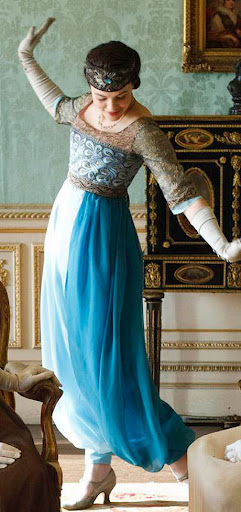
Finally, a TV series: Downton Abbey.

I love it. I do. But please: there is no way on earth that upstairs and downstairs ever collided and colluded so often and so intimately. After the Great War – perhaps. As people’s lives were shattered by grief and missing, and as the men and women at the many Fronts discovered they could be friends or enemies across class and that death really didn’t distinguish; then the social – if not economic – barriers in British society began to crumble. Or in a crisis, such as a corpse in your bedroom, yes, one might feel a trusted maid is the only place to turn.

Sybil: can’t touch this

But it really does reek of narrative reshaping history for upstairs characters to confide in the servants, for maids to offer unsolicited personal advice, for there to be such informality and idle chatter in the house of an earl. An earl! Not a minor baronetcy, but one of the great titles in the kingdom. Perhaps I wouldn’t mind the inaccuracy it it managed to be consistent, but it isn’t. Some of the voices and relationships are consistent and some aren’t. I don’t mind the lovely daredevil Sybil being too egalitarian, but other characters on both sides waver in and out.

Yes, I am one of those people who shouts at the television or scoffs in the cinema at blatant rewriting of history. Don’t get me started on Shekhar Kapur’s versions of Elizabeth I, for example.

As if!

And if I huff “As if!” several times in one viewing, we are in trouble.

I’m afraid there have been many “As ifs” during the otherwise winning Downton Abbey, though it won’t stop me watching it.

* [Later: that sounds more brutal than I meant it to. It’s a terrific story.]

Challenges

Happy to see Swashbuckler books on the lists for the Premier’s Reading Challenges in NSW and South Australia this year, and never fail to be amazed at what a wonderful idea the PRC is.

In news of other challenges, summer is the time for people to make resolutions and sign up for everything from gyms to book clubs, and book bloggers are no exception.

One of my favourites, to which I challenge you all, is the Australian YA fiction challenge, kicked off by Irresistible reads and Inkcrush. The idea is that you simply read 12 local YA books this calendar year, and post reviews: you sign up so everyone else can read your reviews (and vice versa) even if they’re on Good Reads or the like, rather than a blog.

And you get to wear the badge of pride:

I haven’t decided on my books yet, but titles by both Simmone Howell and Margot Lanagan are in the pile already. And I need a copy of Stephen Herrick’s latest.

I doubt very much that any vampire/angel/unicorn books will be on my list. Mind you, I’m not averse to a decent fantasy novel, especially if there’s lots of sword-fighting (unless it involves several chapters of crossing plains and mountains on horseback and eating herb-laden stew – which, by the way, fantasy writers, is a stupid thing to cook on the road unless you have a pressure cooker – or Esky).

In fact, I’m not normally averse to a decent vampire/demon novel either but I am so sick of standing in the YA section of a bookshop staring at nothing but black and red covers, and now just want it to be over.

Dragons? Any time.
Your good old-fashioned vampire-killer? Sure.
Smart, strong, sexy vampires? Depends.
Magic? You bet.
Evil trickster demons (so long as they aren’t too scary)? All good.

Total vampire epidemic? Done. Next?

Sandy togs

I wondered briefly if I should take Byron to read in Byron Bay. Settled instead on Christos.

Now wondering whether one should take one’s e-reader to the beach. Paperbacks really do seem somehow more beachy.

So as usual the suitcase contains five books plus I have something silly to read on the plane – plus the e-reader. Luggage no lighter than normal. But I do have more than a hundred books to choose from when I get to the usual day two “I don’t feel like reading any of these” phase.

Ebookish

I got a Kobo for my birthday.
It comes with 100 free ebooks. For the past few days I have been spell-bound by The Count of Monte Cristo which I had, inexplicably, never read.
Good Lord. What a book. No sword-fighting at all (every movie version I’ve seen has a lot of swordfighting; assuming, I guess, that if it’s Dumas there must be swordfighting) but what a lot of plot going on. Dickensian. Dumasian. Is that a word? It should be. Anyway, I gasped aloud a few times and read until midnight last night because I just had to.
So that was a good test of the machine, which helps to regulate your speed because you simply can’t flick randomly forward to find out what happens next (as if anyone would cheat like that – as if anyone here, for example, read the last page of the last Harry Potter book first, just to see if he was alive at the end).
I’m telling myself now that I will read right through the 100 free books in alphabetical order. I don’t know why. I imagine the resolution will only last until I get up to Aesop’s Fables and then I’ll skip onto the letter G. Or W.
But the list does include many books I haven’t read for years and would like to read again (Twain, Somerset Maugham); books I read every year or so when the mood suddenly strikes (Tolstoy, Austen); books I never quite finished but will one day because one should (Gibbons, Nietzsche); books I can live without reading all over again because once was quite enough thank you very much (Dostoevsky – sorry, Marx & Engels); books I’ve always meant to read (Hesse, Sun Tzu, Thoreau); and books that I wouldn’t bother buying but will probably quite happily read on the train (Jack London, Conan Doyle). In many cases, I already have a real copy, but that’s neither here nor there.
Perhaps more importantly, I can download books that have been out of print for decades, for research purposes. I do that now, of course, from Gutenberg Project or wherever, but I don’t tend to read them as books on my laptop. I search or scan through, looking for key phrases or information.
The Kobo means I can turn the pages, sitting in bed or on the way to work, and really read. The pages look just like ink on paper. Not backlit so no eye strain unless you read for days on end. Which is possible, just the same as ink and paper.
And it doesn’t weigh nearly as much as the last Harry Potter.

Researching history

Many people have been asking me how I researched the historical events on which the three Swashbuckler books are based. What did I do? Well…
1. Immersion
Read novels set in the period. In my case I had already read lots of inspiring nautical adventures such as Patrick O’Brian and CS Forester, but I have read many more since I started the research.
I also had to read all the older and current maritime novels and adventures aimed at children, even if they’re bad: firstly to make sure I wasn’t replicating anything, and secondly to get the hang of the vocabulary and feel of the reading age (9 – 12).
Read history texts until my eyes fell out. Looked at maps, original (or facsimile) manuscripts, engravings, paintings, newspapers and pamphlets – anything. Read other stuff – tangential but interesting histories – because you never know what you might find. I didn’t know about the uprising against the French invasion of Malta when I first started writing book one: I just stumbled across it, and found it so fascinating that it became central to the plot of the trilogy.
2. Detail
Once the narrative and the sense of time and place is clear, there’s an awful lot of referencing, fact-checking and map-staring that has to happen. This can be particularly difficult if you’re stupid enough to set three books on the other side of the world, and live in a city without a vast collection of references on Malta. The internet helps a great deal, of course, and through it I found brainy people in Malta who could answer dumb questions for me.
But the web can also mislead. Many websites (like my own) are written by enthusiastic amateur historians – even Wikipedia. This is a great and wonderful thing, unless you’re relying on them for absolute accuracy. They will sometimes be wrong. So will the professionals, even in books. I read about four different locations for the church in Mdina where the uprising took place, for example, some not even in Mdina at all. I couldn’t be sure until I stood outside it.
3. Tracking
I keep a spreadsheet of real life action tracked alongside fictional action, which includes things like seasonal changes (which wind will be prevailing, for example) and actual events. Sometimes I needed to track the action and characters hour by hour – other times it’s week by week. This is particularly important in books two and three where the characters get more caught up in real life events on Malta, as well as lots of fictional events.
I didn’t keep proper records of where I’d found certain items of information (I got bored with keeping card files, which is what I usually do) and as a result drove myself completely mad looking up things all over again.
4. Stand there
I didn’t feel that everything was right until I could stand in the limestone dust of Malta and feel the sun on the back of my neck and stare at the sea and just – know.
From now on I am always going to base my books somewhere fabulous so I have to go visit. Often.
5. Check everything again
Redrafting can be as much about checking and refining information as it is about language and character. You end up taking out a lot of those historical details that seemed so critical at the beginning, and I spent a lot of time working on how to convey information without it feeling like a history lesson. Looking back, I think I got better at it by halfway through book two.
Even though the narrator, Lily’s, voice is really rather modern, I tried to check the etymology of every phrase and significant word to avoid glaring anachronism. I double and triple-checked maps, dates, language, clothing, food, ship details – everything. I hope. No doubt there’s something stupid stuck in there somewhere.
6. Editing
This is how editing works. The manuscript is edited, then I check it, then it is finalised by the in-house editor, and then typeset (beautifully) and I check the pages again, then they are proof-read, then the editor looks through them one last time.
In the early stages, I can still fix things that I’ve realised aren’t quite right, say if I’ve woken up in the middle of the night in a cold sweat because I’m unable to remember which arm Nelson lost. Editors can ask clever questions like “Why is the candle burning when it’s broad daylight?” (Answer: Because the author is an idiot).
I’m a (magazine) editor by trade, so I do this stuff for a living and my work ought to be flawless – and there’s still a bloody typo on page 89. No, don’t look.

Sandra Gulland, who wrote a successful trilogy on Josephine B, has a great website, and she records some of her less reliable research methods, all of which I also did:

I spent too much money on books;
I collected tacky memorabilia;
I travelled long distances to go to museum shows;
I grew teary-eyed on the cobblestones of Paris…