This is where I write.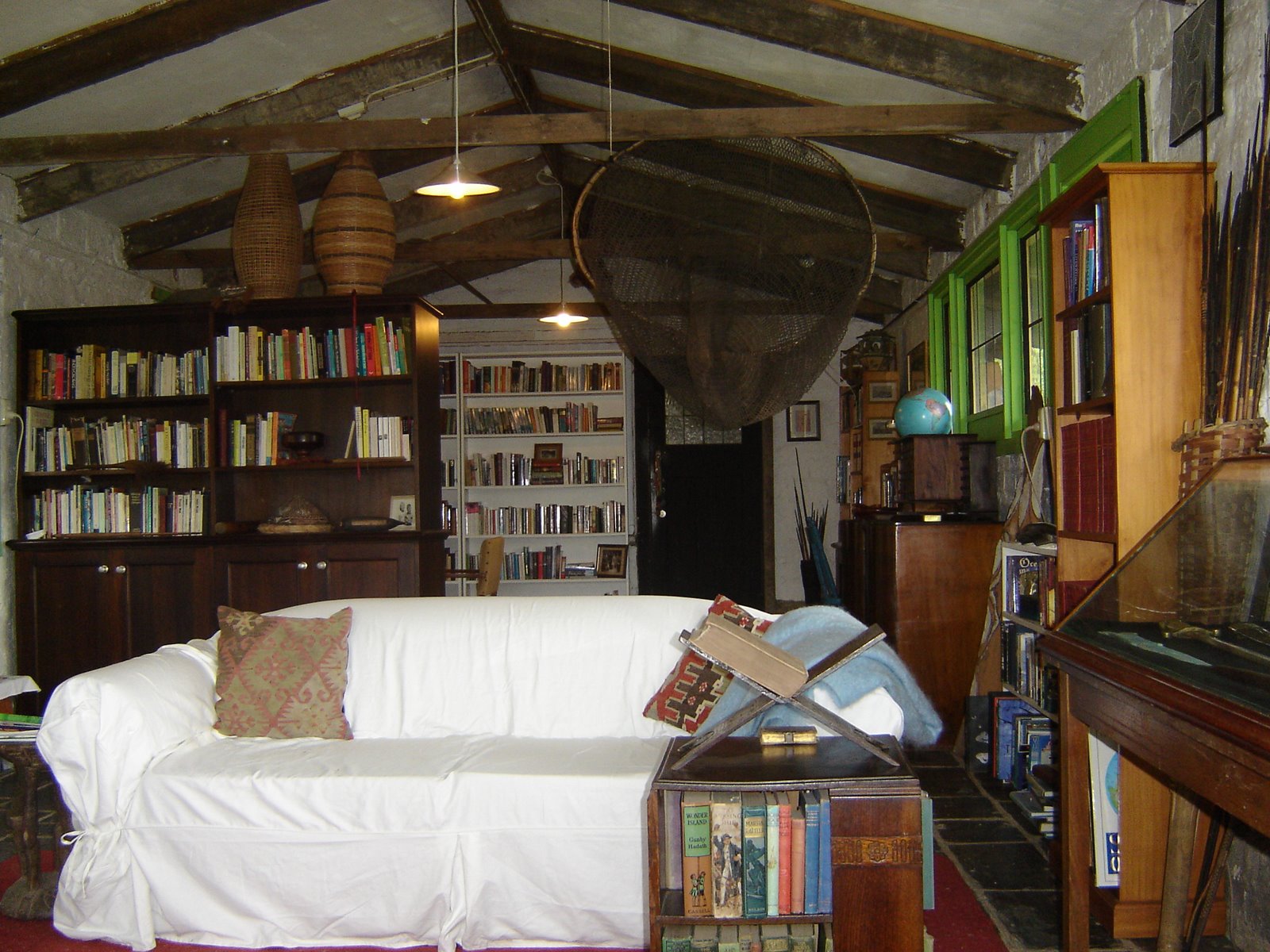
Well, to be precise, this is where I should be writing.
This is where I write.
Well, to be precise, this is where I should be writing.
It’s raining.
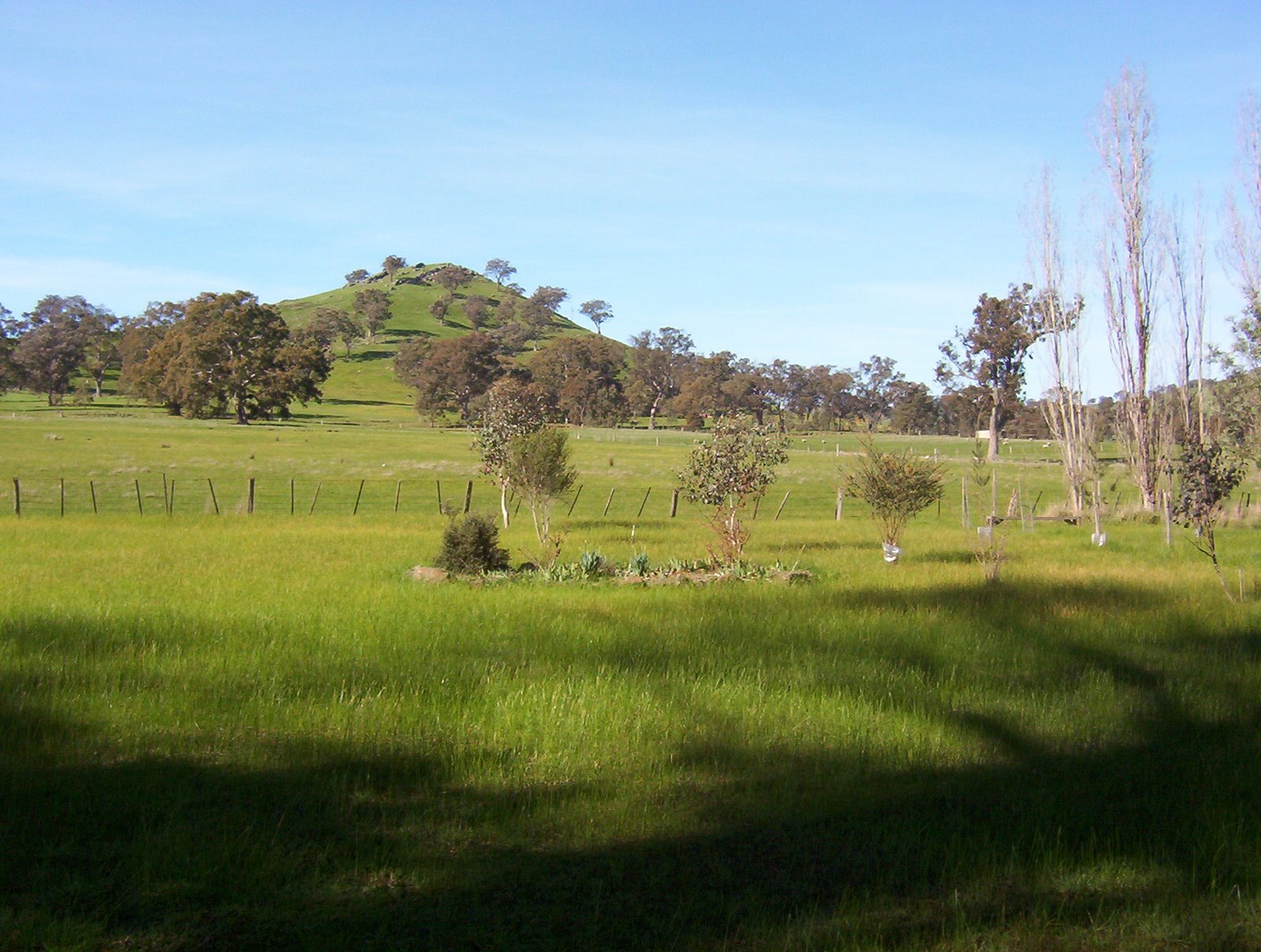
Right into our new water tank, connected in the nick of time yesterday. Not much, granted, but if it does this for a couple of days, as predicted, I’ll be happy.
I had the feeling (and it’s only October) that it was never going to rain again.
So things I have learned this winter and spring:
• There is no such thing as a rabbit-proof plant*, with the possible exception of bearded iris**.
• Slaters like beer, just like snails, and die happy. Sadly, they also like seedlings.
• Very small kittens can take on very large rabbits and win.
• If you buy a bunch of spring onions at the supermarket, even if they’ve been in the fridge for a while, and stick the leftover ones in the garden, they will just keep growing.
• Parsley, even when not moved as seedlings, can go from baby leaves to bolt in about a week. Who wants to molly-coddle their parsley? (On the other hand, I do have a self-sown one flourishing in the driveway gravel – gardening is so random sometimes.) And ringtail possums love it.
• Raspberries will flower in the first year.
• Pear trees will not (and not much in the following year, for that matter, but I do have one centimetre-long Buerre Boscs so far this season). Cross-pollinators don’t always flower at the same time, but it somehow worked anyway.
• Roses are actually tough as old boots.
• Broccoli can be too – but when being eaten, not growing.
• Never think “Those cherries are coming along nicely – I’ll put the bird netting on at the weekend”. Your tree will be stripped by then.
• Sugar cane mulch actually stops water getting through to the soil.
Pleasant surprises• All the alliums seem ridiculously happy in my veggie patch: red onions, garlic, leeks, chives, garlic chives, ornamentals – all booming.
• Broad beans are going nuts, in spite of being badly mauled by slaters.
• Broccolini, as opposed to broccoli, grows like the clappers and tastes sublime, though it can be very hard to find in the first place.
• The rhubarb inherited from my dear late great-uncle (who could grow anything) divided into three crowns and thrives in his honour.
• Waving poppy seed heads around in the air one year creates poppy heaven the next (only I think they might be opium, so too many more and it’ll look like Afghanistan).
And I know it shouldn’t really be a surprise, but you’ve never tasted food as good as food you’ve grown and picked just before you eat it.
* Allegedly rabbit-proof plants include rosemary, grevillea, lavender, correa, borage, comfrey and succulents of all sorts. I’m a witness to the fact that rabbits will eat any or all of these, even when there is plenty of other green stuff around. Correas are simply pudding.
** Irises, however, are not sheep-proof, as I have learned to my cost in my country garden, but that may not concern too many gardeners.
I’m not reading anything except media at present.
I’ve tried – I have about five books on the go but have stopped even bothering carrying them around with me.
In the evenings I do crosswords. I’ve never done them before, always been hopeless at Scrabble, because my word-searching brain cells seem to operate in the opposite way.
But I’m worried about my memory fading, and apparently having a hard job and reading a lot and writing in patches isn’t enough to save you. You have to do groping for facts kind of thinking. SO I do crosswords, although I find I am far too literal for many of the clues.
If I can’t work it out, I check the answers the next day, and invariably find that the answer has, in my view, nothing to do with the clue.
Seriously: is “hopeless” another word for “incurable”? Not in my book.
How exactly are you supposed to know when you’re supposed to be literal and when you’re supposed to be lateral?
It must just be a crossword world kind thing. Takes some getting used to.
But I can’t read about Captain Cook or the collection of Aboriginal artefacts post-contact at present because I’m too obsessed with Sarah Palin. In a morbid, car-crash kind of way.
I tear open the paper every morning to read about her latest debacle, saddened as the campaign progresses that she is now so tightly managed that we will never again have the pleasure of seeing her interviewed.
I couldn’t tear myself away from the VP debate, hoping for something more dramatic than a refusal to answer any question she didn’t understand. Sadly, our hopes were dashed.
Loved Slate’s conversion of some of her more mind-numbing statements into poetry, and the attempt to graph her sentences against basic logic, let alone grammar. Laugh? I nearly …
The whole thing has been hilarious from start to (almost) finish, and yet deeply sobering when I remember, as I often do, that these are the people who elected George W Bush – twice. Hanging chads aside.
All the media comment at the time of her nomination focused on the ways in which she would bring the evangelical vote back to the Republicans. No-one seemed to acknowledge that it was really a play for that slice of voters that both campaigns and media like to pretend isn’t really there: the rednecks. When they talk about race, when they talk about class (always the middle class, as if it’s not those below middle who are really badly suffering – talking about the poor or the working class, after all, might be construed as socialist), when they talk about the Bible Belt or the South, what they are really after and/or fear are those terrifying trespasser-shooting drill-baby-drill tabaccy-dribblers who don’t give a damn about anything that happened since the end of the Civil War and the fight against the Navaho. She portrays that as the real America, is if most people in the country are still out on the frontier. They aren’t. They are in Chicago and New York and LA and Houston and all those thousands of huge cities. They are not rednecks. They are urban poor, urban middle-class, urban voters, leading urban lives and working in factories and offices and construction and even – God help ’em – in the finance sector. Even the vast majority of people in rural areas are not rednecks.
Why they all think that a few ignorant losers are somehow more genuinely American than the bulk of the population is beyond me. It’s not an elephant in the room, it’s a herd of bison – that’s what the rest of the world fears, and it’s clearly what Obama fears, why McCain chose Palin and why he possibly now regrets it – and that’s why Palin is scary.
The more certain it becomes that Palin won’t be elected, the more optimistic my view of human nature. But I am not breathing easily yet.
I’m not one of those people who sees Obama as a Messiah. I don’t really believe he’s any less self-obsessed or cynical than Hillary or McCain, just a little younger so he has a bit more cynicism to learn.
But I have been around politics enough and from a tender age to know that nobody can put themselves forward without a high degree of both political nous that comes with learning the hard and conniving way, and a level of narcissism.
That’s a given.
He won’t change Washington irrevocably and nor does he even seek to change that US-style God-given world sheriff with a Bible in one hand thing that leaves the rest of the world shaking its collective head. I’m truly amazed that the presidential debate actually accepts that it’s somehow evil and “socialist” to talk about spreading the wealth around, or continuing the profoundly unhealthy and deeply weird role of insurance companies in basic health care.
But never mind.
Within that context, he shines.
So Sarah Palin, and the twit who decided she was a good get for VP, will hopefully be little more than a cheap joke in around 20 days’ time.
On the flipside, we have all become Tina Fey fans, which has to be a good thing.
Then we can all get back to our crosswords and books.


I am making a garden in a building site.
True, it’s a 40 year-old building site, but that adds an extra layer of both challenge and excitement. There are sections of bush, with a thin layer of quite nice topsoil on top of a thick layer of clay and then solid but easily shattered rock. That is, it’s solid if you try to dig it, but shatters into a thousand fragments if you try to use it for anything sensible like garden bed edges.
But the area around the house is a 1960s building site and rubbish tip. The people who built the house (three mudbrick buildings, very gorgeous) made the bricks here themselves, having carved three house sites out of the clay and rock.
I don’t know how they made the bricks. The clay is full of shards of riverstone, which they sieved and then obviously piffed over the side of the house sites. Along with bottles and bits of failed pottery and car batteries and sardine tins and for some inexplicable reason plastic ivy leaves which I find, by the handful, every week.
So I am either gardening on steep banks littered with shards and old rubbish, or in solid clay. In the middle of my vegie patch there is a car axle sticking up out of the dirt. I don’t know why. But it’s concreted in, so it’s staying there.
Gardening here is what we might call a Valuable Learning Experience. I am now, for example, possibly the world’s greatest forensic digger-upperer of old beer bottles (besides professional archaeologists, of course). There was a fashion in the ’60s for including beer bottles in mudbricks. Our cottage has a wall made of sherry flagons, which makes you want to fire up the fondue set. There are bottle buried everywhere.
Today I was digging a hole to move the olive tree, which is in the shade and bent almost horizontal by the force of a pink hebe.
Never heard of such a thing as a venerable olive tree threatened by a wee sweet hebe? You’ve never seen this hebe. It’s a Monster Hebe. It’s the King Kong of hebes. It’s the size of an elephant and I’m not exaggerating. Yes, I know they are usually about a metre high at most. This is the size of the MCG. And pink. Of course. I hate pink. This hebe is like a Barbara Cartland Mardi Gras Float.
Anyway, so the olive tree must be rescued. I dig a hole for it. For once, I am not digging in an area that is stony, so it must be solid clay. Though I have dug it into a raised bed a while back so it’s not too solid. Clink. Not one but two old beer bottles in one hole (you have to extricate them very carefully so they don’t shatter, and this is a skill I have had to develop over the last year).
Also in the soon-to-be-a-hole is some black plastic. And the cuff off a once-white shirt. That’s all in the process of digging just one hole.
The ground full of rocks is worse. Some of them are just the size of a matchbox, but enough to turn the spade blade. There may be dozens in a square foot of earth. And needless to say I also piff them all elsewhere, which I will no doubt live to regret.
Other rocks are the size of a dog. Mind you, once you’ve got those buggers out, you have a mighty decent-sized planting hole. But no soil to backfill.
Yesterday I was planting correas on one of the banks and in the end resorted to scraping a hole in the stones, filling it with compost and planting into it. The Derek Jarman method.
If I’d thought about it properly, I could have made a gravel garden like Beth Chatto. People keep telling me to turn it into a rock garden but I can’t stand those Carefully Managed Rocky Bank Gardens. This garden just happens to have rocks, that’s all. And stones. And beer bottles lurking beneath the surface.
Come to think of it, Derek Jarman probably would have quite liked that. He’d probably be perfectly happy about the car axle. But I hate to think what he’d make of the hebe.

Children’s author Enid Blyton has been named the best-loved writer in new Costa Book Awards poll to discover the UK’s “most cherished” writers.
Blyton, who wrote more than 700 stories over a 40-year career (The Famous Five, Secret Seven, Malory Towers, Noddy), and has sold over 600 million books in total around the world, came out top and continues to be a phenomenally popular author. Despite her death in 1968, around eight million books are still sold worldwide every year, including more than a million Famous Five tales.
Fellow children’s author Roald Dahl came second in the poll, thanks to gems such as James and the Giant Peach, The Witches and Matilda.
So, the top 50 best-loved authors in the UK are:
1. Enid Blyton
2. Roald Dahl
3. J.K. Rowling
4. Jane Austen
5. William Shakespeare
6. Charles Dickens
7. J.R.R. Tolkien
8. Agatha Christie
9. Stephen King
10. Beatrix Potter
(Read the full list of 50 here.)
C.S. Lewis came in at number 11.
If we draw a kindly veil over the fact that Dan Brown came in between Maeve Binchy and Emily Bronte, there are a few lessons here:
1. The books we love as children – the books that introduce us to reading as a mania – stay with us forever.
2. That remains true even when those books don’t appeal to our adult reader eyes (and indeed may not bear too much close scrutiny on re-reading).
3. Some recent polls about books seem to have been influenced by recent movie releases or big-splash book launches – I’d suggest this list is not, perhaps because it’s focused on authors.
4. The list of works here can be divided into those driven by plot or character (I’d suggest only Shakespeare, Austen and Dickens balance both). 20th century plot-lovers seem to have the numbers.
Lucy Mangan in The Guardian explores the allure of Blyton:
I myself can barely bring myself to talk about my Enid Blyton years. Who wants to let daylight in upon magic?
…For hundreds of thousands of us, Blyton was the wedge that cracked open the pleasure-filled world of reading and allowed us in. Our rational adult sides reject and mock Kirrin Island and all the adventures played out there; our inner children remember it rightly, and gratefully, as the promontory from which we caught our first glimpse of the promised land.
As George would say, ripping!

Random House Children’s Books in the UK has yet to make a decision when it will reprint Jacqueline Wilson’s My Sister Jodie after deciding to remove an offensive word from future reprints of the book.
The publisher said it had received three complaints over the use of the word “twat” in the title aimed at children aged 10 and over. It is to be replaced by the word “twit”. It has sold more than 150,000 copies of the book since publication in March.
In a statement, following the decision to remove the offensive word, the publisher said: “We are very sorry if anyone is offended by the language used in Jacqueline Wilson’s My Sister Jodie.”
As someone who ensures a fair sprinkling of piratical swearing when appropriate in books for young readers, I feel fairly sure that if young Dame Jacky says “twat” she means twat, just like every kid reading her books.
Next they’ll be replacing the very British “bollocks!” with “dash it!”.
Then to avoid offending three of her literally millions of readers (or more probably their parents), we can all go back to being Enid Blyton.
Dash it all.

I live in a city of literature.
It’s official.
I live in the best part of town, too.
Here…

Back in Auckland. Flew in over the sea and stared fondly at what I took to be Waiheke Island, my old home. The plane banked and I realised I was looking in completely the wrong direction and we were coming in from the south. That infallible geographical sense of mine.
So I’m in a town I know and love – or think I know, as it’s already, in 18 months, changed perceptibly, as cities do. There are still roadworks everywhere, as indeed there always will be, still not appearing to make any difference to the hellish traffic. There is torrential rain, followed by sun, followed by more rain.
But there is no Mahinarangi Tocker. I’ve been sleeping in her empty room, pulling weeds out of her garden, talking about her with those who miss her the most, surrounded by her pictures – her smile – on the walls, on the fridge.
There’s a theory she might have come back as a tui. There were three watching me closely in the garden this afternoon. I have my suspicions. Fly high, lovey.

Very odd. I had a gardening blog. But it’s vanished.
Granted, I had neglected it, just like this one, for a month or so, due to technical problems with both my brain and my laptop/modem/router (but I won’t start on that).
Then last night I went to post on the gardening blog and it’s gone.
Not just the blog, but the entire website of which it was part.
Vapourised.
Now, this is a site which I helped set up in a previous life (and only about 2 years ago) in New Zealand, where I was the editor of the magazine – the site was the online version.
New Zealand Lifestyle Block – NZ’s “premier magazine for the small farmer”. It was fun. Each month I got to choose between a cute piglet and a cute lamb for the cover star, instead of grinning humans who are, frankly, deeply boring month after month.
Yet in spite of working there for years, editing the damn thing, and blogging for them (by request) for another year I got no hint at all that this was happening.
I heard a rumour last month that the mag had been sold by ACP. I can’t see any press releases to that effect on the ACP website, nor indeed any sign that the company ever founded and published the magazine.
The URL redirects to a completely different site/blog which has no mention of the previous site, and no advice to the painstakingly developed online community of bloggers, image posters or readers that it is gone.
No archive. No sign of life at all.
Maybe I dreamed it. Maybe any moment Bobby will step out of the shower and I’ll realise it never happened.
Anyway it’s all gone, including those precisely crafted posts of mine (needless to say I don’t have a copy), and that precipitates what is probably a necessary change to this blog.
I’m changing the focus of this blog. This might help (technical problems aside) with my block about blogging recently – having too many to sustain just makes me feel grumpy and not want to go near any of them. So now this blog will cover all of it: writing, reading, thinking, collecting, technology, gardening and other random stuff.
Once I’ve bashed the bejesus out of the modem and router, or whatever drastic action is required at this desperate stage, I might even be able to post properly.

 Kelly Gardiner