On the other hand

Storylines (the Children’s Literature Foundation of New Zealand) has announced this year’s list of Notable New Zealand Books.
Ten books in four categories have been selected, from more than 120 books published during 2005.
Rosemary Tisdall, chair of Storylines, said “creating the list was an exciting challenge as the overall quality of New Zealand children’s writing and illustrating continues to improve, except in picture books where too many were quite ordinary, with no real attention to quality writing, illustration or design.”
The selectors “were impressed by the increasingly varied range of topics, styles and genres coming through from New Zealand publishers.”
Given that many of the Notable Books are on the list of New Zealand Post Book Awards for children’s writing announced last week, it’s interesting that one group of judges believes the “days of political correctness are over”, while the other panel recognises that the already well-endowed field “continues to improve.”
Surely there’s something else going on here. This year, the NZ Post Book Awards proclaimed: “Some people might be concerned with the content and language used in some of the novels, but it seems writers and publishers are really beginning to ask what, exactly, our young people want to read about.”
It made me wonder what they said last year…
The 2005 young adult fiction winner was Malcolm and Juliet by Bernard Beckett and the judges’ comment at the time was:
Malcolm and Juliet is the winner because of its startling originality, breathtaking turn of phrase and diamond sharp wit. The frank depiction of teenage sex might be a little confronting for parents, which means it’s probably right on the money for its target audience.”
The wonderful Clubs was the outright winner last year, lauded by the judges as “a new way to tell stories, new ways to use pictures and new ways to mix the words and pictures together”.
So this latest crop isn’t a breakthrough at all. I can only assume that this year (and last) the NZ Post judges are trying to encourage good behaviour, by which they seem to mean realism and tackling contemporary issues.
But in doing so they run the risk firstly of making it seem as if they are criticising authors such as David Hill, Kate De Goldi and many others who have been writing smart and relevant contemporary work for years. It’s unfair to suggest they haven’t previously asked themselves “what, exactly, our young people want to read about”.
Secondly, they are in danger of dismissing books that are not about or set in contemporary NZ, or which are in other genres – such as Margaret Mahy’s fantasies.
I’m not sure that they actually meant to do either of those things, but I do worry about this general idea that the only fiction that kids ought to read is stuff that is about the modern world that they know, realistically described.
There are many ways of looking at, living in, describing, understanding and reading about the world.
There’s nothing wrong with pure escapism, either, especially if your little corner of contemporary society is too much to bear.
But writers of historical fiction (and fantasy) often make clear – and sometime obtuse – parallels, analogies and insights that can be drawn from writing set in other places, or other times, or perhaps other worlds. You don’t have to hit readers over the head with it, or hector them. But the lessons of history anywhere in the world can be just as compelling, sometimes more so, than the lessons of modern urban Kiwi or Aussie life.
Applied history, if you like.
I’ll write more on that again soon.
In the meantime, here are some of the Notable Books of NZ published last year, with congratulations to all concerned:
JUNIOR FICTION
Janie Olive by Fifi Colston (Scholastic New Zealand)
Through Thick and Thin by Shirley Corlett (Scholastic New Zealand)
Hunter by Joy Cowley (Puffin)
Super Freak by Brian Falkner (Mallinson Rendel)
Stella Star by Brigid Feehan (Scholastic New Zealand)
Sil by Jill Harris (Longacre Press)
The Moa Cave by Des Hunt (HarperCollins Publishers)
Maddigan’s Fantasia by Margaret Mahy (HarperCollins Publishers)
My Story: China town Girl – The Diary of Silvey Chan, Auckland, 1942 by Eva Wong Ng (Scholastic New Zealand)
What about Bo? by Jillian Sullivan (Scholastic New Zealand)

YOUNG ADULT FICTION
Deep Fried by Bernard Beckett and Clare Knighton (Longacre Press)
Sea of Mutiny by Ken Catran (Random House New Zealand)
Talking to Adam by Sarah Ell (Scholastic New Zealand)
Like Wallpaper. New Zealand Short Stories for Teenagers edited by Barbara Else (Random House New Zealand)
Bodies and Soul by David Hill (Scholastic New Zealand)
Running Hot by David Hill (Mallinson Rendel)
With Lots of Love from Georgia by Brigid Lowry (Allen & Unwin)
Kaitangata Twitch by Margaret Mahy (Allen & Unwin)
The Unknown Zone by Phil Smith (Random House New Zealand)
Land of Milk and Honey by William Taylor (HarperCollins Publishers)

Awards silly season

The Herald reported yesterday that:

The finalists in the 10th annual New Zealand Post Book Awards for children’s writing were announced today, with organisers declaring the influence of political correctness on subject and content matter was over.
Judging panel convenor Julie Harper said all the finalists had demonstrated a pride in New Zealand and its heritage, from the natural world to the country’s recent history.
Ms Harper said fellow judges – TV3’s Carol Hirschfeld and writer Graeme Lay – had spent the summer reading books written by New Zealand authors which included tales of cannibalism, Maori land and environmental issues and smart young characters taking on international corporations.
“The age of political correctness is over with our children’s writers becoming more confident in writing about – in particular – issues related to race and Maori land.”
The finalists were selected from more than 120 children’s books published in New Zealand in 2005 and submitted for the awards. The winners will be announced on May 17.

Once more with feeling: “The age of political correctness is over”.
What’s that mean?
That shrinking violets such as Margaret Mahy, Joy Cowley and David Hill have been in previous years too timid to tackle issues affecting young people in New Zealand?
A similar claim from Linda Kelly about “whitewashing” in publishing in a recent NZ Author was greeted with a fiery response by authors such as the redoubtable Tessa Duder, who wrote: “the extravagant, unsubstantiated claims made in this piece could be easily be refuted by any author, publisher, bookseller, librarian or teacher with a working knowledge of just what is being currently published here and elsewhere.”
I’ll have to do some more thinking and talking to understand what’s going on here.
In the meantime, here are the fiction finalists:
Junior fiction
Hunter, by Joy Cowley (Puffin)
Maddigan’s Fantasia, by Margaret Mahy (HarperCollins Publishers)
My Story: Chinatown Girl – The Diary of Silvey Chan, Auckland, 1942, by Eva Wong Ng (Scholastic NZ)
Sil, by Jill Harris (Longacre Press)
Super Freak, by Brian Falkner (Mallinson Rendel)

Young Adult
Deep Fried, by Bernard Beckett and Clare Knighton (Longacre Press)
Kaitangata Twitch, by Margaret Mahy (Allen & Unwin)
Running Hot, by David Hill (Mallinson Rendel)
The Unknown Zone, by Phil Smith (Random House New Zealand)
With Lots of Love from Georgia, by Brigid Lowry (Allen & Unwin)

Pure reading

The truth is that literature, particularly fiction, is not the pure medium we sometimes assume it to be. Response to it is affected by things other than its own intrinsic quality; by a curiosity or lack of it about the people it deals with, their outlook, their way of life.
– Vance Palmer

Historical fiction dilemma #4: Character

Sometimes characters come easily. Other times they slip through your fingers like baitfish, or change imperceptibly through the writing until they become someone completely different. Sometimes they are natural, and the dialogue spills out of them as if they’ve had a few beers after work. Others grind and scratch – usually because I haven’t understood them properly from the first.
Historical characters are all too often caricatures. The women are feisty. The working men are gruff and unshaven. Ship’s captains are either Hornblower without the seasickness or Ahab without his whale. Officials and governors are duffers.
It’s easy to understand how this happens. Sometimes it’s done playfully, or in tribute, or as part of an infexible rule of genre. I’ve done it.
But unconsciously, what we think we know about people of the past is fixed in our minds by our own reading (or even movies) so it feels natural to recreate favourite Austen or Dickens figures. When I think of the French Revolution, what I’m imagining is Carton on the scaffold while Madame Defarge knits, or Hilary Mantel’s tragic Desmoulins – or perhaps even the Scarlet Pimpernel. That’s in spite of having read thousands of pages of non-fiction on the subject.
It also feels natural to imbue them with our own contemporary attitudes. Sometimes this works, especially if it’s done consciously. In Fingersmith Sarah Waters rendered a Dickensian London around a Collins plot topped by a layer of feminist perception – perfectly. In other cases, the characters simply don’t ring true, no matter how meticulously their outfits are described.
Readers expect some post-Freudian, or even post-Flaubertian, depth – and fair enough, too – which results in self-aware characters, living in pre-Freudian fictional worlds.
You won’t get away, nowadays, with, “It was the best of times, it was the worst of times.” Dickens, for all his intricate plotting and forensic detail, was hardly a light touch with the quill.
When, recently, I read Adam Zamoyski’s 1812, I saw Pierre trudging through the snow with the other prisoners of war, and Denisov in every guerilla attack.
James Wood touched on Tolstoy’s genius for creating historical characters and detail in his rather scathing review of John Bayley’s The Power of Delight in the LRB:

“For Tolstoy, Bayley suggests, creation of character was not really a voluntary act, a willed thing; it was something he almost could not help, and his favourite male characters, like Stiva Oblonsky or Pierre Bezukhov, or even, in a way, Napoleon, share with Tolstoy this infectious, involuntary solipsism: they cannot help being themselves. It is the same with Tolstoyan comedy: ‘In general we feel about Tolstoy’s humour that he is not concerned with it himself, and probably rather despises the notion, but that it comes out from under his hand involuntarily when his narrative is at its best.’ This is very subtle, and similar subtlety is brought to bear on Tolstoy’s superlative use of detail. Detail is not lovingly fondled and fetishised as it is in Flaubert or Nabokov or Updike; it is always on the move: ‘At their best, Tolstoy’s details strike us neither as selected for a particular purpose nor accumulated at random, but as a sign of a vast organism in progress, like the multiplicity of wrinkles on a moving elephant’s back.’ At moments like these, Bayley seems to see literature from the inside, as writers themselves do.
Tolstoy, like Chekhov, makes most writers seem forced, hysterical, self-indulgently ‘stylish’.”

Historical fiction dilemma #3: Readership

Aren’t you wearing tweed?

I just remembered the day I decided to be a writer.
Ivan Southall came to visit our school. I’m not sure how old I was, but I must have been in grade 4 or 5, and as far as I was concerned Ivan Southall was a god.
He’d written what I considered to be the greatest book ever published, To The Wild Sky. I loved all my historical favourites, but Ivan Southall’s books like Hills End, Ash Road and The Fox Hole were different. They were Australian. They were about kids in the bush. Hot days, bushfires, floods. They were about me.
If Geoffrey Trease had visited my school I’d have fainted. But Ivan Southall was the local hero, having gone to school in Box Hill, and so I stayed vaguely conscious.
Big events like that never happened at our school. It was just a little primary school, out on what was then the edge of the city, edged with bush. There were bushfire evacuations every so often, and once the Duke of Edinburgh drove past and we all had to stand for hours, waiting by the side of the road, waving our flags at every car in case it was him. When Armstrong landed on the room, they moved the (only) television out into the hallway and we all sat on the cool lino and watched.
So a visiting author was big news. That was also the first time I experienced the terror and thrill of being star-struck. Mr Southall (even now I can’t call him anything else) wore a tweed jacket. Of course he did. He was an author.
So that’s the bit I could be making up. For all I know he was clad in walk shorts and long white socks with sandals, but in my mind he will always be in a tweed jacket. Possibly smoking a pipe. Because, as everyone knows, that’s what authors do. I even did that in about 1980, which just shows you how tragic I am. Even the pipe (it was horrible). But to this day I’m very fond of a good tweed jacket.
I can’t recall a thing he said. I remember him as being rather stern, and extremely tall, and I was too awestruck to ask any questions. Mr Southall wasn’t just an author: he was a decorated air ace, a DFC for God’s sake, a war hero. He became one of Australia’s most decorated children’s authors, winning the Carnegie Medal for Josh in 1971 and the Children’s Book of the Year Award four times. In 2003 he won both the Dromkeen Medal and the Phoenix Award for his work over the years.
But back in 1970 at Antonio Park Primary School something about seeing a real live writer in the flesh (and tweed) made me realise that there were people who just wrote for a job, who lived in houses just like me and drank tea and who, although clearly godlike, were probably quite normal when you got to know them.
I think I got my gorgeous hardback copy of Hills End signed, but I was probably too scared, and it’s in a box somewhere in Melbourne so I can’t check. I’m not very good at getting books signed. Once I stood next to Marina Warner, book in hand, and held my breath for so long I got dizzy, but somehow it just seemed too much to ask the poor woman.
But then again she wasn’t in a tweed jacket.

Greedy Cat and Nickle Nackle get the gongs

Robyn Belton is this year’s winner of New Zealand’s most prestigious award for children’s literature, the Margaret Mahy Medal.
The award is given annually by Storylines (the Children’s Literature Foundation of New Zealand) for “a distinguished contribution to children’s literature and literacy”. Last year’s winner was the lovely David Hill.
Storylines also announced yesterday that much-loved author-illustrator, Lynley Dodd, creator of Hairy Maclary (who happens to be a dead-ringer for my late lamented dog Lil), has won the 2006 Gaelyn Gordon Award for a Much-loved Book for her first book, The Nickle Nackle Tree.
Published in Britain in 1976, the picture book was Dodd’s first after the successful My Cat Likes to Hide in Boxes with writer Eve Sutton (1973), and has remained in print ever since.
The annual award recognises a book unheralded at the time of publication but which has remained in print and proven itself a favourite with readers. Last year’s winner was Tessa Duder’s classic Night Race to Kawau .
In a career spanning more than 30 years, Lynley Dodd has created such well-loved and iconic characters as Hairy Maclary, Slinky Malinky, Schnitzel von Krumm and her latest, Zachary Quack. Her books, admired for the wit and technical mastery of both the verse and pictures, have been regular award winners in New Zealand and are widely published in America, Australia and elsewhere.
Robyn Belton, a graduate of the Canterbury University School of Fine Arts, and now an illustrator and tertiary lecturer (based in Dunedin) has been a leading New Zealand illustrator for more than 20 years.
Her debut work, The Duck in the Gun, an anti-war picture book published in 1984 with text by Joy Cowley, won the Russell Clark Award and was one of 10 children’s books selected for the Hiroshima Peace Museum. But Belton’s most beloved creation is Greedy Cat (also with text by Cowley). I’m particularly fond of her exquisite Bow Down, Shadrach and The Bantam and the Soldier.
Belton will present the customary lecture, given each year as part of the acceptance of the award, at the Storylines annual Margaret Mahy Day, on March 11 in Auckland. The inaugural lecture was presented by Margaret Mahy in 1991. This year is also Margaret Mahy’s 70th birthday, to be celebrated that day with a dinner and a hui for writers and illustrators. I’ll be there, waving a sparkler or some such thing.
The next Storylines Festival of New Zealand’s Children’s Writers and Illustrators in on 11 to 18 June (in cities around NZ). I’ll be there, too.

Historical fiction dilemma # 3: Readership

I don’t suppose you’ve read Peter Raven: Under Fire. It’s an odd book. I read it late last year – and I acknowledge that it’s vaguely in competition to my own, but then again I’ve read more kids’ naval adventure books than most people, so it’s an informed opinion. Under Fire is trying to be both an adventure for boys 10 to 12, and a romance for girls a bit older. It’s going for a balance between Hornblower and Hillary Duff.
Either story might have worked. Trying to do both makes its narrative jump and its pace jerk. One minute you’re in a naval battle, the next a ballroom. I also fear that the young male readers will be turned off by the romance bits.
I can hear it now. “Is this a kissing book?”
Yes and no.
But I can sympathise with the author, Michael Malloy. There are few kids’ adventure books read avidly by both girls and boys. The exceptions include some of the biggest titles in publishing (Harry Potter, Narnia, Deltora), so clearly it’s a balancing act you want to get right, unless you’ve got a very specific readership in mind. Boys won’t read a book with a girl on the cover, or a female protagonist. It’s sad, but there you go.
On the other hand, years ago I knew many women who wouldn’t read books by men (it was the ’80s). “What about War and Peace?” I’d ask. But I did understand. They’d spent a lifetime looking for their lives to be reflected in books – you could be Elizabeth Bennett or Madame Bovary, throwing yourself at Darcy or throwing yourself under a train, and there wasn’t too much in between, or that’s how it seemed. So once they got their hands on books by women like Fay Weldon or Iris Murdoch, or even good old Marge Piercy, they weren’t about to go back to hacks like Hemingway. It was a phase. Perhaps a necessary one. Without it, there’d have been no Virago, no Women’s Press.
It wasn’t just about gender. It was the same for working men – or unemployed men, for that matter – before Lawrence and Wells. It was the same for queers before Genet or Baldwin, for … well, you get the idea.
Can you remember what that was like? To search high and low for a protagonist who sounded like you; who lived, if not your life, at least something vaguely recognisable or felt and thought about the world in a way you understood; to read about someone you could have been or could be or perhaps might once have been?
Now women readers have the luxury of relating to everyone from Bridget Jones to Lily Brett to Jhumpa Lahiri. We can choose to align ourselves with a whole world of characters, navigate through myriad worlds and lives.
So readership has become a very specialised thing. There are no more truths universally acknowledged. There’s Young Adult Chick Lit. Coming-of-Age Westerns. Christian Thrillers. Africana Science Fantasy. Visionary and Metaphysical Fiction.
Each one of these has a market, a readership of varying sizes (especially in the US), a shelf at Borders, and quite often a formula that allows readers to recognise a familiar genre.
At present I’m working on a time slip novel. It’s got its own genre (time slip is of course a long-established tradition, but it’s now divided into sub-genres).
The Swashbuckler books are conscious tributes to nautical adventure books from O’Brien to Sabatini, but with a tomboy protagonist. The girl pirate book is almost a genre in itself now (mostly aimed at girls). Genre is fun.
Readership is different, and perhaps more complex. Genre is internal – it’s about writing as craft, as tradition. Writing for a readership is about making connections, about voice, about listening. I think.

Historical fiction dilemma #2: Voice

Historical fiction dilemma #1: Ethics

Book worms

“Books are the basis of our cultural heritage. Some may influence our world view or even shape our lives. Many of our childhood memories have to do with the books that we read or that were read to us. We identify those who are like us, and understand their inner world, by the books they read. We approach a book as we approach a work of art or a meeting with a new acquaintance, bringing with us our knowledge and experience, and during the encounter – in the course of reading – an intimate relationship is formed between ourselves and the book. The words stimulate our senses and engage our emotions. We see in our mind’s eye the characters and places described. We hear their sounds and smell their scents – but we smell the paper, too, and stroke the pages and the covers, and some readers even ‘taste’ the book by moistening their finger to turn the pages.”
From ‘Beauty and the Book’, an exhibition at the Israel Museum last year.

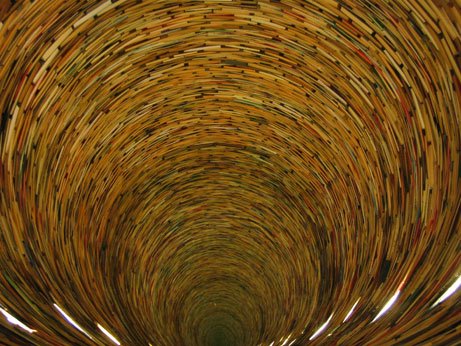
This piece, by Matej Kren, is called Idiom. The tower is constructed from thousands of books, collected from libraries and publishers. This and more extraordinary photos of the book tunnel are at BookLust.