Freedom of the press

Sometimes things happen in the real world that are so weird, you really wouldn’t write about it. Because who would believe you?

It’s been a bit like that lately. Here are just a few wild media events:

  • Wikileaks.
  • News of the World.
  • Social media supporting protests in countries everywhere – especially the Middle East.

All quite bizarre at times and terribly, terribly modern.

Or not. These are extensions of activities that have been central to the life of a great deal of the world for centuries – millennia.

Granted, there weren’t too many bloggers in Damascus in the seventeenth century, but there have always been rabble-rousers, trouble-makers, idealists and writers whose words have spread far and wide, whose ideas and discussions have ignited unrest or provocative debates or even revolutions.

Socrates. Luther. Spinoza. Galileo. Jefferson. Those kinds of ratbags.

You know where I’m going with this. People have always dreamed and written and published their thoughts and beliefs and aspirations, whether on clay tablets or parchment or – in recent centuries – in mass media such as the pamphlets that swirled around London in the 1640s or Paris before the Terror.

For everyone one of those ratbags, there’s someone trying to shut them up – or down: authorities burning books or burning authors, excommunicating or exiling people, throwing authors and teachers into prison or camps or dungeons, banning books and media outlets.

In many of the countries in the world today, the situation is not so extreme. But let me just unpack that: I was going to write “most countries” but then realised, I don’t even know if that’s true, numerically. There are writers, journalists, artists, bloggers, whistle-blowers and teachers in prison or exiled or in danger in dozens of countries around the world right now.

Even in the liberal democracies, the immediate political response to a Wikileaks or a controversial artist is banning. Often it’s just a play to the tabloids which, as we know, are peerless upholders of intellectual integrity. Even in the liberal democracy in which I live, Australia, there’s no constitutional right to free speech.

In the media, slippery slopes head off in all directions. Anyone, like me, who has spent any time in commercial media – print or online – can tell you that every day, every week, is a battle between editorial and sales/marketing teams about what messages are acceptable, from the annoying pop-up ad campaigns on your website to the pressure not to report on certain issues, or not to publish letters critical of advertisers.

In too many countries, that pressure is about not being critical of authorities or political movements or organised crime or businesses or religious leaders – and in far too many places, you ignore that pressure at your peril. Yet people still do. And many still die.

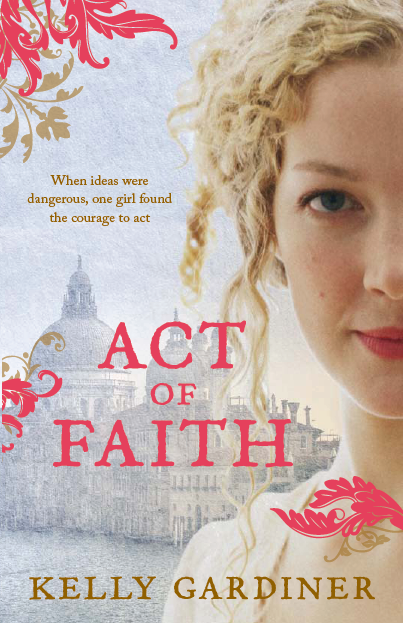
Yes, this is what my novel Act of Faith is all about. It’s set in the 1640s, when the Parliament in England and the Catholic Church in Rome were as keen on burning or jailing dissidents as each other. When I wrote it, I knew there were parallels happening around the world – what’s fascinating is how many of the debates are now at the forefront of public discourse. Or they should be.

  • What does freedom of the press really mean?
  • How do we ensure freedom of expression, and of belief, in a multicultural/transnational publishing world?
  • What freedoms should be embedded in the fabric of a free and independent nation?
  • (Is ‘nation’ itself an outdated concept when it comes to information?)

And why, oh why, do we seem to be moving backwards? In 1948, in the aftermath of the Second World War and the frenzy that destroyed so many great thinkers, writers, artists, activists and musicians along with millions of other souls, the United Nations declared:

Everyone has the right to freedom of opinion and expression; this right includes freedom to hold opinions without interference and to seek, receive, and impart information and ideas through any media and regardless of frontiers.

– Universal Declaration on Human Rights.

It really is that simple.

Out into the world

This is the Preface from Act of Faith:

Dear Reader,
This book you hold is a treasure, of sorts, as is every book I have ever known.
I have made it for you – especially you – for reasons you will understand as my words unfurl before your eyes.
Turn these pages tenderly.
You hold my life in your hands.
Isabella Hawkins
Venice
1647

They are my words, of course, and as I send the book out into the world I feel much the same as – years ago – I imagined Isabella might when I wrote those lines in her voice.

These weeks around a book release are anxious ones – this time more so, for some reason.

But I’ve realised over the last couple of days that worrying, although inevitable, is useless.

I have made as good a book as I can.

That’s all I can do.

Coming soon, to a City of Literature near you

I’m honoured to be part of this year’s Emerging Writers’ Festival (note the apostrophe) as a “Living Library” on 4 June. That means you can book a fifteen minute one-on-one session to pick my brains on how to create characters.
Or you can quiz Paddy O’Reilly on structure and narrative (which I do over lunch on a regular basis).
Or:

  • Criticism & reviewing: Geordie Williamson, literary critic
  • Poetry & performance: Julian Fleetwood, poet & playwright
  • Editing: Jo Case, editor
  • Drafting & planning: Alan Bissett, novellist & screenwriter
  • Creative collaborations: Warwick Holt, joke writer & freelancer
  • Writing online: Simon Groth, If:Book director & digital writer
  • Translation: Leah Gerber, academic specialising in literary translation
  • Freelancing: Kevin Patrick, freelance writer.

What a line-up, and what a smart idea. You treat us like books you can borrow for fifteen minutes. Ask us anything. But please remember to return all books to the trolley.

And in my day job at the State Library, we’re gearing up for the Reading Matters conference, with guests this year including Cassandra Clare, Lucy Christopher, Ursula Dubosarsky, Rebecca Stead, and Markus Zusak. Can’t wait.

Lately I’ve been…

Reading
Text books and journal articles for the PhD, including:

  • The Sappho History, by the marvellous Margaret Reynolds – crisp, smart writing
  • France Observed in the Seventeenth Century by British Travellers, by John Lough – a hoot
  • Still browsing through the wonderful One Thousand Buildings of Paris, with photos by Jorg Brockmann and James Driscoll, and pithy text by Kaathy Borrus
  • Rabelais and His World, the classic text (I know that’s an over-used description, but true in this case) by Mikhael Bakhtin – filled with vivid flashes and genuinely brilliant insights into the world of fairgrounds, festivals, freaks and folklore around early modern Paris – on archetypes and ancient lore that trickles down to us today.
  • The Secret Life of Aphra Behn, by Janet Todd. Still remember the moment, in 1985, when I first visited London and wandered around Westminster Abbey – looked down, and there, below my feet, was Aphra’s grave. Getting that weird chill thing even now. Or maybe it’s a flush. Anyway – there’s a good subject for a cracking movie bio. Spy, playwright, independent woman, deviant, subversive – and yet not. Fascinating.
  • George Sand: A Woman’s Life Writ Large, by Belinda Jack. Ditto – except for the grave thing.

Escapist reading is The Sealed Letter, by Emma Donoghue, about which I’m still making up my mind. I’m not sure why it’s in the present tense, and that’s a question I’m also asking myself about Tragédie.

Waiting
First it seemed like a moment until Act of Faith comes out. Now it seems like years. It’s actually somewhere in between – two months or so. So the anxious, exhilarated, dumb-struck, sleepless, proud, despairing thing is starting a bit ahead of schedule.
Don’t tell anyone, but I feel like this one might go OK.

Watching
Deadwood. It’s like Macbeth on crack.


Muttering
French vocab. It will not stick in my brain. I go to class and everything looks fine on paper, and then I get asked a question and there’s nothing there at all. A black hole where a word or phrase ought to be. It was there yesterday. Where do they go?

And then there’s …
King Tutankhamun exhibition opened at the Melbourne Museum last night. Wonderful, wonderful things. Best of them: his dagger, with goldwork so fine you know the Egyptians had to have some kind of magnifying lens. And a stunning realist mask of Nefertiti. And a tiny cosmetic case shaped like a duck. And – well, everything, really.

Happy hours of research planning the trip to Paris and Provence in October.

Autumn in Melbourne: reddening leaves and rhubarb and stirring great vats of crabapple jelly and green tomato relish and crisp mornings with balmy days. Bliss.

Web resources on writing & publishing

There seems no end to the number of websites and blogs about books, writing and publishing. I guess that’s not surprising. People who write and publish words and ideas are going to do it on every platform possible. But some of it, to be frank, is either crap advice or hysterical or of the Disneyland school of thought (if you want to be a famous author, just follow your dreams and it will happen – even if you can’t write to save yourself – so all you need to worry about is what to wear on Oprah).

So in the middle of this overwhelming waterfall of information, where do you start?

Here are some sources I’ve either found useful or checked out to make sure they make some sort of sense. They are all free, but I strongly suggest that writers at any stage of their career invest in joining a local writers’ centre or society of authors.

Writing advice and ideas:
Some helpful websites of writing tips and advice from experienced authors.
Writers’ Hub (Birkbeck, UK): news, reviews, interviews
Best-selling author Sara Douglass (Australia) shares her experience of the business of writing and the editing/publishing process
Writing World (US): lots of short articles for people starting out and hoping to get published
Write101 (Australia): it’s been around a long time, and chock full of advice
Literary liaisons is aimed at romance writers, but also offers a great list of resources for writers of historical fiction
Allen and Unwin’s writing centre (Australia)

Authors’ associations and writers’ centres:
Trusted and authoritative sources of information and support.
Australian Society of Authors
NZ Society of Authors
UK Society of Authors
European Writers’ Congress
US Authors Guild
Australian Writers Centres
International PEN

Getting published:
There are a billion sites and blogs on this topic, of varying quality, so here are just a few.
ASA Guide (Australia – PDF)
VWC advice (Australia)
Society of Authors advice (NZ)
Help! I need a publisher (UK)

Nothing on but air

Dance, Lalla, with nothing on
but air. Sing, Lalla,
wearing the sky.

Look at this glowing day! What clothes
could be so beautiful, or
more sacred? 

~ Lalla, or Lalleshvari
A Kashmiri poet, circa 1350

Here’s another:


I didn’t trust it for a moment,
but I drank it anyway,
the wine of my own poetry.

It gave me the daring to take hold
of the darkness and tear it down
and cut it into little pieces.

(from Naked Song Lalla, translations by Coleman Barks, Maypop, Athens, GA, 1992)

List of lists

The time for best book lists is here.
Here are just a few:
Publishers’ Weekly (US) includes Patti Smith (which I still can’t find anywhere) and [sigh] Freedom. This is the test for each list – does it include Freedom?

Anis Shivani at the Huffington Post calls it one of the year’s several notably “ponderous, bloated, eminently editable books”. He prefers Orhan Pamuk.

Closer to home, the Fairfax papers asked a whole lot of clever people what they liked. Christos has discovered Margaret Yourcenar. Colm Toibin loved David Malouf’s Ransom. And Geraldine Brooks adored- surprise, surprise – Wolf Hall by Hilary Mantel.

The Guardian did the same thing, with rather more mixed results: Philip Hensher loved Freedom. Can  that be right?

Finally, The Daily Beast added up the votes and came up with a list of lists – with Room at the very top, which is splendid. This list saves you having to read all the others. Nice.

Mine?
Wolf Hall. No contest.