Shortlist announced today. Very happy about the Children’s list in particular.
What strong fields in Children’s and Fiction this year. Don’t envy the judges.
See the full list and judges’ reports here.

Shortlist announced today. Very happy about the Children’s list in particular.
What strong fields in Children’s and Fiction this year. Don’t envy the judges.
See the full list and judges’ reports here.
“Print is not dead. It is not even dying, at least not yet. Think of print like an overweight beast, shedding excess weight. The result is a leaner, more defined, more beautiful experience.”
Smart post on the Future of Print @ Booksquare

Draw your chair up close to the edge of the precipice and I’ll tell you a story.
~ F. Scott Fitzgerald

Got my frozen little fingers on a facsimile edition of Coryats Crudities (1611 – this edition by Scolar Press, London, 1978), a travel narrative by Thomas Coryate of his journey from his home in Odcombe, England to Venice, and back again, mostly on foot – although he was carried in a chair part of the way over the Alps.
He “imbarqued at Dover, about tenne of the clocke in the morning, the fourteenth of May, being Saturday and Whitsun-eve, Anno 1608”.
Most importantly, he follows much the same route as the 17th century heroine in my next book, Act of Faith: along the Rhine, onto Verona and Venice, where he – like her, like all of us – gazes in wonder at San Marco and the Lagoon.
… the most glorious and heavenly shew upon the water that any mortal eye ever beheld, such a shew that did ravish me both with delight and admiration.
Like many of us, he is often lost for words in his wonder, and in those spaces one hears the gasps, sees the eyes widen, knows all too well the feeling that ends up coming out as a pathetic “oh wow, look!” or, in Thomas’s case:
I will descend to the description of this particular place, wherein if I seem too tedious, I crave the pardon of thee (gentle Reader) seeing the variety of the curious objects which it exhibiteth to the spectator is such, that a man shall much wrong it to speake a little of it.
Bless his boots.
We’ve just relaunched our new website at work – huge effort, lots of brainy people, project nearly ate my brain, but it works. Here ’tis.

He was such a bad writer, they revoked his poetic license.
~ Milton Berle
Alan Marshall Short Story Competition announcement on Saturday afternoon at the beautiful Eltham Library (I’m not actually doing much beyond handing around finger-food, but helped with the shortlisting). All welcome.
Then I’m at the Emerging Writers Festival on Sunday, hosting a panel on collaboration. Great festival – for writers, rather than just being about writers.

I take back what I said only the other day about historical detail in fiction.
I’m reading A.S. Byatt’s The Children’s Book, an intricate Art Nouveau gem, layered and woven and brimming with Victorian and Edwardian detail, which is just as it should be for the era, and a triumph of “tell, don’t show” (yes, I do have that the right way around).
Points of view are as slippery as a Pre-Raphaelite sprite, descriptions are as richly detailed as Lalique masterpieces, and bald historical fact is not trussed up or embedded in dialogue: one is simply updated by the narrator on the progress of the Boer War or anarchist assassination attempts.
Of course – of course! – historical detail is only annoying and excessive in clumsy hands, and Byatt’s hands are masterful.

Just finished reading Sarah Waters’ latest, The Little Stranger.
It’s an odd read.
I get what she’s attempting, I really do. But does it work?
In one sense, yes. The setting is a dilapidated country house; the point of view a local lad made good, a doctor, as dull as dishwater, just a little obsessed with the house and its family. Strange things start happening there, sad and violent things, and you know there’ll be tears before bedtime (actually, there won’t be, because most of the characters are too stiff-upper-lip). All nicely realised.
Waters is doing what she does best, recreating a genre, or perhaps era, of fiction: absorbing it, reliving it, and somehow conveying its essence in both plot and language (if not character). It was pitch-perfect in The Night Watch and Fingersmith. It may be close in this – post-war ghost stories are not my thing.
But it’s pretty boring.
The second strange event had me absolutely spooked, though that’s not hard since I get too scared to watch the most run-of-the-mill police show on TV. Apart from that it was difficult to engage as a reader, and even more difficult to care about any of the characters.
The central issue is obvious, and one with which many authors have grappled: the unsympathetic narrator.
It’s not that Doctor Faraday is completely unsympathetic. We appreciate the class anxieties, the son of the former maid now able to enter the big house as a friend. But, as one reviewer noted, “Waters gives herself a sort of handicap with the dull doctor’s narration. This indirectness, which in cruder hands might have led to a yawning insurrection in the reader, becomes essential to the novel’s unsettling power”.
I missed the unsettling power and felt saddled with the dull doctor, and having figured out the supernatural element about halfway through, plodded on laboriously and loyally to the end.
It also seemed to me that Waters’ usual control of her historical detail seems to have gotten away from her: the meticulous descriptions that worked so well in The Night Watch became even more words to wade through here, and seemed often at odds with the doctor’s character.
Tricky stuff to pull off, and points for trying, but it doesn’t really work. Millions disagree, I’m sure, and it was short-listed for the Booker alongside Hilary Mantel’s Wolf Hall, the eventual winner; a triumph of the unsympathetic narrator who wins us over completely and utterly.
Note to self: The more historical fiction you read, the less interested you are in historical detail. And remember this warning, since you are currently entangled with a dangerously borderline unsympathetic narrator.
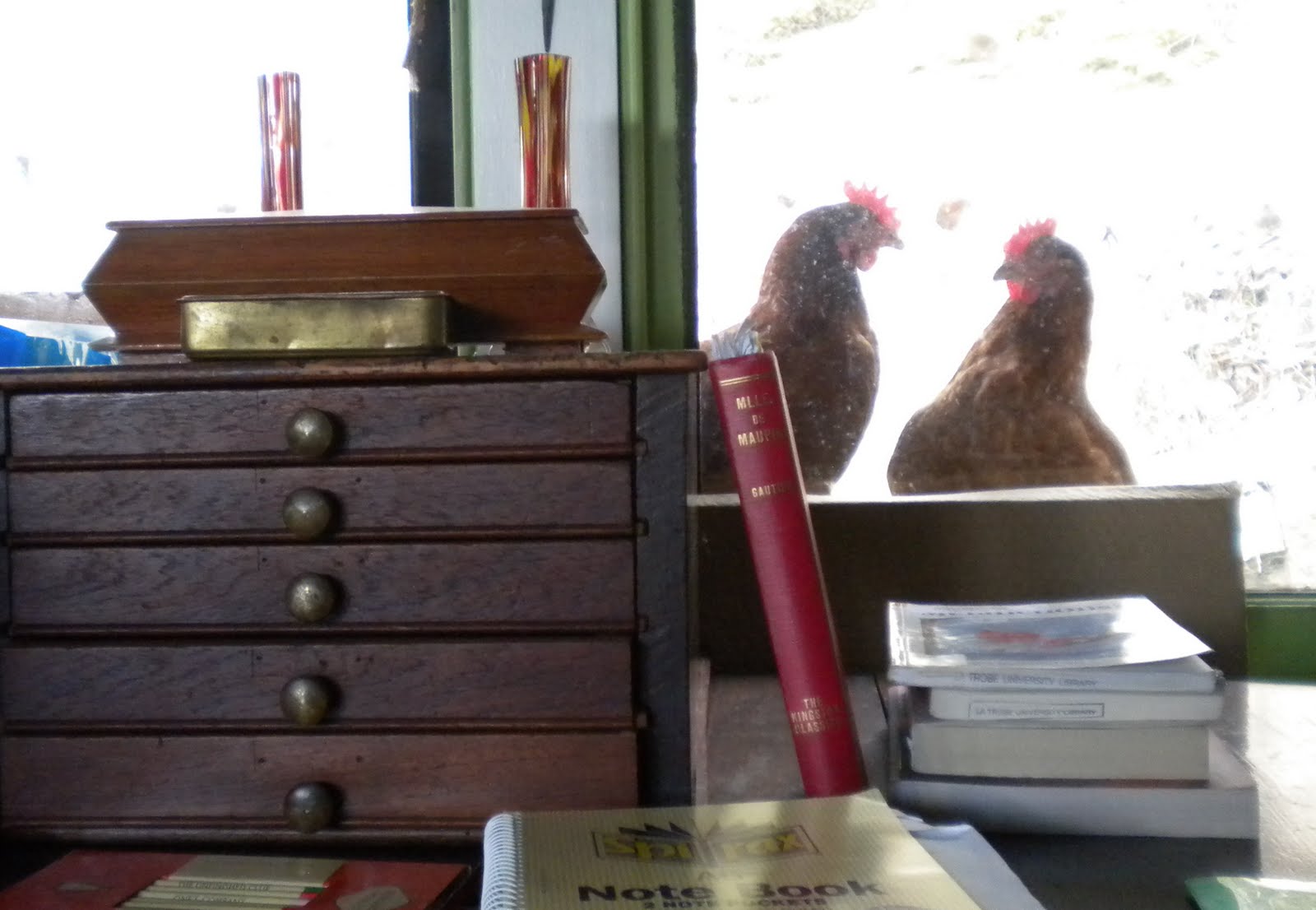
The view from my reading desk: Joan and Jackie helping through the window.
My next book may have to be The Joy of Pruning.
The love of pruning applies, of course, to both gardening and writing. Today I’ve been doing both.
I feel quite sorry for the cotoneaster, since objectively it’s a pretty little thing – one has orange berries, one has red, both quite lovely at this time of year but, sadly, a pest plant in this area.
I feel less sorry for the spare adverbs and adjectives, not to mention gushes of passive voice – can one gush passively? I suppose not – now cluttering up my laptop memory but no longer, happily, my manuscript.
How they got in there in the first place is beyond me.
Purple hebe and purple prose, all gone in one day.
Perhaps the new title should be 101 Ways With Waste.
 Kelly Gardiner