Universally Austen

I was going to celebrate the 200th anniversary of Pride and Prejudice with a post about how it isn’t really constructed as a romance and yet is so often portrayed as some kind of blueprint for chicklit.

But the inestimable Alison Croggan has not only got there first, but done a much better job of it, too – so go read her article in Overland:

… for all their stereotypical romance structure – girl and boy meet, strike impediments, overcome them, and at last are united in matrimony – I’ve never been able to quite understand why Austen is considered the presiding muse of romance. No-one is more hostile to the idea that ‘love conquers all’ than Miss Austen.

Her books are, from beginning to end, all about money: the economic status of her characters frames and governs every aspect of their lives.

Quite. But why the romance obsession?

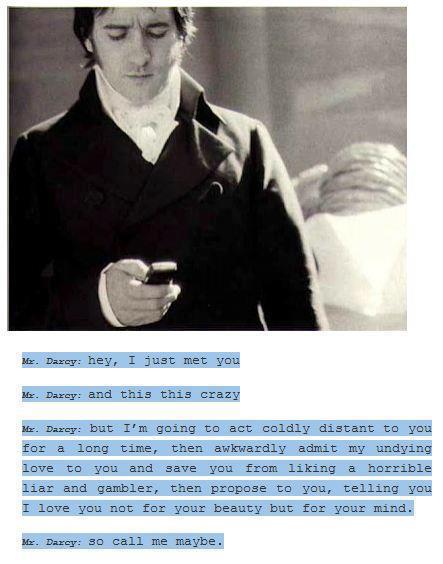
It is, needless to say, a fine romance, and clearly very engaging. I’ve posted before about Mr Bloody Darcy and his apparent impact on the readers of every novel with a female protagonist since 1813.

Silly image of Darcy texting

But I’ve been thinking lately more about Elizabeth Bennet and her impact on us. Of course, there are shelves full of PhD theses on the topic, but the most obvious point to make is that Lizzie is also the progenitor of countless fictional heroines – including my own.

That’s not surprising: she was one of the first popular heroines in literature, and remains one of the most finely drawn (like Jane Eyre). But while Emma Woodhouse is articulate but oblivious, Elinor Dashwood keeps her emotions to herself, Fanny Price is too timid to speak out, and Catherine Morland is fabulously naive (“I cannot speak well enough to be unintelligible”), it’s Elizabeth –  and to a lesser extent Jane Bennet – who reappear most often in later novels.

Perhaps more importantly, to the reader, she is a reflection of our best selves. Although she too wishes she had said something different, something less cutting or more brilliant, in some circumstances, the Lizzie we adore always has the perfect comeback. No matter how muddy her hem, how embarrassing her mother, how undistinguished her family, how snivelling her admirers, she says the sorts of things we wish we could say. The things we imagine ourselves saying, in the bleak dark hours after being slighted or insulted or jilted.

That’s also why we love Bridget Jones, of course, because she is the brilliantly conceived flipside of Lizzie, always saying the worst possible thing – or utterly tongue-tied – in every situation.

Lizzie is who we wish we were. Jones is who we really are.

And her Darcy loves her anyway.


Summer reads: Act of Faith

Having a book on the Gold Inkys shortlist is a gift that just keeps on giving. You can find an extract from Act of Faith in The Age and other Fairfax papers this week as part of the Summer Reading series – and you can read extracts from the other sensational shortlisted titles too.

Meanwhile, I’m on holidays by the beach in New Zealand, trying not to work on the other books in the series. But I can’t help it.

Happy new year

Thanks to all of you who’ve followed the blog, been in touch on Facebook or Twitter, posted reviews on Goodreads or elsewhere, and (or) read Act of Faith.

For my next trick, I’ll be doing edits on the sequel over the next few weeks, but we’ll have to wait a while to see it in print. Should be out around August.

In the meantime, have a great summer holiday (or winter reading spell, if you’re in the northern hemisphere) and I look forward to another busy year ahead.

2013. Already? Didn’t see that coming.

Cheers,

K

Lately I’ve been…

Rather quiet, haven’t I?

That’s because I’ve being going through the living hell that is moving house.

But now we’re in, if not unpacked, and still edging our way through rooms crowded with boxes – mostly containing books (I don’t know where they all came from and I still don’t understand how they’re all going to fit in the new house).

I’m in Sydney this morning, having come up for the NSW Premier’s Literary Awards, in which Act of Faith was shortlisted for the aptly named Ethel Turner prize for young adult fiction.

And what a shortlist. The other books on it were:

  • Bill Condon, A Straight Line to My Heart (Allen & Unwin)
  • Ursula Dubosarsky, The Golden Day (Allen & Unwin)
  • Scot Gardner, The Dead I Know (Allen & Unwin)
  • Penni Russon, Only Ever Always (Allen & Unwin)
  • Vikki Wakefield, All I Ever Wanted (Text).

I was thrilled and a little amazed to see my book listed alongside those titles. The beautiful Only Ever Always won the Award, and we all dined and felt terribly glamorous in the beautiful Mitchell Reading Room at the State Library of NSW.

Editing has begun on The Sultan’s Eyes, work on the cover design is quite advanced, and I should have the manuscript back to look over the edits in a couple of weeks. What happens then is that I check and recheck, then the changes are made and the editors check it all again, it gets typeset, then we all check it again. And possibly again. By which point we’re all thoroughly sick of the thing and don’t want to see it until it arrives in a box with a picture on the front.

In the meantime, it’s back to focusing on La Maupin and academic conference papers, and a hectic time at work, before taking a summer break in which I intend to read a whole lot of books that have nothing to do with the seventeenth century.

Except I can’t help wondering what would happen if Isabella Hawkins returned to Cromwell’s London…


Coming up

I’m reading work in progress at Bespoken this week: Thursday 25 October at 7.30 at Hares and Hyenas bookshop in Johnston St, Fitzroy.

I’ll read a couple of chapters from Tragédie. Tom Cho and Daniel G Taylor are also reading from their work. Should be a great night.

More info and bookings  here.

After that I’m laying low for a few weeks so I can move house and recover from all this month’s major deadlines and get ready for next month’s deadlines.

I’ve finished writing the sequel to Act of Faith – it’s called The Sultan’s Eyes and it’s with the publisher. I’ve even seen a few rough designs for covers, so things are rocketing along.

Rather quickly.

Classy entertainment

I’ve been thinking lately about the tradition of the working class as entertainment, those fictional and cinematic ventures into the foreign world of the East End or Fountain Gate, where life is hard but people have hearts of gold and everyone has a good belly laugh at everyone else’s expense.

There’s nothing new about this, of course, and the idea of a different class as a foreign country filled with entertaining specimens of The Other is not confined to the downtrodden. You could argue that The Great Gatsby does exactly the same thing, casting an essentially middle-class gaze on the upper echelon, while Captains Courageous teaches a pampered boy rude lessons of life and death through friendship with a poor fisherman. On the long march through the snow Pierre finds the answers to the questions of life, the universe and everything in the form of an old Russian soldier and a little white dog. The Dorrit family and Arthur Clennam switch roles in life (at least economically) with comic and tragic consequences, and the face of conspicuous consumption, Mrs Merdle, learns to live with less (or perhaps not).
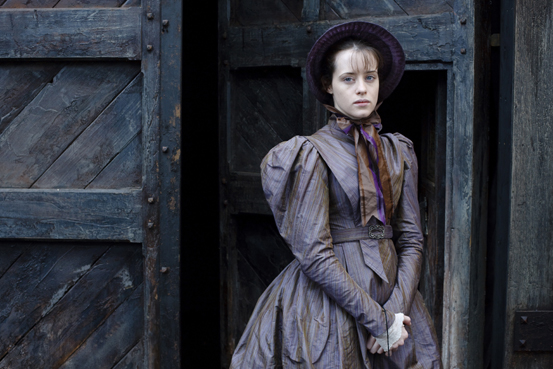
Image of Little Dorrit

Little Dorrit at the gate of the Marshalsea

In all of those examples class conflict or difference is intrinsic to the story and its characters. You’d think we might be over that whole storyline by now, but no.

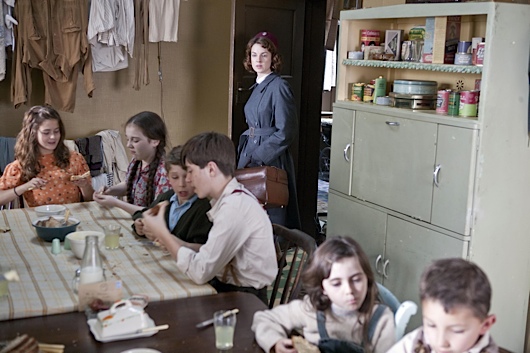
In Call the Midwife, a British TV series set in the East End in the 1950s,  we see the world through the eyes of the middle-class Jenny Lee. There is great poverty, cockroaches and preventable illness in the tenements (unchanged from Dickens’ day), prostitution and violence, huge families living on nothing but love, washing lines everywhere, screaming babies, lessons for young Jenny at every turn. The show (and presumably the memoir by Jennifer Worth on which it is based, which I haven’t read) has an equal amount of fun at the expense of Chummy, the plummy hyphenated do-gooder who grew up in India and can ride a horse to hounds but not a bicycle. Jenny Lee learns about friendship, love, hardship, courage and loss from people she would normally never meet. She comes to see the women as “heroines” not “slatterns”. But she is essentially on a visit to another world.
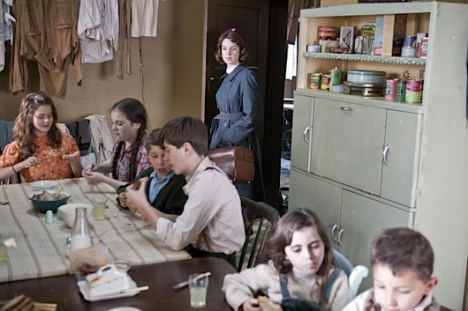
Image of Call the Midwife

Jenny Lee confronted with family life in the East End

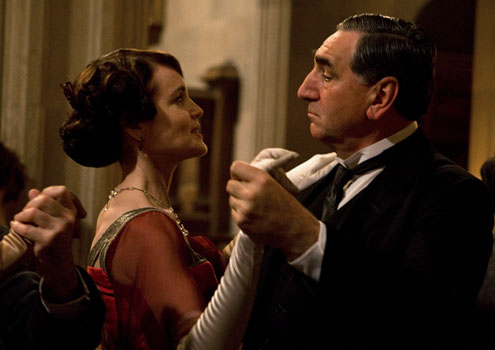
Then there’s Downton Abbey, which I love, but which on one hand paints a world where immense privilege is only sustained by the hard work and moral fibre of those who pour the claret and polish the silver; and on the other hand tries to blur those class lines through dialogue and plot points which any real earl’s family would never have considered. Involve the housemaid in your affairs? Only as an accessory. Vice versa? Don’t be absurd.

In the revisionist world of Downton, we want to believe that the upstairs family members are so fundamentally good that they care deeply about the lives of those downstairs, that the household is enmeshed in one narrative, not two. Not even Tolstoy would have argued such a thing. Sure, no earl wants his daughter becoming a suffragette and running off with the chauffeur. But no earl would involve himself in the affairs of those below stairs, and nor would his family. They’d hardly have noticed the servants at all. Still, we can’t have that in Downton, can we?
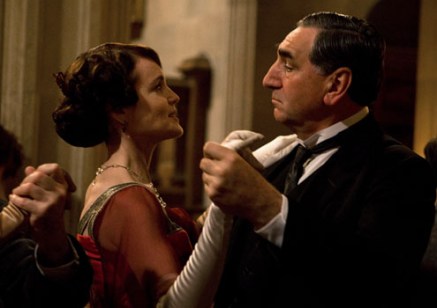
Image of Downton Abbey

Her Ladyship dancing with Carson the butler

Closer to home, in every way, is Kath and Kim, the comedy series now become a movie. This focuses on the lives of the second- and third-generation post-war working class: as if the babies born in Call the Midwife and their kids all migrated to suburban Melbourne and got a perm. Which is not unlikely.

I never laugh at Kath and Kim. I tried to watch it in the early days, because I enjoy the work of the three comediennes behind it. But many of the jokes at the expense of the characters simply aren’t funny to me: when I was growing up everyone pronounced film as fillum, after all, so what’s hilarious about that? I just don’t get the jokes because they are about my generation, the people who migrated from Port Melbourne (our local equivalent of the East End) to Springvale or Mitcham or Sunshine, and from there to Berwick or Deer Park or – yes, Fountain Gate.

This has been playing on my mind over the last few weeks, and this morning I read this from Nigel Bowen in The Age:

Over the last decade and a half, the educated have had to make the painful adjustment to living in a society where aspirationals often out-earn them and largely determine the political agenda. Like galled aristocrats confronted by a rising merchant class, their typical response has been to snigger at the tastelessness of the newly affluent. Kath & Kim does this more gently than much of the “cashed-up bogan” comedy but it still does it. The malapropisms, mispronunciations and mixed metaphors of the characters allow the university-educated to chuckle at those who don’t understand the hilarious implications of wanting to be effluent rather than affluent. Many of them would see Kim – bloated by junk food, addicted to tabloid media, bedazzled by hyper-consumerism, utterly self-absorbed – as a portrayal rather than a grotesque caricature.

Bowen divides us between educated and aspirational, and it makes sense now our class sensibilities are less finely-tuned than they were a generation ago. But the cultural division runs deeper than that, and many of the university-educated people of my age are only able to be so due to that one brief shining moment of free tertiary education that jump-started a generation of kids (like me and our Prime Minister) into the professional class. Those who went before us never had the chance to finish school. Those who came after are still paying off their HECS debts. (God knows what will happen to those wanting a TAFE or university education in the next few years.)

There is inherent goodwill in Little Dorrit and in Call the Midwife. The reader or viewer in a comfortable armchair can engage at a safe distance with the lives of such exotic creatures as East End warfies or the inmates of the Marshalsea Prison, just as you might watch Michael Palin visiting the Bedouin or a David Attenborough doco. There is warmth, understanding, respect and as much likelihood of tragedy as comedy. Even in the long-running British series Keeping Up Appearances, one character’s snobbery was comic but everyone else was relatively normal.

Is one of the issues with Kath and Kim that aspiration isn’t a joke unless you are looking down on it from above?

Remember that Pulp song?

Sing along with the common people,
sing along and it might just get you thru’
Laugh along with the common people
Laugh along even though they’re laughing at you
and the stupid things that you do.
Because you think that poor is cool.
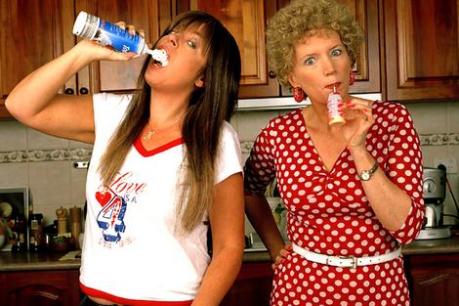
Image of Kath and Kim

Kath and Kim and conspicuous consumption

I see it through a slightly different lens. It’s a grand thing that my generation can watch Kath and Kim on their enormous plasma TVs in their McMansions in Cranbourne or Templestowe. Our grandparents would be so proud that all those hours in factories and on the wharf or on dusty Greek farms have meant that later generations can buy a house, have a car or two or three, a lawn to mow.

The conspicuous consumption lampooned in Kath and Kim is, in part, a way of staving off future fear, of saying “Look how far we’ve come – we made it into the lower-middle class!”, of celebrating the fruits of the labours of many generations. But clearly being lower-middle class isn’t good enough. It’s almost white trash, but with al fresco dining.

In a very silly book called How to be Inimitable, George Mikes wrote (in 1960):

The one class you do not belong to and are not proud of at all is the lower-middle class. No one ever describes himself as belonging to the lower-middle class. Working class, yes; upper-middle class: most certainly; lower-middle class: never! Lower-middle class is, indeed, per definitionem, the class to which the majority of the population belongs with the exception of the few thousand people you know.

(As an aside, lower-middle class is probably what the ALP means when it bangs on about working families. But the global financial crisis has meant that plenty of people who thought they had “risen” to be middle-class have found that their footing there is tenuous. That’s why Obama is readjusting the American Dream so that people aspire not to be Donald Trump but to be, more realistically, middle-class, as it was after the Depression and as it is now in countries such as India and China. That’s partly why the Republicans can’t quite figure out how to respond – they’re still stuck on the Trump narrative. And it’s unsettling for those of us whose youth was spent resisting becoming bourgeois.)

The characters in Kath and Kim aren’t on the bread line: they go to the mall and buy dreadful clothes and drink middling wine. Kath doesn’t have to take her father’s good pair of trousers down to the pawnbroker every second Friday to get a couple of shillings to see the family through to pay day. The telly can be bought from a store, rather than the local fence. Nobody need be in jail for running a bookie outfit on the side, or run from the coppers down the back lanes, or do a midnight flit because the rent’s due. That wasn’t true for their parents and grandparents.

The real Kaths of this world know what it was like, even if their kids don’t: they’ve been told the stories, perhaps lived the reality and they never want to be in that situation again. They don’t need to watch Call the Midwife to know how poverty looks. Many people in Australian suburbs know exactly how it feels – if only poverty had vanished along with the perm.

Sure, I’m as ridiculously susceptible to unrealistic nostalgia about the East End or Station Pier as the next person. One day I might even write about it. I loved the vaudeville singalongs of my childhood, and all the stories about uncles fighting bare knuckle bouts in someone’s front parlour, about the brawls at the cinema on Saturday nights, the black market deals, the SP bookies and two-up games in the alley behind our house. I love how my grandmother made everyone’s wedding dresses by hand and the women always tried to look like fillum stars when they were going out on the town.

But I also know that Uncle Phil lived on rabbits and little else up country in the Depression, that our family’s name was written in the pawn shop register every fortnight (‘one good tablecloth – linen’), that my grandfather had no proper boots until he went to work at 13.

I bet that was just hilarious.
Big week, big news

First: Act of Faith is on the shortlist for the Gold Inky in Australia’s teen reader choice awards. That’s a lovely surprise, because the shortlist is chosen by an independent panel largely composed of young readers, along with (this year) book blogger Danielle Binks and last year’s Gold Inky winner, James Maloney. It’s also a great honour to be shortlisted along with:

  • Shift by Em Bailey
  • Night Beach by Kirsty Eagar
  • Queen of the Night by Leanne Hall
  • The Reluctant Hallelujah by Gabrielle Williams.

More information – and voting form – on insideadog. I should tell you to vote for me but really, with that list, vote for whoever you like.

I can also announce that the Swashbuckler books are now available as ebooks from all the major retailers, which is great news because copies can be hard to find in print nowadays. More information on sources from HarperCollins.

Coming up

Next week, I’m celebrating Adult Literacy Week with the good folk at Park Orchards Learning Centre.

The topic?  The Journey of the Book – From Inspiration To Publication. A writer (that’d be me), editor and publisher discuss the stages of creating a book.

It’s at 7pm on Thursday, August 30. Cost: $25. Bookings: 9876 4381. More information in this article in the local paper (with a marvellous typo in the final line).


On 15 September, I’m at Fitzroy Library introducing people to Twitter. We’ll talk about how it works, what on earth it’s for, and how to use it for good not evil.

That’s on Saturday 15 September from 1 – 3.30pm at Fitzroy Library. Bookings are essential, apparently (certainly the last workshops I did there booked out quickly). Call 1300 695 427 or email yarralibraries@yarracity.vic.gov.au. More information on the library website.


The adverb liberation front

Once upon a time,  I blogged about George W. Bush. That shows you how long ago it was: he was President at the time.

One of the responses was from a charming right-wing fellow from the US, who no doubt spends his days trolling the web looking for just such a post and responding forcefully. But this chap had a good college education, so not only did he threaten me with an apocalypse and eternal flames, he also found an extract of my writing and rewrote it, removing all the adjectives and adverbs, and posted it as a comment to show the world what an incompetent fool I was.

He’d made the sing-song voice of a twelve year-old pirate narrator sound like Jake Barnes or Sam Spade, but he was only acting out, in troll form, the instructions of endless numbers of writing teachers and “coaches”, editors, authors, manuals and half a million writing advice (join today! first month free!) websites.

Eliminate all those mealy-mouthed adverbs, they say. Cross out adjectives and delete them from your dictionary.

I believe the road to hell is paved with adverbs, and I will shout it from the rooftops.

— Stephen King

Adverbs have an especially bad name because they are often used as qualifiers: possibly, probably, very, totally, utterly, mostly. We see them a lot in government or consultants’ reports where they work hard to undermine any firm verbs, adjectives and nouns: potentially viable. They are used as weasel words, but they are blameless. There’s nothing wrong with an adverb or two. A plague of adverbs is a different matter, but that’s true of any plague.

I’ve long had a theory that it’s all Hemingway’s fault – not his, exactly, because he knew better than anyone how to place every word so it counts – but the generations after him who wanted to be Hemingway. There’s a rule book of writing which endeavours to turn every work into Hemingway, or perhaps Elmore Leonard.

But here’s the thing: it’s just one set of rules, designed for a certain style, or a range of styles, of writing. It’s also a particularly twentieth-century US style. If you want to deliver punchy realism, then  descriptive words are used sparingly, as are all words.

Before there was Hemingway, there was Twain:

I notice that you use plain, simple language, short words and brief sentences. That is the way to write English–it is the modern way and the best way. Stick to it; don’t let fluff and flowers and verbosity creep in. When you catch an adjective, kill it. No, I don’t mean utterly, but kill most of them–then the rest will be valuable. They weaken when they are close together. They give strength when they are wide apart. An adjective habit, or a wordy, diffuse, flowery habit, once fastened upon a person, is as hard to get rid of as any other vice.

— Mark Twain

Adjectives have a bad name in some quarters: perhaps a reaction to high Victorian prose and all those long descriptive passages people were forced to read in high school.  I’m sorry for your suffering, but take another look:

In an old house, dismal dark and dusty, which seemed to have withered, like himself, and to have grown yellow and shrivelled in hoarding him from the light of day, as he had, in hoarding his money, lived Arthur Grid. Meagre old chairs and tables, of spare and bony make, and hard and cold as misers’ hearts, were ranged in grim array against the gloomy walls; attenuated presses, grown lank and lantern—awed in guarding the treasures they inclosed, and tottering, as though from constant fear and dread of thieves, shrunk up in dark corners, whence they cast no shadows on the ground, and seemed to hide and cower from observation. A tall grim clock upon the stairs, with long lean hands and famished face, ticked in cautious whispers; and when it struck the time, in thin and piping sounds like an old man’s voice, it rattled, as if it were pinched with hunger.

— Charles Dickens, from Nicholas Nickelby

It may seem wordy compared to Leonard,  and plenty of people would scoff at the idea of Twain or Dickens using plain English and short sentences, but they did  in comparison to their contemporaries. Their descriptions include some of the most gorgeous writing you’ll ever read. Spare and bony chairs. Grim. You can see it, can’t you? Feel it?

Twain could wax as lyrical as the next author, but it depended entirely on the voice he created. Here’s Huck Finn:

 It was kind of solemn, drifting down the big, still river, laying on our backs looking up at the stars, and we didn’t ever feel like talking loud, and it warn’t often that we laughed—only a little kind of a low chuckle.  We had mighty good weather as a general thing, and nothing ever happened to us at all—that night, nor the next, nor the next.

Every night we passed towns, some of them away up on black hillsides, nothing but just a shiny bed of lights; not a house could you see.  The fifth night we passed St. Louis, and it was like the whole world lit up.

Twain or Hemingway would  ignore the didactic websites and coaches: they knew that their story, their own styles, and the voices of their characters were what mattered.  Some narrators describe things, some don’t. Some sketch an outline, some paint in oils, some wave neon lights around. Most writers use too many words or thoughtless construction when we’re drafting: editing is about taking out the gratuitous  adverbs or nouns or entire passages.

I won’t tell you how to write, but I will tell you to read. Read Hemingway (especially The Sun Always Rises) but read Emma Donoghue’s Room, Orhan Pamuk’s Snow, and Hillary Mantel’s Wolf Hall too.  Not a wasted word in any of them, but very different styles, intent and voices. Read Twain and Dickens and Austen and Tolstoy.

There are many ways to tell a story. And some involve adverbs.

Coming up in July

After two residencies and many weeks away, I’m back in Melbourne and settling in for winter. I’m working on the redraft of Tragédie and waking up at 6am remembering things I still need to fix in The Sultan’s Eyes.

A couple of appearances:

On Saturday July 7, I’m part of a panel called ‘What’s fit to print? Issues in youth literature’. It’s part of the Bayside Literary Festival: Art of Words, and it’s a revival of a panel discussion with Hazel Edwards, Adele Walsh and Maria Pallotta-Chiarolli at the Midsumma Festival. We had so much fun we’re doing it all over again, this time with the addition of George Ivanoff. Moderated by Crusader Hillis.

2 pm in Brighton: details here.

Then on Wednesday 18 July I’m at Boroondara Library. The session is designed especially for boys 10 and over – I reckon we might be talking a bit about pirates. (The lovely Rebecca Lim presented a session especially for girls this week. Lucky things.)

7pm, Hawthorn Library: details here.