From tomorrow I’ll be in Sydney, at the Children’s Book Council conference, Book Now.
I have no idea whether I can blog from there, but I’ll try to keep a few rational thoughts aside to post when I can.
Cheers.

From tomorrow I’ll be in Sydney, at the Children’s Book Council conference, Book Now.
I have no idea whether I can blog from there, but I’ll try to keep a few rational thoughts aside to post when I can.
Cheers.
“We are the lantern bearers, my friend; for us to keep something burning, to carry what light we can forward against the darkness and the wind”.
– Rosemary Sutcliff
This timeless line is from The Lantern Bearers, one of her novels for young readers about the centuries-long battle between Briton, Roman, and then Saxon civilisations.
I had thought Kate Grenville was backing off a little from her claims that novelists are somehow able to write more authentic history than historians. Or perhaps she didn’t mean it quite that forcefully.
Clearly that was not the case.
Shortlisted, along with several other writers of historical fiction, for the Miles Franklin Award (which I admit has never quite recovered its lustre after the Demidenko debacle), she had this to say:
“There’s a sense that a cupboard has been opened in the last 20 years that was always closed before in Australian history. We built a big, beautiful armoire and put the uncomfortable parts of our history in there.
“Bit by bit, door by door, the cupboard is being opened. Lawyers and historians have played their part and now the novelists are moving in.”
Them’s fightin’ words!
I wonder what Robert Hughes (Fatal Shore) or even Alan Moorehead (Fatal Impact) would think of being dismissed so lightly? Not to mention novelists from Marcus Clarke (For the Term of his Natural Life) or poets like Judith Wright (everything).

They shall grow not old, as we that are left grow old;
Age shall not weary them, nor the years condemn.
At the going down of the sun and in the morning
We will remember them…
As the stars that shall be bright when we are dust,
Moving in marches upon the heavenly plain;
As the stars that are starry in the time of our darkness,
To the end, to the end they remain.
‘For the Fallen’, Laurence Binyon, The Times, 21 September 1914
(From The Winnowing Fan: Poems of the Great War in 1914)
It’s bucketing rain today. I woke up early, almost early enough to go to the Dawn Service, got up to check we weren’t being flooded, and was greeted by a shower of cold water on my still-sleepy head. It was raining inside the house.
That still wasn’t enough motivation to get me out into the weather for the first service. I might go later. Last year, for the first time, I wore my great-grandfather’s ribbon bar. Trooper Horsfield was a stretcher bearer and medical orderly in the South African War, and then in Palestine and Flanders. I never knew him, never even knew about his war service until recently, as he was gassed and died later of complications when Dad was still young.
When Dad heard I was writing about World War One ambulance drivers (a few years ago now) and had also started collecting medals, he gave me the ribbon bar and silver Wound Badge.
Anzac Day has always meant a lot to me, even though it was not supposed to if you were on the Left in Australia in the ’80s and ’90s. We’ve always been in two minds: the other side of Dad’s family were leading anti-conscription campaigners during the War To End All Wars. And on the other hand, I’m obsessed with military history. I find now that it all fits together perfectly easily in my head. How? I’ll explain another time.
But Anzac Day means a great deal more since I’ve been to Turkey and understood more deeply what the conflict meant to the Turkish people – and since I stood in the little graveyard near Anzac Cove and stared up at the impenetrable hills.
Nearby stands the monument on which is inscribed one of the most moving and generous statements on any war memorial. It’s from Ataturk’s 1934 speech – the words of the man who was by then the leader of the country but who in 1915 was a young commander in the defending forces.
Those heroes that shed their blood and lost their lives: You are now living in the soil of a friendly country therefore rest in peace. There is no difference between the Johnnies and the Mehmets to us where they lie side by side here in this country of ours.
You, the mothers, who sent their sons from faraway countries wipe away your tears; your sons are now lying in our bosom and are in peace. After having lost their lives on this land they have become our sons as well.
Two thousand years before, across the blue Aegean from the Dardanelles, someone else who knew how to stir up the emotions, wrote something more abstract but equally fitting:
Each one, man for man, has won imperishable praise, each has gained a glorious grave – not that sepulchre of earth wherein they lie, but the living tomb of everlasting remembrance wherein their glory is enshrined.
For the whole earth is the sepulchre of heroes; monuments may rise and tablets be set up to them in their own land, but on the far-off shores there is an abiding memorial that no pen or chisel has traced; this is graven not on stone or brass, but on the living heart of humanity.
Take these men as your example. Like them, remember that prosperity can only be for the free; that freedom is the sure possession of those alone who have the courage to defend it.
– Pericles

The desire to build a boat … begins as a little cloud on a serene horizon. It ends by covering the whole sky so that you can think of nothing else.
– Arthur Ransome
This is the small but perfectly formed pirate ship my mate Amanda and I would love to build. Tomorrow we will have gone on to planning something else. A trek in Bhutan. Sailing to Fiji. Or something like that.
Instead we’ll probably have lunch and look at boating magazines.
The dreaming is half the fun. It’s much better than actually doing all that sanding and sawing, or hiking up a mountain, or anything too strenuous. (Well, she might do strenuous mountain climbing and undertake complicated building projects, but I prefer looking at the brochures.)

The ‘historic’ novel is, for me, condemned… to a total cheapness. [As an author] you have to think with your modern apparatus a man, a woman – or, rather, fifty – whose own thinking was intensely otherwise conditioned, you have to simplify back by an amazing tour de force – and even then it’s all humbug.
– Henry James
Many people have been asking me how I researched the historical events on which the three Swashbuckler books are based. What did I do? Well…
1. Immersion
Read novels set in the period. In my case I had already read lots of inspiring nautical adventures such as Patrick O’Brian and CS Forester, but I have read many more since I started the research.
I also had to read all the older and current maritime novels and adventures aimed at children, even if they’re bad: firstly to make sure I wasn’t replicating anything, and secondly to get the hang of the vocabulary and feel of the reading age (9 – 12).
Read history texts until my eyes fell out. Looked at maps, original (or facsimile) manuscripts, engravings, paintings, newspapers and pamphlets – anything. Read other stuff – tangential but interesting histories – because you never know what you might find. I didn’t know about the uprising against the French invasion of Malta when I first started writing book one: I just stumbled across it, and found it so fascinating that it became central to the plot of the trilogy.
2. Detail
Once the narrative and the sense of time and place is clear, there’s an awful lot of referencing, fact-checking and map-staring that has to happen. This can be particularly difficult if you’re stupid enough to set three books on the other side of the world, and live in a city without a vast collection of references on Malta. The internet helps a great deal, of course, and through it I found brainy people in Malta who could answer dumb questions for me.
But the web can also mislead. Many websites (like my own) are written by enthusiastic amateur historians – even Wikipedia. This is a great and wonderful thing, unless you’re relying on them for absolute accuracy. They will sometimes be wrong. So will the professionals, even in books. I read about four different locations for the church in Mdina where the uprising took place, for example, some not even in Mdina at all. I couldn’t be sure until I stood outside it.
3. Tracking
I keep a spreadsheet of real life action tracked alongside fictional action, which includes things like seasonal changes (which wind will be prevailing, for example) and actual events. Sometimes I needed to track the action and characters hour by hour – other times it’s week by week. This is particularly important in books two and three where the characters get more caught up in real life events on Malta, as well as lots of fictional events.
I didn’t keep proper records of where I’d found certain items of information (I got bored with keeping card files, which is what I usually do) and as a result drove myself completely mad looking up things all over again.
4. Stand there
I didn’t feel that everything was right until I could stand in the limestone dust of Malta and feel the sun on the back of my neck and stare at the sea and just – know.
From now on I am always going to base my books somewhere fabulous so I have to go visit. Often.
5. Check everything again
Redrafting can be as much about checking and refining information as it is about language and character. You end up taking out a lot of those historical details that seemed so critical at the beginning, and I spent a lot of time working on how to convey information without it feeling like a history lesson. Looking back, I think I got better at it by halfway through book two.
Even though the narrator, Lily’s, voice is really rather modern, I tried to check the etymology of every phrase and significant word to avoid glaring anachronism. I double and triple-checked maps, dates, language, clothing, food, ship details – everything. I hope. No doubt there’s something stupid stuck in there somewhere.
6. Editing
This is how editing works. The manuscript is edited, then I check it, then it is finalised by the in-house editor, and then typeset (beautifully) and I check the pages again, then they are proof-read, then the editor looks through them one last time.
In the early stages, I can still fix things that I’ve realised aren’t quite right, say if I’ve woken up in the middle of the night in a cold sweat because I’m unable to remember which arm Nelson lost. Editors can ask clever questions like “Why is the candle burning when it’s broad daylight?” (Answer: Because the author is an idiot).
I’m a (magazine) editor by trade, so I do this stuff for a living and my work ought to be flawless – and there’s still a bloody typo on page 89. No, don’t look.
Sandra Gulland, who wrote a successful trilogy on Josephine B, has a great website, and she records some of her less reliable research methods, all of which I also did:
I spent too much money on books;
I collected tacky memorabilia;
I travelled long distances to go to museum shows;
I grew teary-eyed on the cobblestones of Paris…

Devotees of realist fiction for young adults should take a look at this:
YA Kit – Create Your Own Young Adult Novel
Hilarious – or at least it would be if it wasn’t so apt.
By the way, you might have noticed a new widget down the right hand side of this blog: Library Thing is one of those brilliant, simple-yet-elegant ideas that make the web sing. Free online reading catalogue. You can see what I’ve read lately, and anyone can set up their own, even for private viewing.
It’s sensational. Also rather addictive.

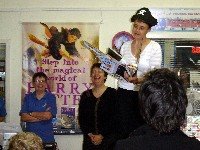
My book hit the decks last night, blessed by kind words from Lorain Day (Commissioning Editor, HarperCollins, and person of impeccable taste in manuscripts) and Julie from Jabberwocky Children’s Bookshop, which hosted the launch.
For those who weren’t there, here’s – roughly – what I said, besides thanking everyone:
It’s an honour to be a part of such a rich tradition of children’s literature, and to be welcomed into a community of writers, illustrators, teachers, librarians, and devotees completely focused on books and the children that read them.
My family isn’t here this evening – they’re all in Australia – but if they were, they’d all say, without exception: it’s about bloody time. They’ve been waiting a while for this.
I meant to start writing my first book about twenty years ago but somehow it slipped my mind.
I finally got around to it just before I moved to Auckland. My girlfriend reckons I wandered into the study and by the time I came out for dinner I’d written a book.
She might be exaggerating slightly. The truth is that when I’m writing I usually forget to eat dinner altogether.
But it does seem that suddenly (well, three years later) there are three books, and more on the way, and more ideas for new books and stories than anybody could ever write.
So here’s the first one, and I’m very happy you’re all here this evening to help me launch her upon the stormy waters.
Yes, that is a pirate hat on my head. I snatched it from the head of a passing Jabberwockian, who had dressed for the occasion.
And don’t I look tall? That’s what being published does for you.
 Kelly Gardiner