Fiction is democratic, it reasserts the authority of the single mind to make and remake the world.
~ E L Doctorow
Fiction is democratic, it reasserts the authority of the single mind to make and remake the world.
~ E L Doctorow
Reading
So instead I’m taking to the beach:
Watching
The sixth HP film was always going to be slightly problematic, since it is largely about the trio and their quest/conflicts, without the usual ensemble, and all the big battles will be in the final instalment. But it really does work, not least because the three main actors are now so much better than they were when they were younger.
I’ve heard numerous stories of small children sobbing in the cinema. It’s not a little kids’ film by any stretch of the imagination – please, if your kid is not old enough to read the book without help, don’t take them to the movie.
Writing
Of course I’m writing my PhD novel. But also making scribbles for a sort of fantasy something.
And doing last minute proofing things to Act of Faith, which is now coming out in July.
All the great things are simple, and many can be expressed in a single word: freedom, justice, honour, duty, mercy, hope.
~ Winston Churchill
I try to leave out the parts that people skip.
~Elmore Leonard
History is a collection of found objects washed up through time. Goods, ideas, personalities, surface towards us then sink away. Some we hook out, others we ignore, and as the pattern changes, so does the meaning. We cannot rely on the facts. Time which returns everything, changes everything.
~ Jeanette Winterson
I write novels, short fiction and poems for adults, young adults and young readers.
My new book is Act of Faith and it’s in the shops now.
Here you can read about my books, including sneak previews of some works in progress.
I’m also a journalist and editor who has worked on newspapers, magazine and websites, and my poetry has appeared in leading literary journals. You can read some of my travel writing, feature articles and poems.
Or you can read my blogs:
I never quite expected the words “Camus” and “Paraparaumu” to appear in the same story, but trust Bookslut to get there first.
An interesting post from Elizabeth Bachner on being transported by the legendary Margaret Mahy all the way from Manhattan to Paraparaumu, as an adult reader of a young adult novel. Margaret Mahy can do that to you.
Bachner has been scouring The Ultimate Teen Book Guide: More than 700 Great Books, and spends some time discussing the nature of best books – the books to which you return, no matter what age you were when you read them:
It makes me expect some new book [which will] thrill me, and heal me, and mutually love me, and make me safe. It reminds me that being full-grown doesn’t mean I have to be stolid, untransformable, bored, or dead. Beginning and ending things does not have to be teenage.
She touches on the question of whether the YA novel’s success in a crossover market is because it allows time travel by the reader back to their own adolescence or simply across genre. Or simply about finding a bloody good read.
I was wondering the same thing this morning, as it happens, having downloaded the new Scott Westerfeld, Behemoth, a ripping steampunk yarn set in World War One. Sure, I can put it down as research of my own, but the truth is that the first book in the trilogy, Leviathan, sucked me in good and proper as a reader of any age, so that I felt I had to get the ebook immediately instead of waiting to be able to locate a hardback in the shops.
My critical author brain reads it out of one eye, my breathless twelve year-old self reads it with the other.
I don’t even pretend when reading some books – for example, Harry Potter. If I think about the words on the page too much, I wish for a more heavy-handed editor. So I don’t think about it. It’s not hard. The story and characters inevitably carry me away from my adult self.
Mind you, my adolescent self largely had to get by without young adult novels and spent a great deal of time angsting with Camus too.
So maybe we’re just catching up on lost opportunities.

Yesterday I had a day off.
Granted, it is the weekend, so I’m entitled. But I don’t usually sit still much on the weekends.
Instead, yesterday I ignored my usual length list of jobs, faffed about for hours, watched two episodes of Buffy in the middle of the day, read a bit, joined the City Library, stayed in my pyjamas until after lunch and ate chocolate. I did not at any point think it was a valuable part of my creative process. I was just a blob.
I didn’t chainsaw the fallen tree or go to the trainer or sort out the compost or do the washing or harvest the winter vegies or make the soup or clean out the chook house or catch up on my research or file my papers or bake banana bread. My partner is away so I hardly spoke to anyone. I didn’t leave the house. Well, I couldn’t, since I was still in my dressing gown.
My brain needed a rest. Space. Nothing.
Serendipitously, Sarah Wilson’s column in the Sunday Age this morning is on that very topic.
When we yearn for more space we want to keep it as … a languid void that exists between us and everything else… it’s the expanse between us and sunset. Or between us and someone we fall in love with while watching them being “them” from across the room.
Quite.
So that was my yesterday.
This morning I woke up with a book in my head. That happens sometimes.
JK Rowling says Harry Potter “strolled, fully-formed” into her head on a long train trip and by the time she got to the station (presumably King’s Cross) she knew pretty much everything that happened to him, including the last line of the last book.
I can’t quite claim that. I should admit that my brain has been riffing on something for ages that I thought was little more than unspoken Dickens fan-fiction.
Now suddenly it’s something else. I’ve had scenes playing in my head, over and over, literally for months and I failed to recognise them for what they are: a new story. It has shape, is filled with dialogue and characters, but I hadn’t given it enough imaginative space – or perhaps distance – to see it from the right angle.
So I wrote down:
Now all I have to do is scribble down the other 75, 986 words. In my spare time.
Not today, though. I’ve got too many jobs.
Nice essay by Geraldine Brooks on writing about the world beyond Australia, but with Australian eyes.
“The bookshelves of my Australian childhood were garrisoned by foreign troops, filled with stories by faraway English people who wrote of things I couldn’t see or touch or know: A.A. Milne, Enid Blyton, C.S. Lewis; The Wind in the Willows, The Secret Garden, The Snow Goose. These were good books, but they came between me and my country. Australia had been an independent nation since 1901, but in the 1960s, my imagination was still a British colony.
The characters in my childhood books built their tree houses in reddening rowan trees; they did not scramble up scribbly gums…
One day, I hope to write an Australian novel. But I now know I will have to work for it.”
Clive James has written about this beautifully, too, in Unreliable Memoirs and now, as ever, Geraldine Brooks best describes the feeling: The Writing Life.
People always ask me why I write novels about European history. I’ve never cried more over a book than The Snow Goose; never been more desperate to get my hands on a book than Saturday afternoons at Nunawading Library, browsing the shelf that held both Geoffrey Trease and Rosemary Sutcliffe.
That’s why. That, and the fact that it is, objectively, fascinating.
I have written one very Australian book: the picture book, Billabong Bill’s Bushfire Christmas. But that, too, was set in the past, in that late 50s/early 60s world that does genuinely feel now like a different country.

6.45am Alarm. It’s a writing day at home, not a polish-your-shoes, leave-for-the-station-at-7.45 day, so that’s a sleep-in. I lie in bed too stupid to move and conduct unfinished arguments in my head with annoying people. Up. Put my ugg boots on the wrong feet. Fall over. Stagger out. The river below the house is banked with fog. First wattle blossom appearing. Read a few pages of Little Dorrit over breakfast.
8.30am Feed the chooks. They’re grumpy. Laptop on. Heater on. Fingerless gloves on. At desk. Immediately need more coffee. Read quickly through latest draft of current manuscript to remind myself where I was this time last week.
9am Cat trying to bash the door down so he can come sit on my knee. I ignore him successfully for a while then give in. Check emails, wonder again why I have so many email accounts (home, web, work, uni). Try to find a quote in one of my own books and realise I must have dreamed it and have forgotten details of the book entirely – how can that have happened? Will have to read my own books. How embarrassing.
10am Two main tasks today and tomorrow. First, as every Thursday, I type up scribbles from my notebook written over the last few days in spare moments – over breakfast, on trains, in a cafe. Usually I follow-up with historical research, at home or on campus, and devote Fridays to drafting.
But this week I’ve decided to consolidate all the historical records of dialogue or writing by the subject of my book (Mademoiselle la Maupin, 17th century opera singer and duellist) into one document and that will form the kernel of my PhD exegesis.
I’ve found scraps of dialogue in books by fencing masters (1904), American journalists (1930s), opera and Baroque music specialists (several) and hacks all over the world from 18th century onwards. In French or English. (That’s quite apart from the genuine dramatisations on stage, page and screen.) There’s a poem she may or may not have written, there are gorgeous passages from contemporary diarists and letters, and there will be, though I haven’t found them yet, police statements and other primary documents.

The thing is, you see, there are many accounts of her life in which I can read her supposed voice, but they reflect the tone of the times in which they were written and the views of their translator or historical interpreter. So, for example, if the author has read too much Dumas, you hear La Maupin saying things like “En garde, you bounder!” If they think she’s a transgressive monster, or an Amazonian heroine, or a victim, or a flapper, or a feminist prototype, their own words fall from her historical lips – as will mine. Only I’m writing a fiction in my version of her voice, so I’m hyper-conscious of what I’m doing.
Anyway, that’s the plan.
11am Girlfriend delivers coffee. Sigh of relief. She’s writing at home today too, but we are in separate buildings and see one another only for reasons of food and beverage. Still, it’s nice to know she’s here.
Realise I have somehow been reformatting my blog instead of writing up my notes. Love the new Blogger templates and options and keep changing my mind. First morning of my writing day blocks are often a bit ratty. That’s OK. Have to allow some time for doing promotional stuff. At least I’m not gardening or reading something completely unrelated. Get back to work, you fool.
12.30pm Finished typing up notes. Good practice – gets my head back into 17th century France, where it belongs. Bit of faffing around on book blogs and industry websites. (In the middle of book contract negotiations and need an update on subsidiary rights.) Interesting time to be negotiating a new deal. Think e-book rights may change in the next year or so but have to work with what’s happening now. Keeping an eye on Future book and Booksquare. The Australian Society of Authors, of which I’m a member, has just released a new paper on the topic.
Checked the announcement of the PM’s lit award shortlist, out today. Brilliant selection. YA and children’s publishing in Australia is really quite extraordinary, as is New Zealand’s: both countries, as so often, punching way above weight.
3.30pm Back at the desk after food foraging and some much-needed exercise. Somehow managed to Velcro myself to my Crumpler in the process of getting out the door. Nasty. Chooks are up on the window sill staring at me and, for some inexplicable chook reason, moaning softly. Spending a few glorious hours hunting down La Maupin in one of my favourite places: the digitised collections of France, Gallica. I can leaf through the libretti and cast lists of the operas in which she starred. Last time I got so beside myself I forgot to eat and had to be prised off the laptop.
5pm It happened again. Went mad downloading libretti (as PDFs). Just can’t get over the sight of her name, and the names of all these other people – her ex-lover, Thévenard; her idol, Le Rochois; her rivals and friends; her adored Fanchon; her nemesis, Dumensil – whose lives I’m imagining. It all helps. I can see where she’d come on stage (for example, she’s the first thing people would see in Hesione, dressed as the Priestess of the Sun), read her lines, know who is on stage with her in every scene. Not to mention the Gazette!
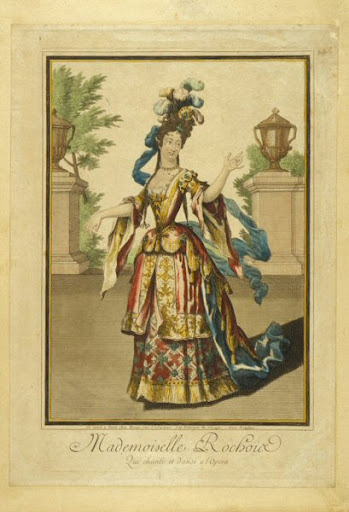
Priceless. I love digitising. Never mind your iPad. Digitising of heritage materials and archives is changing the world in such fundamental ways it will never be the same. It’s as revolutionary as the invention of the printing press. Which is the theme of my next book, as it happens. (And part of the reason for my day job – disclosure.)
6pm That’s enough. Back to Little Dorrit.
 Kelly Gardiner