Almost a Logie

Was very chuffed to hear that Act of Faith made it onto the Gold Inky longlist this year. It’s a great honour. A sensational list, too.

Congratulations to everyone on the Gold and Silver longlists. And long live Inky!

Image

I must say I’m quite partial to an awards sticker nowadays. Last week I signed a whole lot of copies of Act of Faith with their new silver CBCA Notables stickers on the covers. Very posh. Although I do rather fancy the idea of a silk sash. With gold fringes. Not for me, you understand. But Signora Contarini would love it.

Multifunction machines

Remember the fax? Remember how amazing it was that you could expect an answer from someone anywhere in the country (let alone overseas) within 24 hours? Wow.

Who owns a fax now? Talk about instant obsolescence. I haven’t sent a fax in years, and if I ever have, it’s been from my desktop PC or from a machine that is really a printer and photocopier.

I have an ereader. An early model Kobo. It doesn’t do anything fancy. You just read stuff.

When I say “early model”, I mean it’s about three years old. Maybe four. And it’s already gone the way of the fax machine, because almost immediately after it came out, the new ranges of ereaders and the tablets appeared, on which you can not only read stuff but also highlight, annotate, flick pages, interact, play music, and make toast. Well, maybe not the toast, but that’s not far off.

I should get a new ereader or a tablet, I know. But I waver between early adopter and conservative purchaser. I like that my Kobo isn’t backlit, because after a day of staring at a screen it gives my eyes a rest. I also have a little netbook instead of a tablet, because what I mostly do is type, and there are things about an iPad that don’t suit me and my needs. Yet.

It’s clear to me that the tablets, ereaders and netbooks are in a transitional phase, and as a poverty-stricken writer (well, not quite, but I’m only on a part-time wage) I don’t upgrade my hardware every year or so just to keep up.

So I’m happy to wait for the next round of devices that bring those elements together properly. It’s not far away. Just this week, Kobo has announced a partnership with Google Play to provide access to apps and games though its Vox tablet. And Microsoft is expected to announce a deal with Barnes and Noble melding the Xbox and an ereader/tablet. There are already millions of book and literacy apps for iPad/iPhone and Android that explore new territories in interactive reading and gaming.

But apart from the reading devices and platforms, one of the issues that I think is huge for publishing and for writers is the issue of territorial rights in the  digital era. The sector has been (rightly) banging on endlessly about royalty percentages and the impact of digital on what is often more about printing – not publishing as such. I’ve long thought that the real impact on publishing models would be on rights.

Traditionally, a publisher buys the rights to a book for specific regions such as the US, UK, or Australia/New Zealand – or world rights, with translations into languages other than the original being dealt with separately. But digital publishing makes a nonsense of territories. Who cares what rights you’ve bought or sold, when readers can order your ebook from any retailer they prefer, based anywhere in the world?

And now one of my publishers, HarperCollins, has announced a new venture called HarperCollins360, which aims to “make each HC title available in all English-language markets, when the necessary rights are held”.

I don’t know yet what the business model is, what it means for existing contracts. I don’t know how much will be based on POD (print on demand) and ebooks, which could threaten some authors’ deals for territories other than their own. Every transnational publisher must be thinking along similar lines, and that may hold implications for smaller local publishers which work the international rights deals. So there will be many issues to thrash out in the industry, and I’m sure the Australian Society of Authors, agents, SPUNC and others will be right in there.

But I do know I’ve been held back in the past from being distributed in some key markets because of territorial rights – the Swashbuckler books, for example, couldn’t be sold in Malta, where they are set, because Malta is technically part of the UK territory, and HarperCollins UK didn’t have rights to publish them. I’ve always wondered whether India and the many Asian countries with large English-speaking populations are under-developed markets for Australian writers. Everyone gets so focused on selling into the US and UK – but what about Canada and South Africa? I can see great possibilities in a more global approach. It makes sense, and also helps break down all those subconscious post-colonial obsessions with approval from the mother country or the Americans. Haven’t made it unless you’ve got a review in the New York Times? How about the Times of India?

So, as with ereaders, I’ll be watching and reading and talking and keeping up to date – and possibly waiting for the dust to settle. Will I be an early adopter or a conservative? We’ll see.

Social media for writers and readers

Here are some of the platforms and examples used in my workshops on social media for writers and readers.

Twitter:

Twitter hashtags:
  • #ewf12
  • #aww2012
  • #1book140

Facebook pages and groups:

Pinterest:

GoodReads:

YouTube:

Blogging platforms:

  • WordPress (easy to use, can add functions)
  • Blogger (simple, Google product)
  • Tumblr (simplest of all, great for images)

Readers’ resources:

Management tools:

Here are the slides from the sessions:

Coming up

I’m heading off today to present a couple of workshops, as part of the Emerging Writers’ Festival, on social media for writers and readers. Looking forward to it, too, because it combines the two distinct parts of my life: my day job, which is all about online learning and training people in the web; and my writing self.

Late next week I return to Brisbane for the second part of my May Gibbs Children’s Literature Foundation fellowship, to start work on the redraft of The Sultan’s Eyes and also to run workshops as a writer in residence at the State Library of Queensland. Most of the workshops are for schools, but there are a couple of public sessions for younger readers/writers on Words that changed the world – subversive books and the forces that tried to stop them.

I can talk about that stuff for hours. And no doubt will.

An Australian literary voice?

Attended a panel this morning at the always excellent Emerging Writers’ Festival on the idea of an Australian literary voice: “Does one exist? Who tells the stories of Australia? And are our literary voices representative…?” Panellists were Michael Mohammed Ahmad, Stephanie Convery, Bruce Pascoe and Lily Yulanti Farid.

First, the panellists all argued that the idea of AN Australian voice is problematic, that the prevalent voices aren’t representative, and some questioned the very notion of a nationalist voice or the need for one.

The speakers were all great and came at the topic from different perspectives – no consensus as such, just lots of unpacking, because it’s all too much to fit into an hour’s discussion. I think it’s fair to say there’s pain around this issue, and Mohammed hinted that he gets a bit of grief for raising the issue in some forums – which I can well imagine.

I’ve been thinking about all that since, so here are a few thoughts and questions.

What we often think of as national literature is about place, right? Mohammed used the example of Irish literature: we know what that means,  we know more or less who it includes.

In a sense that’s true: I immediately pictured Irish literature and it looked a bit like an old postcard of Galway Bay.

But I bet that there are a whole lot of Irish writers who feel excluded from the idea of Irish literature.

Surely the same discussions go on in Ireland and England and France and a whole range of other countries too.  Don’t you reckon? Remember when the Zadie Smith or Monica Ali generation of young British writers exploded on to the scene? English literature was not just Dorset or the Lakes District any more –  or even Bloomsbury – it was also the East End and North London. Wow. Mind-blowing. But the post-war novelists got the same reaction.

So is ours a different thing because it’s much more exclusive? Could be. Or is there a fundamental question in there for us about the Australian sense of place and the way in which that comes through in the books we prize (not necessarily the books we write)?

This country most prizes – awards, discusses, reviews, quotes, studies, canonises – writing about the mythical place of the colonial or post-colonial bush. (Though it should also be said we don’t necessarily buy the most awarded books  in great numbers, if at all – but the books sold in the millions are often concerned with the colonial past or the bush too.)

That obsession won’t go away, I think, until there is a genuine and deep reconciliation with the truth of dispossession. We have a long way to go before that permeates enough to change the way non-Indigenous Australians see and mythologise and engage creatively with the land.

The people writing about place differently include Kim Scott, of whom Alison Ravenscroft wrote recently:

In his hands, even the country—the mountain itself—is differently shaped: it is a different thing. In That Deadman Dance we are told of the mountain that sheltered Wabalanginy: ‘like an insect among the fallen bodies of ancestors, he huddled in the eye sockets of a mountainous skull and became part of its vision, was one of its thoughts’ (52). Rocks are fallen ancestors, country is a body, to travel is to journey beside animated ancestors. Scott is not telling the same old story, populated with men and women who are remarkably recognisable to white readers as a version of ourselves, or familiar from our fantasies of our others. His writing calls his white readers to suspend our belief in our own knowledge of the smell, shape and sound of the world; he calls readers like myself into stories that are unbelievable (to me), impossible, implausible, even as they are ‘true story’ for his Indigenous protagonists. He invites us to bear the unbelievable, to stay with it until it morphs into another shape.

The good news is that sometimes when a beautifully written perspective like  That Deadman Dance or Alexis Wright’s Carpentaria comes along, it is embraced. That’s not true for all or even many writers – no matter how good their work – who are marginalised or excluded by that nationalist myth, or who simply chose to write about something completely different or in a completely different style.

The other most significant place is suburbia or the bourgeois world – that’s a subversion of the bush myth in one way, but it’s also traditional in our literature (Patrick White, for instance, or Christina Stead) and also in realist  writing generally.

Others have written and spoken about the issues involved with the supposed national identity and gender, especially lately. It appears that male writers focused on suburbia are in the Best in Show literary category, while women writers who focus on suburbia are doing Women’s Writing, and the writing  that is most often awarded is predominately written by straight white men about the outback. There are statistics, there are arguments, there’ll be a little bit of movement here and there. That sound you hear is heads banging against brick walls.

So there are simple answers to the questions raised for this morning’s panel. No, there is not AN Australian voice, it’s just that some voices are prized over others. Those that are most prized fit into a certain canon and that canon will have to change if only so we don’t get bored to death. The other voices (which is, let’s face it, just about everyone) are sometimes in danger of being drowned out, and we have to do a whole lot more to support them.

But I feel optimistic that there are enough people who want to hear them, and that when they do, they will realise how much more interesting and glorious a choir can be instead of that guy on the street corner singing Eagles covers.

Because when you think about it, Irish literature includes as diverse a range of writers as Childers, Stoker, Somerville & Martin, Joyce, Yeats, Shaw,  O’Casey, Beckett, Wilde, O’Brien, Heaney,  Enright, Binchy, Trevor, Banville and Tóibín. You don’t see all of them banging on about Galway Bay.

Coming up

This weekend I’m speaking at ‘Words at the Warrandyte Cafe’ on why and what I write, what I read, and particularly the world of Act of Faith.

It’s 4pm to 6pm Sunday 6 May at 61 Yarra Street, Warrandyte. It’s one of a series organised  by the lovely people at the Warrandyte Neighbourhood House, and bookings are through them on 9844 1839 or email info@warrandyteneighbourhoodhouse.org.au.


Metamorphoses

Am loving reading Ovid’s Metamorphoses, here at Varuna.

I have been meaning to read it for ages because I never have, and it’s the text on which the French Baroque composers based many of the operas in which La Maupin performed. Also because, hidden in among the exploits of Jason and Perseus is the story of Iphis, who was raised as a boy: a story La Maupin would have known well.

I don’t get much reading time, but it’s glorious, and one of those splendid, robust 20th-century translations (Rolfe Humphries, Indiana University Press, 1955).  I imagine Eleanor Dark reading this, while the wind rages around the house, as Juno (or whoever is in charge of the weather in Katoomba) decides to flood the earth:

… he turned loose

The South-wind, and the South-wind came out streaming

With dripping wings, and pitch-black darkness veiling

His terrible countenance. His beard is heavy

With rain-cloud, and his hoary locks a torrent,

Mists are his chaplet, and his wings and garments

Run with rain. His broad hands squeeze together

Low-hanging clouds, and crash and rumble follow

Before the cloudburst, and the rainbow, Iris,

Draws water from the teeming earth, and feeds it

Into the clouds again.

Writing together

I’m not much of an extrovert. Far from it. I’d happily stay home and never go anywhere, but that’s not how the world works. You adapt. Leave the house.  Talk to other people. Real people.

So it fascinates me how networked and interactive the writing community is, online and in real life, considering how many writers are introverts. There are those huge web communities where people pitch ideas, get draft feedback, agonise over rejections, beg agents for advice, just like the Writers’ Centres  and events we have in so many places now. There are courses and workshops and a whole lot of people (the extroverts, probably) creating careers out of connecting writers with one another and – of course – with publishers and agents. They scare me a little, but never mind.

The amazing thing to me is how communities develop organically, or when given a gentle boost. The Young Adult authors on Twitter, for example, many of whom have also met in real life at conferences or events, have proved with campaigns such as #YAsaves to be a force for goodness and niceness, able to be mobilised in minutes.

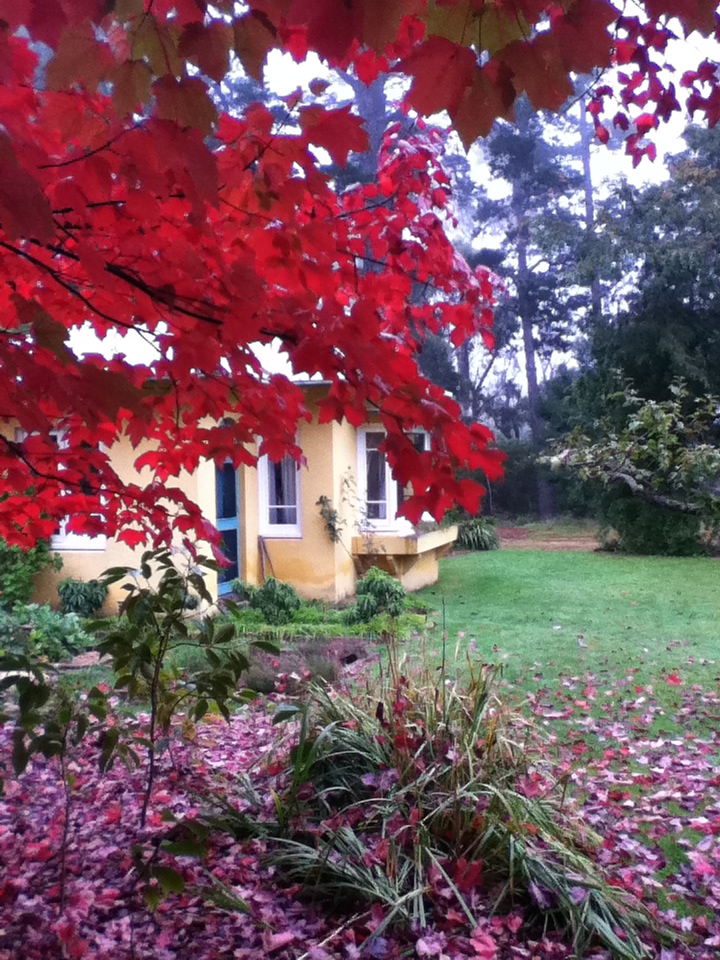
So this week and next I am in writing paradise: Varuna Writers’ House in Katoomba, in the gorgeous Blue Mountains in New South Wales. *

Image of liquidamber leaves

Dry stone wall under the liquidamber - Varuna

It’s autumn here, and some days it rains softly. There are five writers in the house, all working on different kinds of projects and at different stages of our careers. We each have a bedroom and a writing room, in a house filled with books and light. We wake up early most mornings. We may or may not see one another during the day. We slouch about, sit at our desks, proofread in the sunshine, go for walks, refuse to go for walks (in my case), browse the bookshelves, and write.

Mostly write. When we assembled on the first evening we all agreed there was some kind of magic going on. I’d written 5000 words that day – twice the usual rate. We start early (though it’s entirely up to the individual) and most of us are at our desks for 11 or 12 hours. But it’s not just that – somehow the mind becomes more focused, more productive. If there’s a writing zone, we are deep inside it. It’s quiet, respectful, peaceful, dedicated, and we are all conscious of the extraordinary privilege of being here – of being supported, as writers.

We help ourselves to the plentiful food supplies – in some cases every two hours – and then around 6pm we slowly assemble in front of the fire in the dining room, talk about our days, our work, the world and wait for the legendary Sheila to arrive and prepare a fabulous meal.  It’s a little writing community, of sorts: a temporary one, although I know plenty of people who’ve made lasting friendships here.

It’s quite different from my select and extremely rowdy writing circle back home. There are three of us. Most weeks we meet for lunch, for coffee and then go write. Together. We sit about with our laptops somewhere soundproof (for the safety of those around us) and we write in 25 minute sprints, and then for ten minutes we gossip, drink cups of tea, and laugh until we weep. Then another writing sprint. I haven’t been part of that kind of writing community for years, and it’s lovely. (Thank you, Paddy O’Reilly and Fran Cusworth.) It developed naturally, in a way, but we are also all PhD students in a faculty of supportive people.

Online, I’m part of a community of writers and readers, many of whom I’ve never met. We share resources, articles, reading suggestions, outrage, shameless plugs, despair, jokes, favourite videos, support and encouragement. It’s called Twitter and it’s as much a part of my own professional development as – in fact more than, because it’s daily –  my membership of any professional organisations.

So you see – even an introvert gets out sometimes.

Image of Eleanor's studio, Varuna

Eleanor Dark's studio, Varuna

*Varuna was the home of author Eleanor Dark (The Timeless Land)  and Dr Eric Dark, who served with the Medical Corps on the Somme and was awarded a Military Cross following Passchendaele. The MC citation, dated 15th August 1917, reads:

“For conspicuous gallantry and devotion to duty in leading his bearers. He displayed great gallantry and disregard of danger in moving about in the open under the heaviest shell fire, collecting and evacuating the wounded. He worked continuously for thirty-six hours, by his energy and determination contributing largely to the rapid clearing of the battlefield.”

Their house must have been an oasis in their busy lives: both were at the forefront of contemporary politics; Eleanor was a feminist and social justice advocate, Eric a socialist and committed member of the Labour Left during those turbulent decades around the Second World War. Varuna was donated “to literature” by their son Mick and is now a year-round haven for writers of all persuasions. It has a range of fellowships and programs: I was lucky enough to be awarded a Retreat Fellowship.