Re-reading childhood heroes

When I was little, we didn’t have many books. Not that we didn’t like them. We did. But we didn’t own many. We’d moved to a new suburb on the edge of town and for several years there wasn’t much there except houses and dirt roads and orchards and bush. Then when I was about seven, two amazing things happened: they connected us to the sewerage system (which made reading on the loo much more relaxing – no more worrying that the Pan Man was going arrive while you were sitting there), and, wonder of wonders, a new library was built.

And I discovered the magic shelf in Children’s Fiction: Authors by surname, S to Z.

It changed my life. And what I write now is directly related to what I read then. The books I found there (and on other shelves) were part of a golden age of historical fiction for children.

For the last couple of weeks, I’ve been consciously re-reading some of the books I remembered from that shelf (and a few others).  I re-read several of these in recent years as part of research into approaches to historical fiction. But over the last few weeks I have consciously tried to immerse myself in them, one after the other – a feast, or an experiment, or a binge. Or perhaps all of the above.

Here’s what I’ve re-read:

Rosemary Sutcliff

  • The Lantern Bearers (1959)
  • Knight’s Fee (1960)
  • Dawn Wind (1961)
  • Sword at Sunset  – sort of (1963)

Geoffrey Trease

  • Bows Against the Barons (1934)
  • The Barons’ Hostage (1952)
  • Cue For Treason (1940)
  • The White Nights of St Petersburg (1967)
  • Danger in the Wings (1997)

Henry Treece

  • Hounds of the King (1955)
  • The Children’s Crusade (1958)
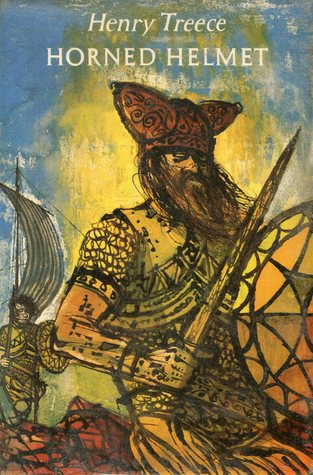
  • Horned Helmet (1963)

Ronald Welch

  • Knight Crusader (1954)
  • Nicholas Carey (1963)
  • Tank Commander (1972).

And favourites from the A – H shelf:

Leon Garfield

  • Devil-in-the-Fog (1966)
  • Smith (1967)

I also re-read The Silver Sword (1956), by Ian Serraillier, which I loved as a kid and found disappointing as an adult reader and Lawrence Durrell’s White Eagles Over Serbia (1957). These technically aren’t historical fiction, as they were written about events in the lifetime of the author (post-World War 2 Europe), but I read them as such when I was young.

I was interested in exploring commonalities and differences in approaches, technique and content in historical fiction of the post-war (UK) golden age, and what and how we write now for middle years and young adults.


Cover - Bows Against the Barons

Different approaches

Many things have changed since these books were published, and even across the decades of these authors’ careers: writing styles, approaches to writing for different reading levels, politics and attitudes; and thanks to archaeology and archival research we know a great deal more about some of the historical periods in which they are set. When I first read these books, there wasn’t really anything we’d define as Young Adult – that generation of authors helped create YA and children’s fiction. We now have a greater technical understanding of how different age groups read, how literacy operates, and (hopefully) about cultural diversity and gender issues.

When these authors were at their peaks, they could assume a certain level of historical knowledge in their readers. A ten year-old might not know much about the Marcher Lords or Edward Longshanks, but they’d get the general gist and they’d certainly know about Roman, Saxon and Norman Britain, for example, or where Vikings came from.

Now, when I ask a class if they’ve ever heard of Napoleon Bonaparte or Cleopatra I get blank stares. That makes me sad, although those students know a whole lot of other stuff that I don’t know.

And of course, these were all UK authors aiming primarily at a UK readership, but even we on the edge of Melbourne knew this general history. We didn’t learn much about the history of our own country, and especially not about its indigenous past, so some things have changed for the better.

The point is, I now can’t assume any consistent historical knowledge. It’s something I need to be aware of when I’m writing – I have to make sure to include as much political and historical, sometimes also religious or geographical, context as possible, all without seeming to do so.
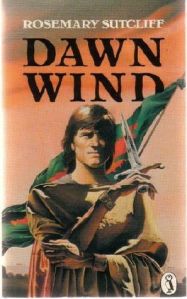
 

Cover - Dawn Wind

Issues in common

Almost everyone who writes historical fiction grapples with the question of how much detail to include in the story. Everyone – even the masters – struggle at times with filling in political back story or placing the action in the context of historical events. It often feels heavy-handed, especially when there are a lot of names of historical figures and battles or events and they all happen off-stage.

Things that drive me mad, such as having to mark the passing of months or even years, are handled with aplomb by Sutcliff and Trease. They are just upfront about it – rumours swirl, messengers arrive, years or months pass. They are especially good at noting changes of seasons – easier when your setting is agricultural.

I often spend some time deciding how to treat violence and especially brutality for middle years readers. These writers, although often writing about war, skim over the details.

Perhaps that’s why many of the climax points seem underwritten or oddly paced – a battle, a confrontation, a fight is over so quickly that it can easily be missed or its importance go unrecognised. They need perhaps more of the thriller technique in these scenes – more menace, more visceral action, and perhaps more reflection.

There’s no coyness about bloodshed in the Treece Viking books, though – indeed, how could there be? You can’t write about Viking warriors without a whole lot of heads being whacked and swords red with blood. Why would you?

Of great interest to me, given my 1917 project, was Ronald Welch’s treatment of the horrors of war in Tank Commander. He certainly doesn’t shy away from depicting the horror of trench warfare, of death, of the fear and panic soldiers experienced when trapped in a trench with shells exploding all around. Welch served in WW2, as did Treece (Trease did too, but as an Army Education Officer – a perfect role for him), which perhaps helps him achieve a level of verisimilitude in his portrayal of men living with the trauma of constant battle. He even describes the execution of a young soldier for cowardice, and there’s no disguising the death and the bloodshed. The moral implications are barely explored – on one hand, the protagonist, John Carey, has sympathy for the young private when he sees him cowering and muttering in the trench – on the other, he doesn’t question the sentence or regret its aftermath, but that is probably a fairly accurate portrayal.

People die in these books – friends, kin, even major characters.There is grief and loneliness, just as experienced by so many young readers who lost family members in the war.
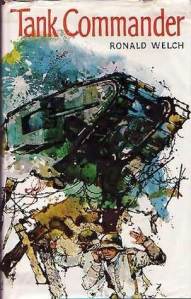
 

Cover - Tank commander

Openings

You can tell a lot from the first line of a book:

The moon drifted clear of a long bank of cloud, and the cool slippery light hung for a moment on the crest of the high ground… – Dawn Wind

I asked, weren’t we taking the pistol, or anyhow the long, murderous-looking pike …  – Cue for Treason

Though Methuen usually lived at his Club whenever he was in London it was seldom that he was seen in the bar or the gaunt smoking-rooms.  – White Eagles Over Serbia

Beorn was only a boy when his father jumped off Ness Rock into the sea and was swept away like a piece of black driftwood.  – Horned Helmet

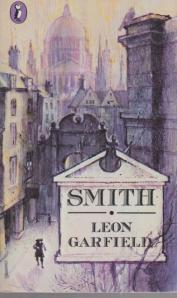
He was called Smith and was twelve years old. Which, in itself, was a marvel…  – Smith

Sutcliff is always painterly, setting the scene as if a curtain is rising.

You’ll often hear the advice from Elmore Leonard: “Never start a book with the weather.” But we’re not all Elmore Leonards. The world needs Rosemary Sutcliffs as well.

Trease kicks off with a bang, then backtracks in the first few pages so you know where you are and whose story it is that you’ve been sucked into – cheekily in Danger in the Wings which begins:

In those first heart-stopping moments – he always remembered afterwards – the course of his whole life must have been decided. It was when he saw the ghost.

A few pages later, we’re relieved and possibly disappointed to learn that it’s the ghost in Hamlet and that the life-changing moment has to do with the theatre.

This is the technique I tend to use, especially for middle years. My young adult books veer a little more to the scene-setting opening. So far.
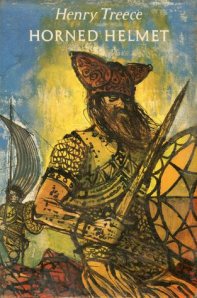
 

Cover - Horned Helmet

Themes

A common theme in many of these books, for obvious reasons, is destruction and upheaval. Sutcliff’s post-Roman Britain, the setting for many of her novels, is a metaphor for the ruin of Europe and the UK after WW2 and especially the bombing raids. Her Britons are trying to rebuild, or are holding back the tide of violent invasion or starving in the rubble.

An overall theme, as is often the case with historical fiction, is that of individuals caught up in the great events of their time. Many of these novels consciously engage with real historical figures, so that their fictional protagonists meet up with Elizabeth 1 or Vortigern or Edward Longshanks. In The White Nights of St Petersburg, young David is caught up in the Bolshevik Revolution. In The Lantern Bearers, Aquila is the last Roman soldier left in Britain. The several hostages in The Baron’s Hostage are kept prisoner by Simon de Montfort, while the boy Beorn goes a-Viking with Jarl Skallagrim in Horned Helmet.

They blend a real and imagined history, and focus on great events as experienced by ordinary (or at least not famous) people.

Garfield’s characters are entirely imagined, and they inhabit exotic landscapes familiar to any reader of Dickens or Stevenson – the gloomy underbelly of the city, the dark side of human nature.

So in these books, we can see at least two common approaches to historical fiction: portraying the past as a fascinating foreign country; or drawing parallels between the past and the now.
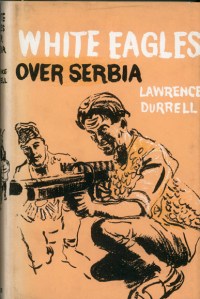
 

Cover - White eagles over Serbia

Structure and plot

These are mostly quests, and it’s noticeable how episodic the narrative is as we follow along the hero’s journey – more so, I think, than in recent novels. The structure is often a simple series of scenes that are not always narratively linked – or at least, they don’t build up across an arc. Early episodes don’t necessarily relate to later plot points or the inevitable climax. Sometimes earlier plotlines fizzle out. It’s as if adventure is enough. And it was, for the young me.

Perhaps this is conscious and related to theme, with the quest sometimes feeling aimless because the world is destroyed and there is no clear road ahead, or because the hero is a soldier living from battle to battle.

But not always. Cue for Treason is plotted like a mystery with a fair degree of foreshadowing, White Eagles Over Serbia is an action thriller, while Knight’s Fee is driven by character. Garfield writes tight, brilliantly plotted books with twists to make Dickens gasp. There are several strands – the overt plot, plus perhaps a romance, plus a character growing up or changing in some way.

In other cases, it seems that a series of exciting situations is enough. Or the progression of an historical event, such as The Children’s Crusade, is simply followed – with a bit of an escapade at the end to liven things up and get the children home in an ahistorical rescue.
 

Cover - Knight Crusader

World views

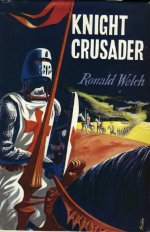
On re-reading, I was shocked at the racism and anti-Semitism in Knight Crusader and Nicholas Carey. Every “foreigner” and/or bad guy is “swarthy” (what an ugly word), every Italian and “Arab” untrustworthy, and everyone who is Jewish is avaricious. And probably swarthy as well. Needless to say, they all have minor roles. As a kid, I loved Welch’s series about the Carey/d’Aubigny (no relation to Julie) family, and my brother and I used to fight over who got to read them first. If I noticed this nasty tone, I’d forgotten. Probably I didn’t even notice it, sad to say.

Now, if you’re writing about a character who holds those views, as every Crusader did, you might need to write these attitudes into their world view. (In fact, one of the least convincing and historically inaccurate Crusader characters of recent years was Orlando Bloom’s Balian in Kingdom of Heaven, with his modern liberal – almost Orientalist – attitudes and lack of crusading zeal.) Many characters in all of these books voice their contemporary attitudes, especially about gender. Medieval parents disapprove of girls being uppity or wanting to avoid an arranged marriage. That’s as it should be if you’re reflecting the mores of the era.

But in Knight Crusader in particular these come through in the authorial voice. And don’t tell me that it’s because Welch was a man of his generation. You don’t read that kind of nonsense in Trease. Sometimes you come across ignorance about people with disabilities or indigenous people. But not outright nastiness. Mind you, I did also notice hints of homophobia in Sutcliff’s Knight’s Fee, in which the bad guy wears scent and has a high laugh.
 

Cover - Smith

Characters

It’s a long time since I’ve read a modern book for middle years or young adults with an adult protagonist, as there are in The Lantern Bearers and White Eagles Over Serbia. It’s much more common now to have the main character a little older than the anticipated readership. In fact, it’s de rigueur.

But it’s not always possible. If you’re writing about war, for example, as I’m doing at present, the protagonist has to be old enough to go to war. Not every book about WW1 can have a young lad running away and lying about his age to enlist.

What on earth makes us imagine that kids don’t want to read books about adults, nowadays? I imagine it’s due to the obsession with ‘relateable’ characters, on which I’ll post soon. But kids watch movies and TV shows about adults. They act as adult protagonists in games. Over about eight or nine years-old, I reckon young readers are perfectly willing to see the world through the eyes of someone older than them, so long as the rest of the narrative is of interest. If it’s a straight out adventure, why not? Plenty of kids are still reading The Lantern Bearers (more than 50 years after it won the Carnegie Medal in 1959).

Similarly, some of these books are written from the point of view of the protagonist as an adult looking back. They might end, as do Cue for Treason and The Baron’s Hostage, with the hero happily married to the heroine and perhaps writing down an account of their youthful adventures. You don’t see that often nowadays either. But it’s a bit like the epilogue to the Harry Potter books – it draws a boundary around the possible futures you might imagine for the characters. This is how it ends. Don’t bother trying to imagine anything else. Oddly unsatisfying, but perhaps that’s just me.

In The Children’s Crusade and The Silver Sword, in particular, the child characters behave in ways inconsistent with their supposed age. In fact, it’s sometimes hard to know how old people are meant to be, as if there is some kind of generic child behaviour and voice that is applied to everyone, whether they’re six or sixteen.

Most of the protagonists in these books are men or boys. These were authors writing in the tradition of the ripping yarn – of Biggles and Jack London – assuming that adventure tales or tales of war were for boys. Female characters, even in these books of Sutcliff’s, are sketched lightly. Even Regina in Dawn Wind – a haunting character – gets little chance to exercise much agency.

But not Trease. He was one of the first to consciously write pairs of protagonists – one male, one female, and relatively equal (although not quite). The books are often from the male point of view, in some cases there is a hint of romance between the two – or more than a hint – and the young woman’s behaviour may be proscribed by the values of the period, but she is right there in the adventure. These young women are brave, tough, outspoken and engaged in the action.

I did note that there are many characters, possibly too many for a young reader to keep track of, in some of these books, especially when most of them are so lightly sketched it’s impossible to tell them apart. Even some of the protagonists seem to have only one feature – courage, perhaps, or ambition or restlessness – and don’t gather more attributes over the course of the novel.

But then there’s Dog (Dawn Wind), for me, one of Sutcliff’s most memorable characters in spite of having no lines beyond the odd warning bark – so memorable in fact, that to this day I long for a wolfhound, and my great canine love, Lily, looked like a miniature version of Dog.


Cover - Lantern bearers


Language and voice

There’s such a range of writing in these books, from Sutcliff’s glorious landscape paintings to Durrell’s detailed miniatures. To our eyes, both of these authors may not seem to write for a young readership: the language and sentence structure are pitched at a high reading level, and the protagonists are often adults. They are prototype young adult books, in which the reader can get lost in both language and story, which assume an educated and willing reader – of any age – and defy the idea that writing for children should be any less complex than writing of literary for adults. (In fact, in some ways, it can be more complex.)

That said, it’s possible to overdose on Sutcliff’s prose, or perhaps it was easy for her to get carried away with both description and historical detail, and after one too many moons and hillsides and dawns and glens and heavy oak doors, even my eyes started to glaze over. As a result, I have failed, yet again, to finish The Sword at Sunset (which, although a sequel to Lantern Bearers, isn’t really a kids’ book).

As I’ve noted before, Geoffrey Trease was the early master of the transparent voice in historical fiction, trying to ensure that the historical didn’t overwhelm the fiction – designed so that younger readers barely notice the voice and get straight into the narrative. Danger in the Wings has a more casual 20th century teen tone than other books, and therefore has dated a little, but in general the technique stands the test of time (as it does in Robert Graves’ I Claudius, published the same year as Bows Against the Barons).

A curious thing about Danger in the Wings, though: its language seems to be pitched at quite a young age group, and yet prostitution and VD are hinted at and much of the book is concerned with romance. That’s unusual among these books.

Sutcliff tries to create, in voice and in description, an atmosphere to allow the reader to feel her setting. Her characters say,  “It is in my mind that…” or “Let you ride awhile”, but it’s not an intrusive ye olde worlde affectation. She was scathing about what she called “gadzookery” in historical fiction.

The language in the Welch and Treece books is more workmanlike, and its role is to drive the reader along on the adventure. Which it does. But it’s never going to win a prize for beauty.

Two things you’d never get away with now, and nor should you try: the grown-up gather-round-little-kiddies-and-I’ll-tell-you-an-uplifting-story narrative voice and didactic tone of The Silver Sword.

I suppose there are still hit-you-over-the-head moralising books about, but with so much choice, I don’t see why any young readers would bother. Once you get into the story, you don’t notice as much, but the beginning and the ending are more Edwardian in tone than post-war.

Another hero of mine is Leon Garfield, who renders dialogue of eighteenth century London equal to the best of Robert Louis Stevenson – perhaps sharper. We rarely now see the likes of this:

They came to Vine Street. Said Mister Mansfield: ‘If you’ve nought better to do, will you come in and take a bite of late supper with me, Smith?’
‘Don’t mind if I do, Mister Mansfield.’
‘Care to stay the night, Smith?’
‘Don’t mind if I do, Mister Mansfield.’
‘Any family, Smith?’
‘Sisters. Two of ’em.’
‘Likely to worry?’
‘Not much.’
‘Then it’s settled?’
‘Just as you say, Mister Mansfield.’
‘Anything else I can do for you, Smith?’
Smith sighed ruefully. The only thing he really wanted, Mr Mansfield was unable to provide.
‘No thank-you, Mister Mansfield. You done all you can.’

Glorious. Now, the Stephen Kings of this world would have us live without that “ruefully”. But you see here how a master can blend sparse and descriptive language without it feeling overwrought. Most publishers would ask an author to avoid trying to render colloquial speech or dialect on the page.

But again, how perfect, how Dickensian, is the “Sisters. Two of ’em.”?

Historical fiction/fictionalised history

People often tell me that they don’t read historical fiction. Ask them if they’ve read Possession or Oscar and Lucinda, though, and they’ll say, “Oh yes, but that’s different.”

Are they right? And if so, how?

I recently attended the London conference of the Historical Novel Society where, it must be said, almost all the authors who spoke identified themselves as writers of the genre.

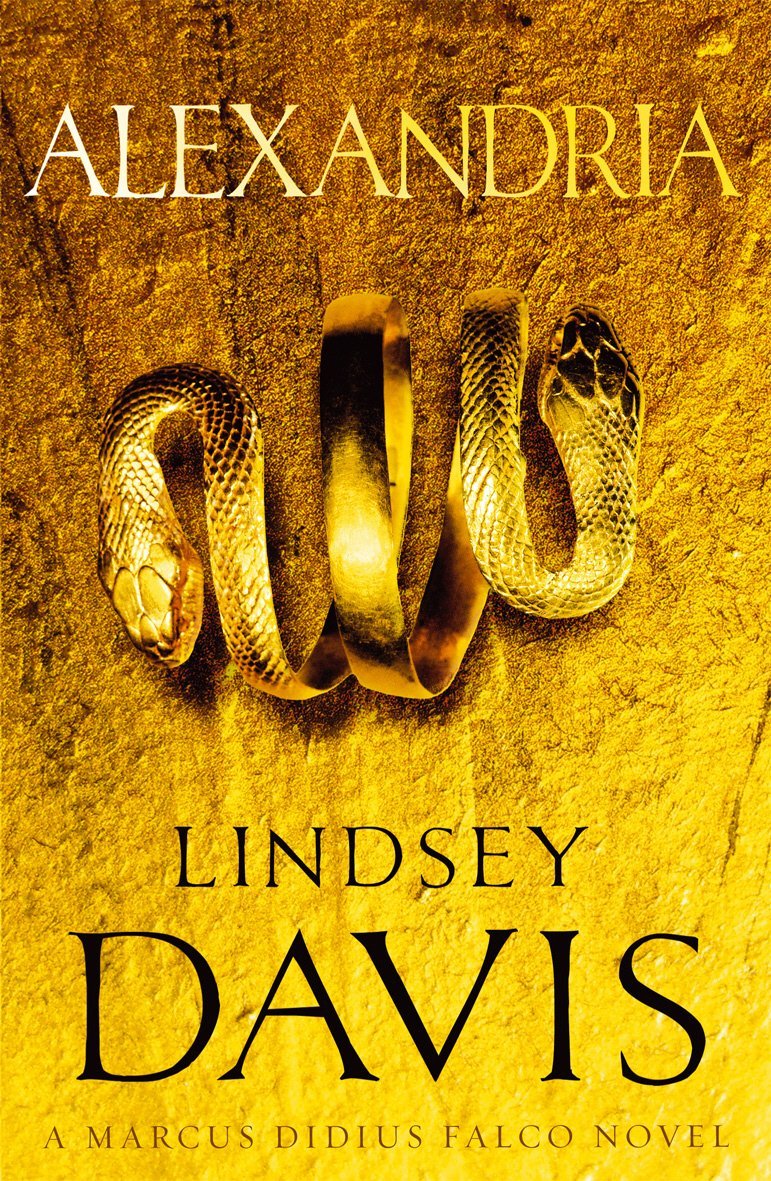
But not all. Emma Darwin and Suzannah Dunn both said they didn’t define themselves as historical novelists, and Lindsey Davis, creator of the Roman detective Falco, said: “I don’t write historical fiction. I write literary fiction.”


Image of Alexandria cover


How interesting.

I’m trying to get my head around something here, so bear with me. Please.

Historical fiction is (arguably) a genre, and as such it has common tropes, familiar forms and styles; guidelines, perhaps, rather than rules. It’s a broad church, of course, and encompasses many eras as well as approaches to technique such as point of view. It contains many sub-genres and genre overlaps, too, such as historical romance, crime, thrillers, and fantasy, and has some particular obsessions (Romans, Vikings, Tudors … and Jane Austen). It can also include time travel or alternative history, and those many stories that move back and forth between eras. Some of it is classed as commercial fiction, while some is categorised as literary fiction. One of its less discussed features, on which I’ll write more soon, is that it is quite often overtly gendered – warriors for blokes, remarkable noblewomen battling the odds for female readers.

The Historical Novel Society defines it broadly as:

To be deemed historical (in our sense), a novel must have been written at least fifty years after the events described, or have been written by someone who was not alive at the time of those events (who therefore approaches them only by research).

Does it have a recognisable form? Its origins are debated, but in The Historical Novel, György Lukács (1962) identified Sir Walter Scott as the originator of the historical novel. It’s absolutely true that other people, including women such as Madame de Lafayette, wrote novels set in the past much earlier than Scott’s 1814 blockbuster Waverley. But I think it’s fair to say that, for better or worse, Scott was instrumental in setting down (at least for readers of English) expectations of what a historical novel might be, how it might sound, what it might include – setting, plotting, character; even that it might fool around a bit with historical accuracy. It created, above all, an expectation of voice, a concept of ‘authenticity’ that is, perversely, completely false and based largely on Scott’s own style. Lukács called it ‘historical realism’, and it’s that form that you read in Tolstoy, say, and the early historical novelists.


Image of Waverley


It has evolved into new and various forms. But when normal people – readers – talk about historical fiction, often what they mean is a costume drama with epic twists and Gothic plotlines, set against a rich and detailed backdrop. Think of those addictive Georgette Heyer or Jean Plaidy books and later Bernard Cornwell or Diana Gabaldon. It is often seen and marketed as commercial fiction, too – like Heyer’s.

(One hopes for accuracy in characters’ contemporary world views, too, and these can be found in many of the best historical novels. But it’s not, apparently, required. There are a great many New Age Georgian guys and feminist princesses reflecting modern ideas and not their own. I’ll come back to this.)

Hilary Mantel’s Thomas Cromwell novels, I think, are something else entirely, something closer to War and Peace. They are works of literary fiction which are immensely popular, perhaps because of the obsession with the Tudors generally and Anne Boleyn in particular, and also because they happen to be brilliant. Compare them to the Tudor books of Philippa Gregory, for example, which are more obviously written in the traditional historical fiction mode, and it’s clear that they are a different form. Wolf Hall and Bring Up the Bodies are works of twenty-first century realist fiction set in the past.


Inmage of mantel book covers


Let me be clear. I’m not making any value judgements or setting one form above the other/s. I am a proud reader and writer of genre fiction. I’m not interested in creating a binary of a canon versus commercial genre. I’m just trying to understand and refine our definitions, and perhaps our expectations.

People shy away from the label ‘literary fiction’, partly because it’s not easily defined and also, particularly in Australia, because it has been branded as elitist and inaccessible (though it isn’t, at least not essentially). Perceptions of it are bound up with certain 20th century styles of writing which began as modernist innovation and became canon – literary fiction isn’t limited to any one form or style, but sometimes perceptions of it are.

Which is a pity. We really ought to get around to reclaiming it one of these days.

Literary fiction is definitely not a genre – it is an even broader church, but let’s agree that it is often concerned with form and experimentation with form, with ideas – including ideas about fiction and writing and narrative. It’s an invitation to explore language and meaning, the way we use words and construct ideas with them; to question and satirise and experiment.


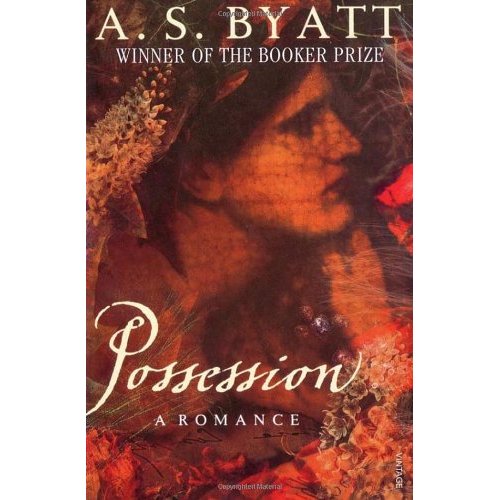
Image of Possession cover


So. Can we agree that literary fiction which happens to be set in the past is different in intent to historical fiction that fits easily into the expectations of the genre? When Peter Carey or Margaret Atwood set a story in the historical past, they are not called ‘historical novelists’. But Alias Grace and True History of the Kelly Gang are among the finest novels of recent years that are set in the past.

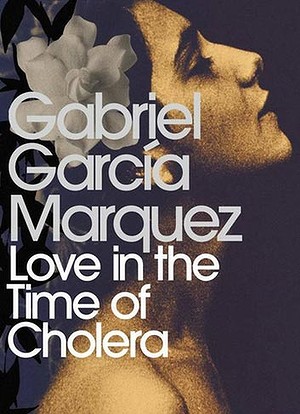
And then there is fiction that operates at the intersection of these two forms: the most obvious example is The Name of the Rose, which is one of the best-selling historical novels of the modern era, but operates on many different levels, including a complex metafictional and semiotic framework based on Eco’s years of study in the area. Think too of AS Byatt’s Possession. The Luminaries. The Passion. The Secret River. Atonement. The English Patient. Ragtime. Beloved. Love in the Time of Cholera.

I can see a Venn diagram in my mind. It’s too hard to draw, but in the overlap of the historical and literary circles are also titles which veer more towards the traditional. The recent success of Hannah Kent’s Burial Rites is a good example: literary in style, but happily recognisable to fans of the genre. Year of Wonders. Birdsong. Angels and Insects. The Song of Achilles. The Regeneration trilogy.

Sarah Waters’ entire publishing history works at this intersection, as does Nicola Griffiths’ Hild – transgressing not just genre but also publishing expectations about what’s permissible and popular in writing about gender and sexuality.

And there’s the rub.

Sometimes it works.

Sometimes it works against the success of a book.

People who love reading ‘traditional’ historical fiction may dislike literary novels set in the past if they don’t meet their expectations of the genre or sub-genre. Or vice versa.

On the other hand, readers, reviewers and book page editors may not pick up a title classified as historical fiction, but would if it was seen as literary. A panel at the HNS conference suggested historical fiction suffers from a certain snobbery, and especially if it’s historical fantasy.

‘Historical novels have often been sidelined or derided for not being serious enough, or taking liberties with facts,’ writes academic Jerome de Groot, ‘[…] as a mode that encourages a sense of the past as frippery and merely full of romance and intrigue.’


Image of Paying Guests cover


A recent feature on Sarah Waters’ new novel The Paying Guests, noted:

Don’t let the words “historical fiction” dissuade you. Waters’ writing transcends genre: her plots are sinuous and suspenseful; her language is saucy, sexy and direct; all of her characters, especially her lesbian protagonists, are complex and superbly drawn.

It seems ‘historical fiction’ is something that might turn off some readers, as if it doesn’t contain suspenseful plots, terrific language and characters. As if it’s just not good enough, or not everyone’s cup of tea. As if to be classified as such will alienate potential readers. (Of course, the same might be said of literary fiction.) As if millions and millions of people don’t read it and love it.

What are they getting at here? Waters’ great strength is her ventriloquism. She manages to capture, in voice, style and in character world view, the literature and the detail of the era in which her books are set. She manages to put it into words that sound both of the era in which the book is set and of our own time; thoughts and preoccupations that feel real and contemporary to us, even though they are not of our time – the spiritualism in Affinity, for example, or the bleak post-war desolation of The Night Watch. It never feels like costume drama (except in Tipping the Velvet).

You see? These definitions matter – to readers and to reviewers and commentators, if not to the writers.

The ventriloquism we hear in Byatt or Waters is not the only alternative approach to Scott’s version of historical voice – I’ve written about this before, so I won’t bang on.

It’s different to the voices and characterisations you’ll find in more traditional historical fiction and, importantly, Waters is willing to focus on characters who are complex, perhaps annoying and unreliable, not necessarily heroic, sometimes downright unlikeable (Maud, in Fingersmith – and yet somehow we fall in love with her … or was that just me?).

So perhaps it’s not that Waters “transcends genre”, nor that there’s anything wrong with the genre – it’s just that her work’s not the same kind of project as some other novels you might read that more clearly fit into the genre of historical fiction.

The same can be said of Mantel, of Catton, of Grenville, of Eco. Perhaps they are simply not trying to do the same thing as Cornwell or Gregory?

Perhaps it’s a spectrum, rather than a Venn diagram.

So what does that mean?

I don’t know that it’s realistic to broaden popular ideas of what historical fiction is. Let it be.

Perhaps instead we can try to define a new form (not a genre) that includes what Linda Hutcheon called ‘historiographic metafiction’ and/or embraces experiments with voice and style, with structure and form, even with history and the way people move through time.

We have enough examples of it from the last few decades. I can see it clearly enough to consciously write Goddess  in that framework, although it has few rules and very soft edges.

It doesn’t need to be defined or have boundaries placed around it – in fact that would defeat the purpose. But it could include writing that:

  • May run contrary to expectations of ‘historical authenticity’ in voice
  • Is willing to experiment with form, language, point of view, and structure
  • Consciously operates on the edges of historicity
  • Interrogates concepts of time, memory, story-telling, and history-making
  • May subvert the rules of historical fiction and/or any other genre
  • May be interested in questions of gender or subvert expectations of gender.

It might be realist or fantastical, test the boundaries of point of view (just how close can Mantel take third person?) and play with notions of historical voice (Winterson’s postmodern Sappho), layer structure and framework and metaphor and time. In fact, I wonder if perhaps subversion is one of its key features?

What else?

And what to call the literary form, if indeed it is a thing? The word ‘literary’ isn’t useful, loaded as it is. But what might it be?

Are the two forms genuinely distinct, or are they two sides of the same coin? Or is it dangerous, or unnecessary, to separate the two?

I dunno. Do you?


Image of Love in Time of Cholera

James Dean was here

A million years ago, I worked in the housing sector, managing services for homeless young people and working on policy and advocacy. One thing I learned very quickly was that young people hated being called ‘kids’ or ‘teens’ – we are people, who happen to be young. Anything else was patronising. Nobody used the term ‘youths’ because it’s so ugly, and it’s like a police descriptor: “two youths were apprehended this morning…”  In policy, in talking to government, in working with young people, we always said ‘young people.’

Now, I know things have changed, the word ‘teen’ has become much more widespread with the globalisation of US language usage, and young people around 13 in particular don’t mind being called ‘teenagers’ because they’ve aspired to be just that for several years. Then they aspire to be young adults and then adults. ‘Teens,’ not so much. It feels like a marketing term, and this is especially true in publishing for children and young adults. The age range of teens is much more limited than the age range of young adults, too, and there’s a fair bit of slippage between the concepts.

So now we have all these debates in the industry and even in the mainstream media about teen and young adult (YA) fiction: what it is, who it’s for, what it’s doing (or not doing) to its readers. Is it too dark? Does it help young people come to terms with the world? Should adults be ashamed of reading it? Or should they embrace its possibilities? Are books for children or young adults less worthy as literature, or as recreational reading? Or a glorious new form invented by [insert current best-seller name here]?

I’d like to take two steps back.

First, let’s clarify that a lot of the debate is around realist fiction, usually set in cities – it’s called ‘contemporary’ in the trade, sometimes ‘urban contemporary.’ When pundits ask whether YA is too dark or morbid, that’s usually what they mean. They don’t really mean the rest of the world of YA, which is actually a lot of books – fantasy, romance, adventures of different sorts, and even historical fiction. They mean realist books with violence or drugs or sex or swearing – maybe death – or all of the above.

It’s not that you don’t get those things in genre fiction, because of course you do, just that in urban contemporary they are often problematised, either by the author (it’s a book about a teen being homeless or dealing with grief or racism or coming out or  self-esteem), or by the commentary on the book. It is written, in one sense, in acknowledgement of issues faced by young people, to tell their stories, which are our stories too, and some of these books are the most beautifully written, engaging, and moving stories you could ever read.

So that’s what many people think YA is, that’s what many people in libraries and the industry think YA is, and indeed that’s what many readers love to read.

(We go through phases when it’s all about a specific genre because some book or film is on the wider public radar, for example dystopian or paranormal fiction, but the issues that inflame debate are often dealt with in quite a realist manner, albeit set in a built world, as in Hunger Games.)

I think it’s also clear that, for a young person, getting your hands on the right book at the right time can change your life. If you believe you are the only queer person in the world, or the only person being beaten or abused, or hating school and everyone in it, or feeling like shit, then reading about similar experiences – feeling that in-depth, close connection you can feel with a character in long-form fiction – can sometimes even save your life. We know that. Readers tell us that.

And that’s the other step back I want to take.

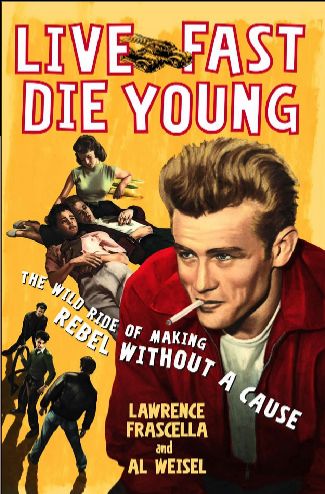
That whole James Dean/Montgomery Clift troubled teen thing is partly true – we’ve all lived it – and partly a social and cultural construct of Western society in the twentieth century. YA fiction arose after the development of that trope.

Image of film poster

Those of us who write historical fiction have to deal with this tension all the time, or at least we should. When you’re writing about a time before there was such a thing as ‘teenagers’*, how do you capture the timeless clash of generations, the age-old process of finding your way in the world, without referencing the teenager concept? What do you do when writing out of a specific cultural context, perhaps where the relationship between generations is completely different? How do you enact it within the traditions of fantasy?

Can I suggest that the idea that all YA literature is teen lit, that all books are about that problematised cultural identity, underlies the commentary about the books themselves?

I worry that talking about readers of a certain age range as teens slots them into a category – a constructed social category as much as a market segment – that says to them you are like this, you need to read these books. Maybe that’s why we sometimes see a disconnect between the books that are bought for young people and the books they buy for themselves.

People who happen to be young, like everyone else, want books of all sorts, about all kinds of things, at different times. They ask for books that offer hope. They ask for books that provide context for the task of coming into adulthood, of understanding the way the world works, of explaining the inexplicable or creating the utterly fantastical. Sometimes they just want a good laugh or a bit of a day-dream.

And don’t we all?

But there’s something about the trope of the troubled teen and the language we use around it that, in turn, troubles me. I can’t quite put my finger on it yet, but it feels like the term teen categorises both people and books in ways that may not be entirely helpful. And that’s weird, because everyone I know in the field cares passionately about young people who read – or don’t read – and the stories that are written for them, and would never in a million years want to be part of a process that was unhelpful. If it exists, it has grown organically, culturally, perhaps without us seeing it.

This isn’t about the stories themselves, you understand, but about all the stuff around the stories – the discourse and the marketing and the language.

It’s not so much about all those newspaper articles. I don’t expect someone who hardly reads any YA and is writing a one-off feature to understand the complexity involved. I also know, as a journalist, that often you have to write a story on a topic on which you need to become an “expert” in a week and you only ever skim the surface. That’s all it is and it shouldn’t pretend to be anything else. And that YA is just one of those things on which everyone feels like an expert, because they were once young and read books. Whatever. So I have a new policy of not reading dumb-ass articles.

(It’s like race-walking. I know that sounds odd, but I grew up in a family of race-walkers, have spent more hours by the track than I’ve spent almost anywhere else, and every four years when the Olympic Games roll around, I have to listen to whole lot of people who haven’t seen a race since the last Games and only ever watch the highlights hotly debating whether or not some competitor should be disqualified.)

Mind you, I do get cranky when I read articles that are also based on nothing, because it tells me they have no idea of the technical requirements of writing for certain age groups and haven’t bothered to do any research or read many other authors in the field. (There’s a terrific summary here, with bonus bingo card.)

Famously, Caitlin Moran’s recent statement ** that there are no strong female characters in YA, led to the depressing situation of seeing a whole lot of people whose work I adore hopping into one another on Twitter.

So let’s just acknowledge that there’s a lot of thoughtfulness, as well as a bit of crap, written about YA at present.

What I wonder is if people who think about – worry about – and debate these issues need to reconsider a few concepts. This is a question, not an answer. Other wiser people may already have those answers.

Maybe we do mean teen fiction when we discuss contemporary YA – and maybe we need a better term. What if it limits perceptions of the books? Or does it need to be reclaimed?

What if calling our readers teens doesn’t empower them after all? Is it a term applied to them, or something they claim for themselves?

I don’t know. What do you think? What terms do you use, and how do you define them? Does it matter?

Does that troubled teen trope still influence the way we or others perceive YA fiction now?

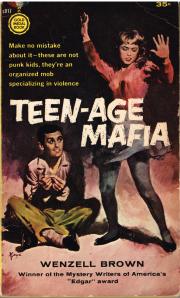
Teenage_mafie

* From the Online Etymology Dictionary:
teen (n.) “teen-aged person,” 1818 (but rare before 20c.), from -teen. As an adjective meaning “of or for teen-agers,”  from 1947.
teens (n.) 1670s (plural), “teen-age years of a person,” formed from -teen taken as a separate word. As “decade of years comprising numbers ending in -teen,” from 1889.
teenager (n.) also teen ager, teen-ager; 1922, derived noun from teenage (q.v.). The earlier word for this was teener, attested in American English from 1894, and teen had been used as a noun to mean “teen-aged person” in 1818, though this was not common before 20c.
teenage (adj.) also teen age, teen-age; 1911, from teen + age (n.). Originally in reference to Sunday School classes. Teen-aged (adj.) is from 1922.

** Later: In retrospect, I think she meant working-class young women. While there are quite a few, we could always do with more.